Short answer: the British Biology Olympiad (BBO) and the Biology Challenge are both run by UK Biology Competitions (UKBC), but they aim at different stages. The BBO is the flagship event pitched at sixth-form / high-school students who already have strong biology. The Biology Challenge is UKBC’s competition for younger year groups. If you are studying A-level, AP or equivalent biology, the BBO is almost always the right target.
Same umbrella, different stages
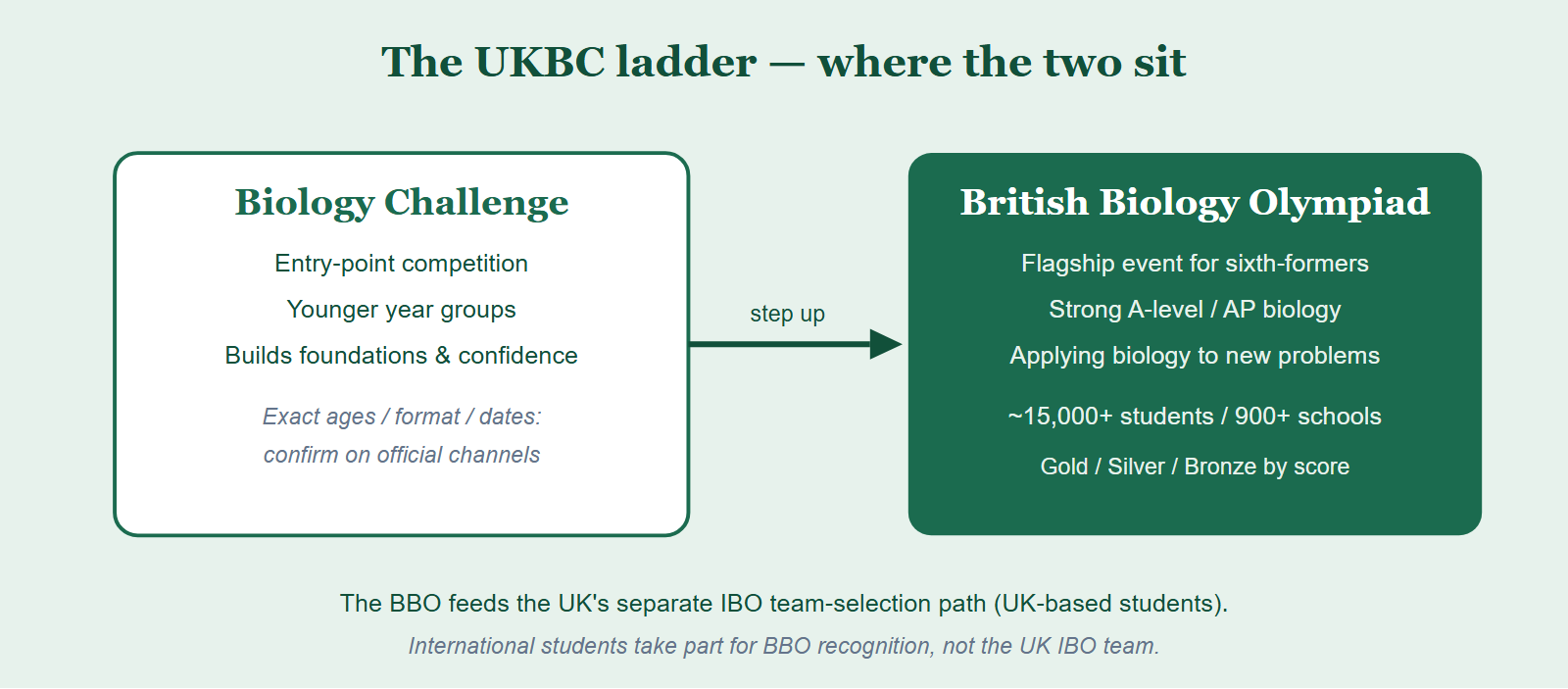
UKBC — a registered charity operating under the Royal Society of Biology — runs a family of biology competitions for different age groups. Its own description is blunt about the hierarchy: the BBO is “its flagship event for sixth-formers,” and it “also runs other biology competitions for different age groups.” The Biology Challenge is the entry-point competition aimed at younger students, sitting a tier below the Olympiad in that ladder.
The practical consequence is that these two are not competitors you choose between on equal footing — they are rungs. A younger student builds confidence on the Challenge; an older, more advanced student steps up to the Olympiad. For most readers of this guide — international and China-region students already deep into A-level or AP biology — the decision collapses quickly to the BBO. The exact year-group cut-offs, format and dates for the Biology Challenge are set by the organiser and change; confirm those on the official channels rather than assuming they mirror the BBO.
What the BBO actually is
The BBO is a short online exam with no lab component. Questions come in three styles — multiple-choice, fill-in, and ordering — and the whole design rewards applying biology to unfamiliar problems rather than reciting memorised facts. It draws on seven core syllabus areas: cell biology; plant anatomy and physiology; animal anatomy and physiology; animal behaviour; genetics and evolution; ecology; and taxonomy. That maps onto a strong A-level or AP biology course plus some first-year university material.
Scale matters here too. Last year over 15,000 students from 900+ schools took part — this is a mainstream, well-recognised olympiad, not a niche event. For the 2026 season, the China-region exam is on 17 January 2026 and the UK home competition runs 19–28 January 2026. For any other year, confirm dates on the official channels.
How awards work — and why “which should I enter” really means “am I ready”
BBO awards are decided purely by your score against published boundaries: Gold, Silver, Bronze, and further tiers such as Highly Commended and Commended. As a rough guide, the 2024 boundaries landed near 113 for Gold, 103 for Silver and 96 for Bronze — but boundaries move every year, so confirm the current boundaries officially before you set a personal target.
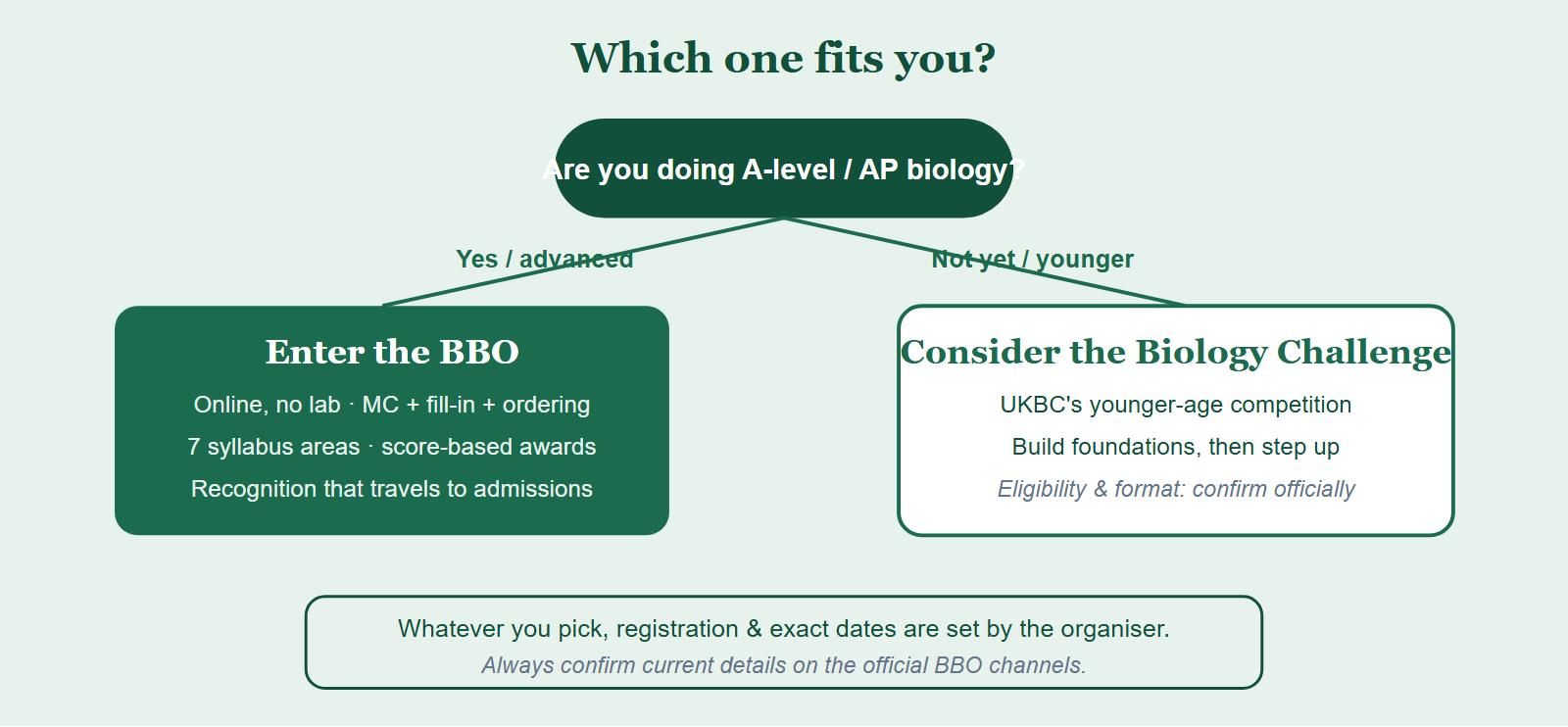
Because the award is score-based and the content is genuinely demanding, the honest version of “BBO or Biology Challenge?” is really “is my biology ready for olympiad-level questions yet?” If you are comfortably handling A-level / AP material and want a result that signals depth to selective universities, enter the BBO. If a younger student is still consolidating foundations, the Challenge is the better confidence-builder — and a sensible stepping stone toward the Olympiad later. There is no rule against aiming high; the score boundaries simply reward readiness.
If you are an international / China-region student
One nuance worth being precise about: the BBO is also how the UK selects its International Biology Olympiad (IBO) team — but that selection runs through a separate, UK-based path. International and China-region students take part in the BBO for the recognition (Gold/Silver/Bronze and the credential itself), not to join the UK IBO squad. The China-region exam date (17 January 2026 for this season) lets students outside the UK sit it under proper conditions. For how registration is administered in your region, confirm on the official BBO channels. We unpack this fully in our guide to the BBO international & China-region exam.
The Biology Challenge route for international students is less commonly travelled, and its administration outside the UK is not something to assume — if a younger student wants to attempt it, check the organiser’s current arrangements first.
Preparing once you’ve chosen
Whichever rung you target, the preparation engine is similar: a strong textbook backbone plus deliberate practice on application-style questions. Campbell Biology, supported by your AP or A-level resources, is the standard text. Because BBO questions reward transfer rather than recall, working through real question formats matters more than re-reading notes — see our walkthrough on how to prepare for the BBO and the official-format reference on our competition rules page.
A useful detail for biology-track students: the BBO and the USA Biology Olympiad (USABO) share roughly 90% of their content, and USABO sits in late March. That means a January BBO can double as a warm-up for a March USABO — a sequencing strategy some of our strongest students use deliberately, covered in BBO then USABO: going for double gold.
On results: in the 2026 season, Hanlin’s biology cohort earned 26 BBO golds, 21 silvers and 5 bronzes, with 5 students reaching the USABO US-region Semifinal (per our own records). That spread is what “ready for the Olympiad” looks like in practice — and it is the clearest signal that, for advanced students, the BBO is the right rung to aim at rather than the Challenge.
Past papers — how to practise the real format
The single most effective preparation step is rehearsing the actual question styles under time. We maintain a collected free pack of BBO past papers for our students — scan the QR code or message us to get it. Worked-solution coverage varies by year, and our teachers add more over time. You can also browse our past papers hub for how to use them in a study cycle. (Past papers are a study aid we compile to help you practise; for official materials, defer to the organiser.)
FAQ
Is the Biology Challenge just an easier BBO?
Not exactly — it is a separate UKBC competition aimed at younger year groups, designed as a foundation-builder rather than a junior version of the same paper. The exact age range, format and dates are set by the organiser and change, so confirm them on the official channels.
I’m doing A-level / AP biology — which should I enter?
The BBO. It is UKBC’s flagship event for sixth-formers and rewards applying strong biology to unfamiliar problems, which matches an A-level / AP level of study.
Can international or China-region students enter the BBO?
Yes — international and China-region students take part for BBO recognition (Gold/Silver/Bronze and the credential), with a China-region exam date for this season of 17 January 2026. They are not entered into the UK’s IBO team, which is selected via a separate UK-based path. Confirm registration details on the official BBO channels.
Are the BBO score boundaries fixed each year?
No. Awards are based on your score against boundaries that are published and change yearly. The 2024 boundaries were roughly 113 Gold / 103 Silver / 96 Bronze as a guide — always confirm the current boundaries officially.
This is an independent English-language guide to the British Biology Olympiad for international and China-region students, operated by Hanlin Education. It is not affiliated with, endorsed by, or sponsored by UK Biology Competitions (UKBC) or the Royal Society of Biology. Rules, dates, eligibility and results are set by the organiser — always confirm current details through the official BBO channels.