
The British Biology Olympiad (BBO) is a short, fast online exam that ranges across the whole of biology, so how you spend the clock decides as many marks as what you know. The organiser does not publish a fixed question count for you to plan around — so the right strategy is to pace by time, not by question number: split the paper into time blocks, keep moving, and never let one hard item eat the clock. For the exact number of questions on your sitting, confirm on the official channels.
How the BBO timing is actually structured
The BBO is organised by UK Biology Competitions (UKBC) / the Royal Society of Biology and aimed at sixth-form and high-school students with a strong interest in biology. It is a short online exam with no lab component, built from three question formats — multiple-choice, fill-in, and ordering. The single most important thing to know for pacing is that the timing is fixed and tight: there is a hard time limit, and the paper is designed so that very few students comfortably finish with time to spare. That is by design — the BBO rewards applying biology to unfamiliar problems, not rote recall, so it deliberately gives you more to think about than minutes to think.
Two practical timing points are worth fixing in your head before you sit it. First, the structure differs by region: international and China-region students sit the BBO for recognition (not selection for the UK IBO team), and the China-region exam falls on 17 January 2026, while the UK home competition runs 19–28 January 2026 (for other years, confirm officially). Second — and this is the planning trap — the number of questions is not something you should assume. Do not copy a count from another olympiad or an old forum post; the format can vary, so check your exact paper’s length and time on the official channels and pace accordingly.
Set a per-question pace from the real numbers
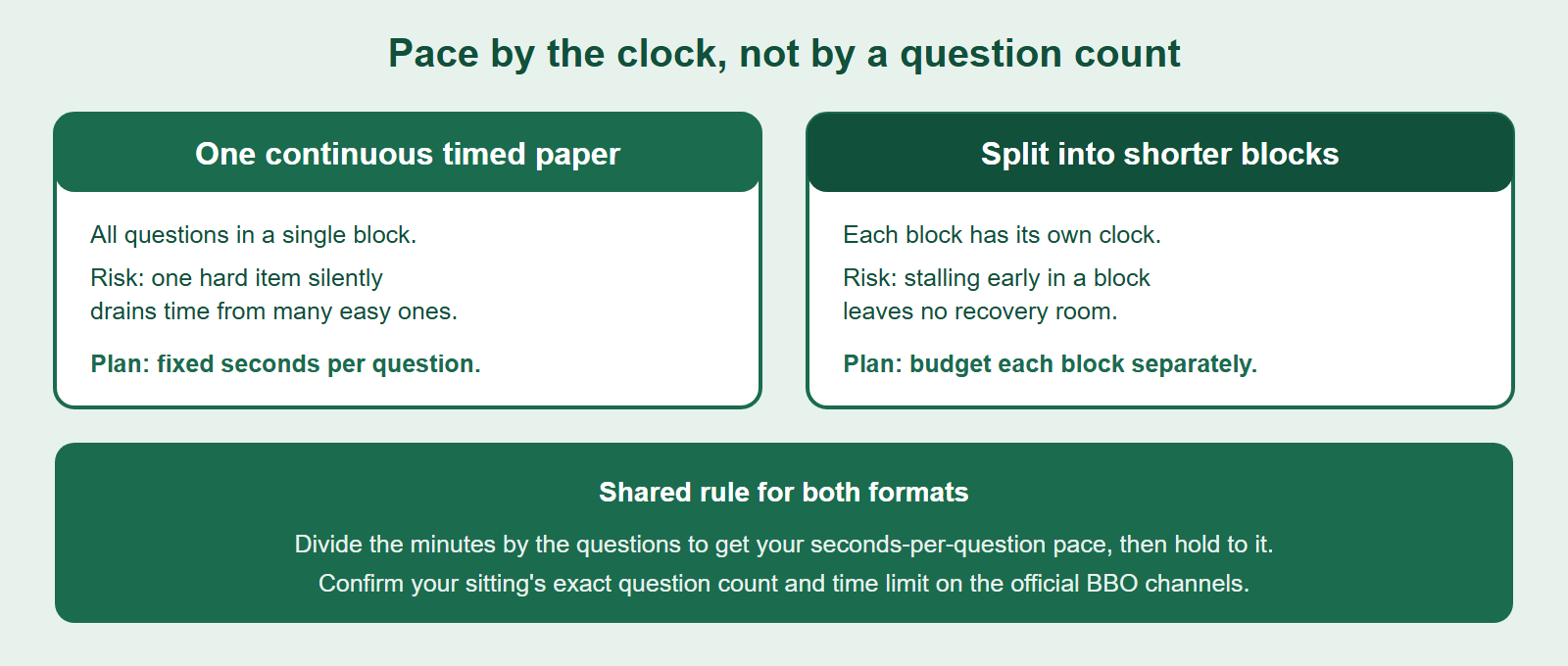
Because the BBO does not hand you a guaranteed question count, your first job — ideally before exam day, using a real past paper — is to turn the actual figures into a simple pace. The arithmetic is the same every year: take the time limit, take the number of questions on that paper, and divide. If a paper gives you 90 minutes and you count, say, 90 questions on it, that is roughly one minute each; if it is 45 minutes, your per-question budget halves. The exact figures change, so do this with the paper in front of you rather than from memory — and confirm the official time limit and length for your sitting on the official channels.
The point of the pace is not to rush — it is to give you a tripwire. Once you know your seconds-per-question, you instantly know when a single item has gone over budget, and that is your cue to flag it and move on rather than sink three minutes into one mark. Strong biologists lose more marks to untracked time than to gaps in knowledge: they answer a hard question correctly but never reach five easy ones at the end. A pace converts “I’m running out of time” from a panic at the end into a small, early signal you can act on.
Two habits make the pace usable. First, do a fast first pass: answer everything you can in well under your per-question budget, banking the easy marks across all seven syllabus areas before the hard items can slow you down. Second, park, don’t stall — the moment a question passes your tripwire, mark it and leave it; you return on a second pass with whatever time you protected. The three formats reward this differently (a fill-in you either know or you don’t; an ordering question can be reasoned in stages), so knowing how each question type behaves tells you which ones are worth a second look.
A three-pass plan for a tight clock
The most reliable way to use a fixed time limit on a broad paper is to make three passes instead of one slow march from question one to the end. Each pass has a job, and each protects the marks the previous pass might have cost you.
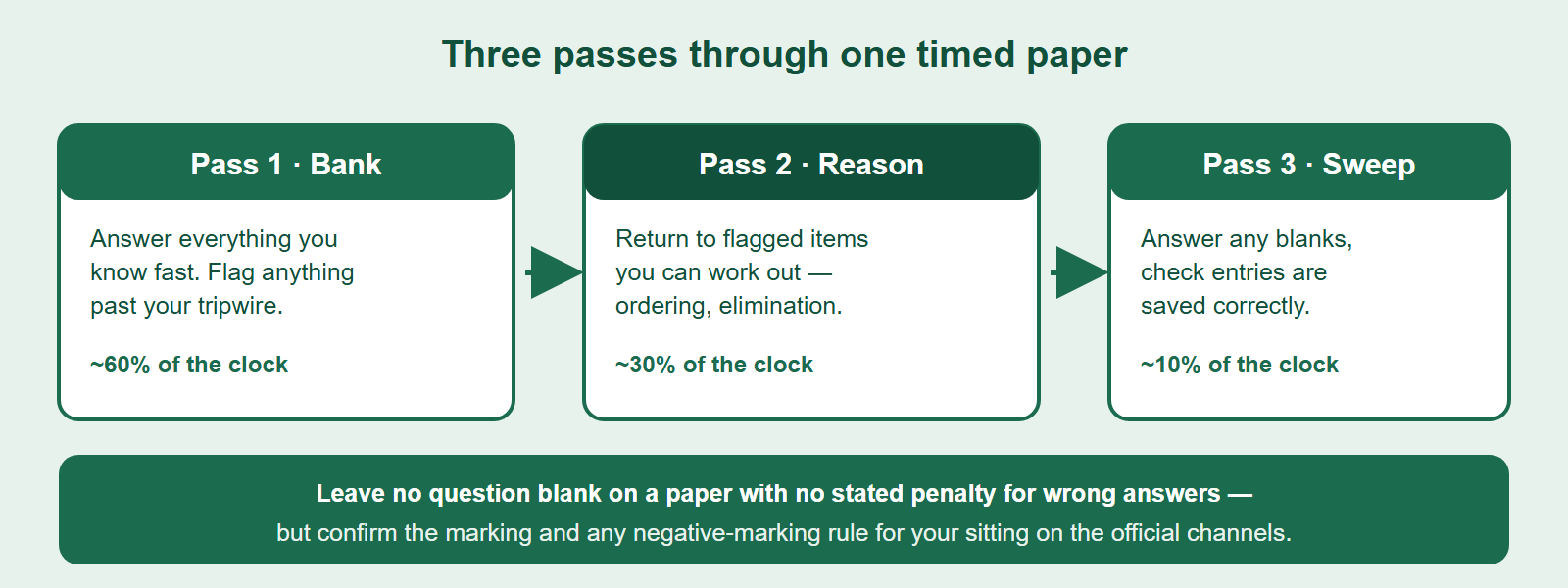
The percentages above are a starting template, not a rule — tune them to your own data from timed past papers. What matters is the order of operations: you secure the easy marks across the whole paper before you spend time on the hard ones, so a cluster of tough questions near the start can never strand you from straightforward marks near the end. On the final sweep, the safest default is to answer every remaining item rather than leave blanks — but only if there is no penalty for wrong answers, and whether your sitting applies negative marking is exactly the kind of rule you should confirm on the official channels rather than assume.
Build the pacing in before exam day
Pacing is a trained reflex, not a decision you make under pressure. The only way to build it is to sit timed past papers under real conditions — same time limit, no pausing, no notes — and then read your own results for time, not just for score. After each paper, ask three questions: where did I cross my tripwire and fail to flag-and-move? Which areas of the seven cost me the most time per mark? Did I leave anything unreached at the end? Those answers tell you what to drill next far more precisely than a raw percentage does.
This is also where the BBO pays a second dividend. Because the BBO and the USABO share roughly 90% of their content — with the USABO sitting in late March — the pacing reflex you build for one carries straight into the other. The biology is the same; the clock is the transferable skill. That is the logic behind the BBO-then-USABO double-gold path, and it is borne out in our own coaching: across the 2026 season, Hanlin’s biology cohort earned 26 BBO Golds, 21 Silvers and 5 Bronzes, and five students reached the USABO US-region Semifinal (Hanlin’s own records). In review, the gap between a Silver and a Gold was very rarely a missing topic — it was minutes left on the table, recovered by disciplined pacing.
One last point on awards, since pacing is ultimately about maximising score: BBO results are decided by score against published boundaries — Gold, Silver, Bronze and further tiers such as Highly Commended and Commended — and those boundaries move every year (as a guide only, the 2024 Gold boundary sat around 113). Every extra question you reach by pacing well is a real shot at clearing the next boundary. Confirm the current boundaries for your year on the official channels.
Practise the pacing on the real thing. The only way to calibrate your per-question tripwire is timed papers under exam conditions. Our collected free BBO past-papers pack brings the papers together — scan the QR code on our past-papers page, or message us, to get it (worked-solution coverage varies by year, and our teachers add more over time).
Frequently asked questions
How many questions are on the BBO?
The organiser does not publish a single fixed count to plan around, and the format can vary, so do not assume a number from another olympiad. Count the questions on a real past paper and pace from that, and confirm the exact length for your sitting on the official channels.
How long is the BBO exam?
It is a short, tightly timed online exam with no lab component, and the precise time limit can differ by region and year. Treat the time limit as fixed and tight, and confirm the exact duration for your sitting on the official channels.
What is the best way to manage time in the BBO?
Divide the time limit by the number of questions to set a per-question pace, then work in passes: bank the easy marks first, return to flagged questions you can reason out, and sweep the rest at the end. Park any question that crosses your pace rather than stalling on it.
Should I leave questions blank or guess?
On a paper with no penalty for wrong answers, answering every item beats leaving blanks. Whether negative marking applies to your sitting is an official rule — confirm it on the official channels before relying on a guessing strategy.
This is an independent English-language guide to the British Biology Olympiad for international and China-region students, operated by Hanlin Education. It is not affiliated with, endorsed by, or sponsored by UK Biology Competitions (UKBC) or the Royal Society of Biology. Rules, dates, eligibility and results are set by the organiser — always confirm current details through the official BBO channels.