Of the seven areas the British Biology Olympiad (BBO) draws on, animal anatomy & physiology and animal behaviour are among the highest-yield to master. Physiology is mechanistic and integrative — the BBO loves to perturb one organ system and ask what happens downstream — while behaviour rewards clean reasoning over recall. This guide breaks down what to learn in each, system by system, and the gaps that quietly cost marks.
Why these two areas earn their keep
The BBO is a short online exam — multiple-choice, fill-in and ordering questions, with no lab component — and it rewards applying biology to unfamiliar problems rather than rote recall. Animal physiology is where that style bites hardest: a question rarely asks you to label a nephron. Instead it hands you a novel scenario (a diuretic that blocks a transporter, a diver holding their breath, a patient losing blood) and asks what the body does to compensate. If you hold a working model of each system — inputs, outputs, and how it is regulated — you can reason to the answer even when the context is new. Animal behaviour adds a second, lighter source of marks: the concepts are finite, and the questions test whether you can read an experiment and classify what is happening.
Both map onto a strong A-level or AP biology course plus some first-year university material, with Campbell Biology as the standard text. The two areas also overlap heavily with the USABO, which shares roughly 90% of the BBO’s content and sits in late March — so depth built here works twice. Below is the realistic weighting of sub-topics, so you spend study time where the questions cluster.
Animal anatomy & physiology: what to master
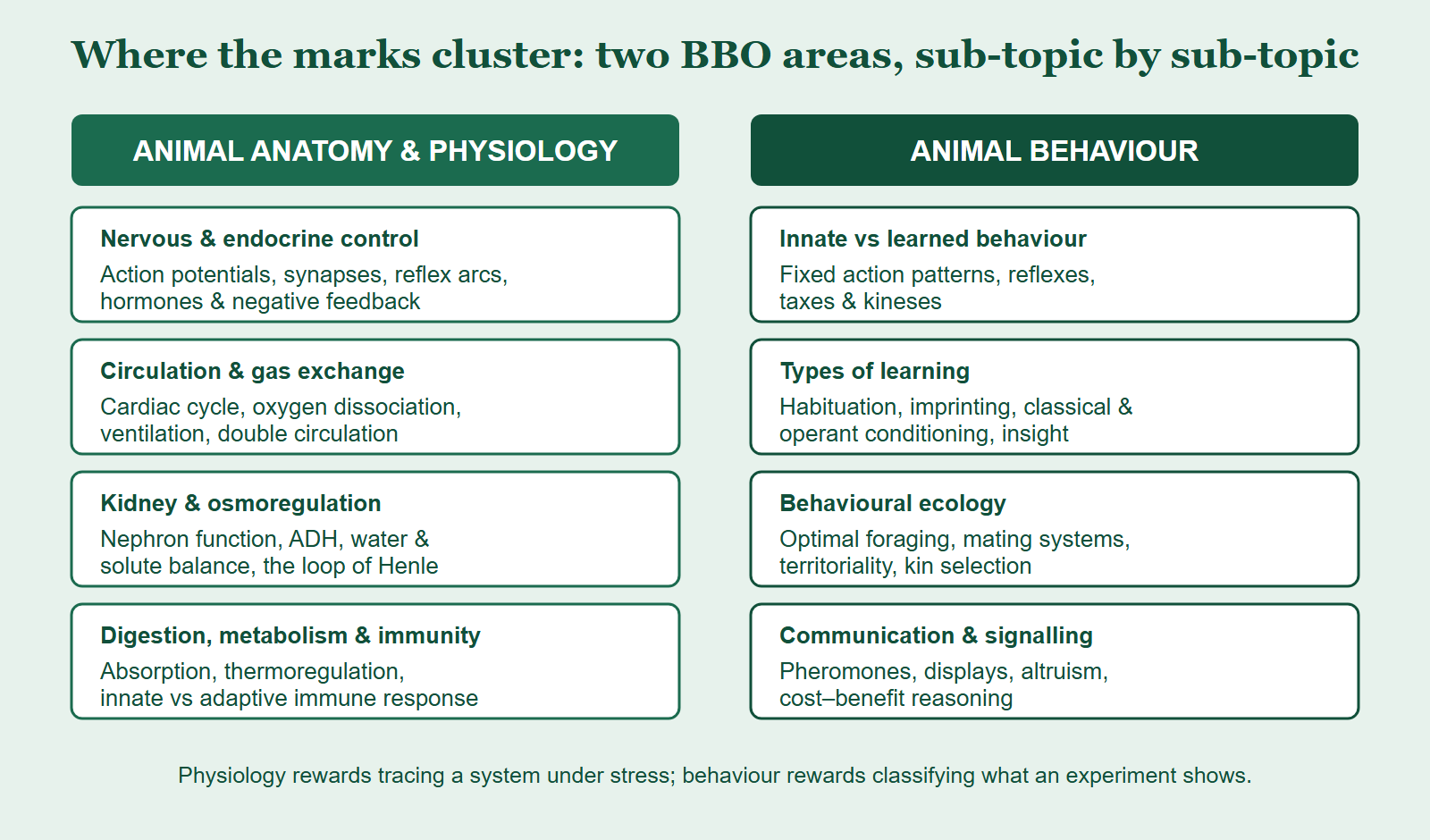
Physiology questions reward a working model of how each system is controlled — not a labelled diagram. Four blocks carry most of the marks:
- Nervous and endocrine control. Be fluent in the action potential (resting potential, depolarisation, the role of voltage-gated channels), synaptic transmission, and reflex arcs — then the slower, chemical control by hormones. The unifying idea the BBO tests again and again is negative feedback: blood glucose, body temperature and water balance are all homeostatic loops, and a question that knocks one input out expects you to predict the corrective response.
- Circulation and gas exchange. Know the cardiac cycle (pressure and volume changes, valves, the conducting system) and the oxygen dissociation curve — including how the Bohr shift moves it. Gas exchange across alveoli or gills, and the logic of double circulation, are reliable territory. Expect scenarios at altitude or in exercise that ask how delivery is maintained.
- Kidney and osmoregulation. The nephron is a BBO favourite because it is mechanistic end to end: filtration, selective reabsorption, the counter-current multiplier in the loop of Henle, and ADH-driven water balance. A classic move is a drug or condition that alters one transporter — you must trace the effect on urine concentration and blood volume.
- Digestion, metabolism and immunity. Absorption and surface-area adaptations, thermoregulation (and how ectotherms differ from endotherms), and the distinction between the innate and adaptive immune response. Immunity in particular rewards understanding the sequence — antigen, response, memory — rather than memorising cell names in isolation.
Common physiology gaps
Three gaps recur in students we coach. First, knowing the steps of the action potential but not the ion logic — so a question about a blocked sodium channel or a changed potassium gradient stalls them. Second, treating homeostasis as a definition rather than a loop they can run forwards: asked what happens after a fall in blood water potential, they freeze instead of tracing osmoreceptors → ADH → collecting duct → reabsorption. Third, learning the nephron as a labelled diagram, so they cannot say where in the tubule a given solute is handled or why the medulla is hypertonic. Every one of these is exactly what an applied question probes.
Animal behaviour: what to master
Behaviour is the most finite of the two areas — the concepts fit on a couple of pages — which makes it a reliable source of marks once the categories are crisp in your head.
- Innate vs learned behaviour. Distinguish fixed action patterns and reflexes from behaviours shaped by experience, and know the simple oriented movements: taxes (directional, towards or away from a stimulus) versus kineses (a change in random movement rate). Mixing these two up is a frequent dropped mark.
- Types of learning. Be able to define and tell apart habituation, imprinting, classical conditioning, operant conditioning, and insight learning — and, more importantly, to read a described experiment and say which one it demonstrates. That classification step is the skill the paper actually tests.
- Behavioural ecology. Optimal foraging, mating systems, territoriality and parental investment are framed as cost–benefit problems: an animal behaves as if maximising net benefit, and you are asked to justify a behaviour in those terms.
- Communication, altruism and kin selection. Pheromones and displays, and the puzzle of apparently selfless behaviour resolved through kin selection and inclusive fitness. Expect a question that asks why helping relatives can be favoured by natural selection.
Common behaviour gaps
The recurring slip is definitional precision under time pressure: students half-remember the difference between classical and operant conditioning, or between a taxis and a kinesis, and pick the plausible-sounding option. The fix is not more reading but drilling classification — given a scenario, name the behaviour — until it is automatic. A second gap is treating altruism as a paradox they cannot explain; once kin selection and the cost–benefit frame click, those questions become some of the easiest on the paper.
How to study these two areas
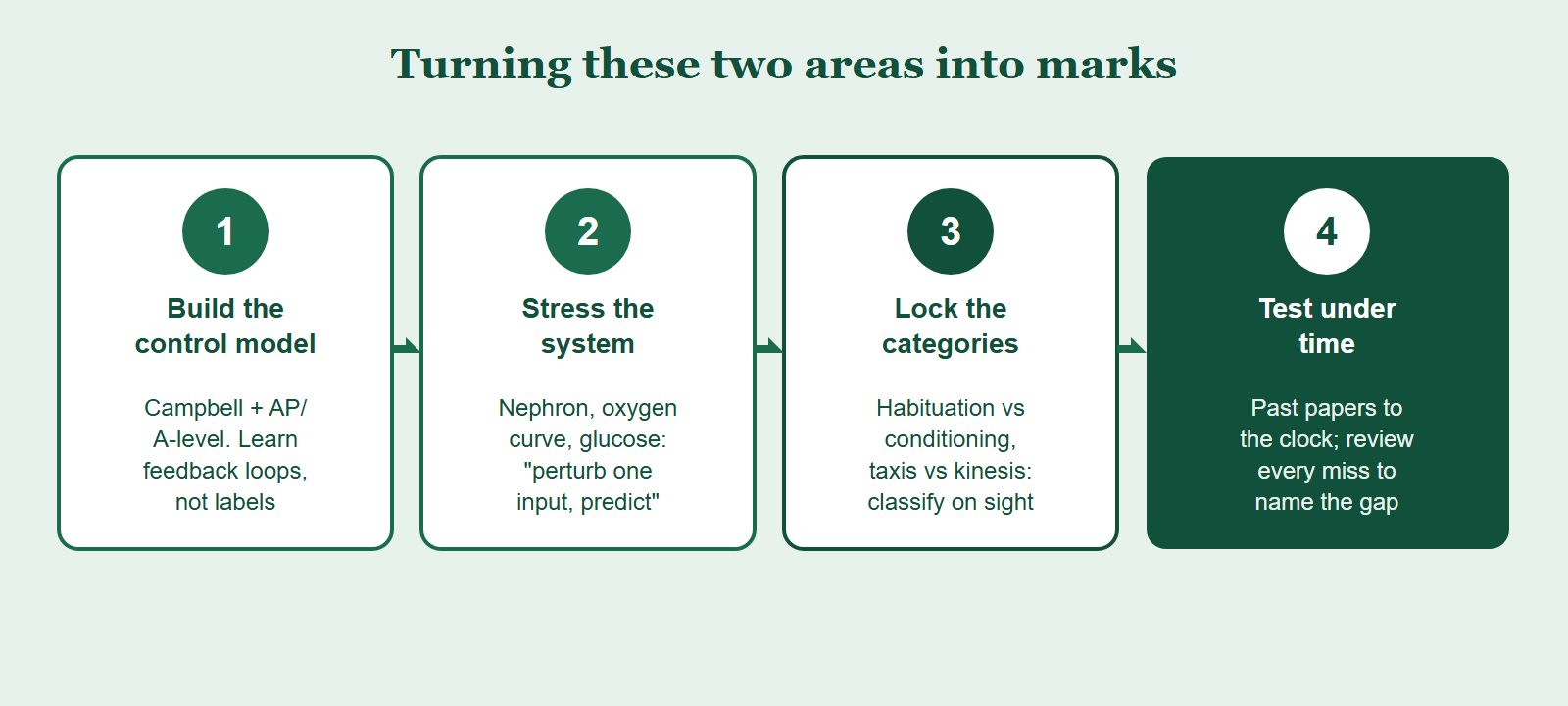
Work the control model from a college-level text — Campbell Biology, with AP and A-level resources alongside — and for every system write the feedback loop out by hand: stimulus, receptor, effector, correction. Then drill the system-under-stress questions (the nephron, the oxygen dissociation curve, blood-glucose regulation) so perturbing one input becomes routine. For behaviour, stop re-reading definitions and instead drill classification: given a scenario, name the behaviour. Finally, convert it all to marks under time. Our collected BBO past-papers pack is free — scan the QR code or message us to get it; worked-solution coverage varies by year, and our teachers add more over time.
Because the USABO shares about 90% of this content and sits in late March, the depth you build here carries straight into a second medal — see the BBO-then-USABO double-gold strategy, and for the wider plan across all seven areas, how to prepare for the BBO. China-region students can read about the separate international / China-region exam. The 2026 China-region exam is on 17 January 2026 and the UK home competition runs 19–28 January 2026; for registration, eligibility and any other dates, confirm on the official BBO channels.
A real-world signal that this depth works: across the 2026 season, Hanlin’s biology cohort earned 26 BBO golds, 21 silvers and 5 bronzes, and 5 students reached the USABO US-region Semifinal (per Hanlin’s own records). Awards are decided by score against published boundaries — as a guide the 2024 BBO Gold boundary was around 113 — but boundaries change yearly, so confirm current boundaries on the official channels.
Frequently asked questions
Which physiology systems matter most for the BBO?
Nervous and endocrine control, circulation and gas exchange, the kidney and osmoregulation, and digestion/metabolism/immunity. All are mechanistic, so the BBO tends to perturb one system — a blocked transporter, exercise, altitude — and ask you to predict the regulated response. The nephron and the oxygen dissociation curve are especially reliable territory.
How is animal behaviour tested in the BBO?
Animal behaviour is one of the seven syllabus areas. Questions typically describe an experiment or observation and ask you to classify it — innate versus learned, the type of learning, or the cost–benefit logic behind a foraging or social behaviour. Knowing the categories crisply matters more than wide reading.
What is the most common physiology mistake?
Learning systems as labelled diagrams rather than control loops. Students who can label a nephron but cannot trace what a diuretic does, or who know the action-potential steps but not the underlying ion movements, lose marks the moment a question changes the scenario. Timed past-paper practice exposes these gaps fastest.
Which textbook covers these areas?
Campbell Biology is the standard college text and covers animal physiology and behaviour in the depth the BBO needs; AP and A-level resources are useful companions for exam-style questions.
This is an independent English-language guide to the British Biology Olympiad for international and China-region students, operated by Hanlin Education. It is not affiliated with, endorsed by, or sponsored by UK Biology Competitions (UKBC) or the Royal Society of Biology. Rules, dates, eligibility and results are set by the organiser — always confirm current details through the official BBO channels.