
Why Proximity on the Page Misleads
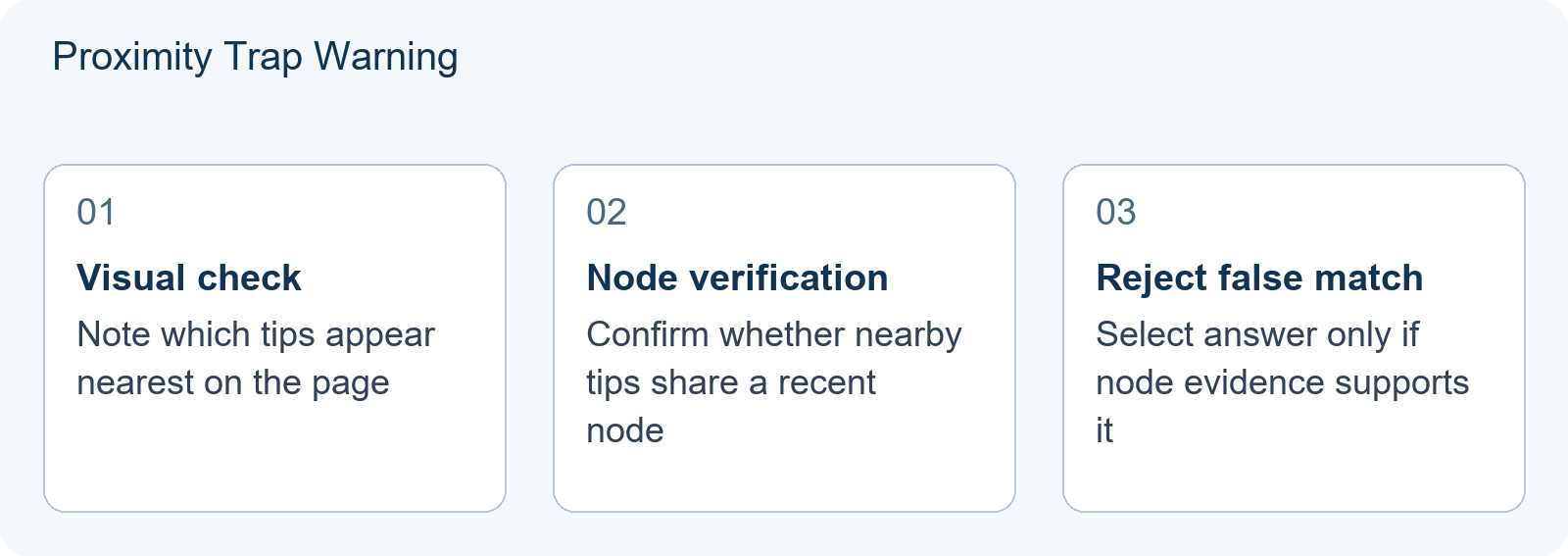
In BBO phylogenetic tree questions, the most common error is assuming that two species placed close together on the right-hand tips are closely related. Tree diagrams are often drawn for visual convenience, with branches rearranged at nodes without changing evolutionary relationships. The critical skill is reading nodes—the branching points that represent actual common ancestors—rather than measuring horizontal or vertical distance between terminal labels.
This distinction matters because BBO questions frequently test exactly this trap. A student who counts nearby tips may select an incorrect sister-group relationship, while the correct answer requires tracing back to the most recent common ancestor node. The following sections build this skill through checked worked teaching illustrations, a deliberate contrasting failure, and a practical diagnostic you can apply immediately.
The Node Rule: What Actually Defines Relatedness
On any rooted phylogenetic tree, two taxa are sister groups if and only if they share a most recent common ancestor (MRCA) that is not also ancestral to any other included taxon in the same immediate grouping. This MRCA is represented by a single node. The horizontal spacing between tips is a layout artifact; rotating a branch around a node changes appearance without altering relationships.
For BBO purposes, this means:
- Rotate any branch around a node without changing relationships
- Two tips adjacent on the page may be separated by deep divergence
- Two tips far apart may share a very recent MRCA
Teaching illustration: Students who practice with manually redrawn trees—swapping left-right positions at nodes—often develop faster and more robust tree-reading skills than those who memorize “shapes” of standard textbook diagrams. This observation is offered as a practical study suggestion rather than a verified institutional finding.
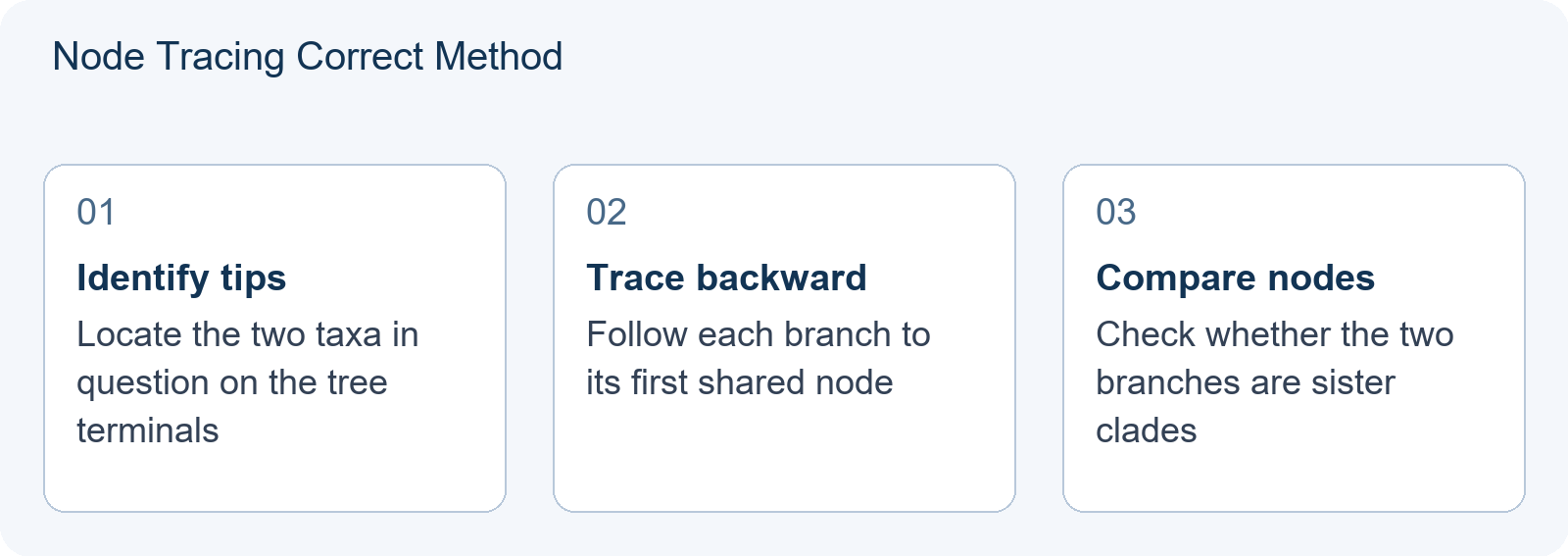
Worked Teaching Illustration: Correct Node Tracing
Teaching illustration—hypothetical tree for skill demonstration:
Consider a simplified tree with five terminal taxa: P, Q, R, S, T. The topology is: ((P,Q),(R,(S,T))). In a standard right-facing cladogram, this might be drawn with P and R adjacent at the top, Q and S below, and T at the bottom.
Question: Which pair shares the most recent common ancestor: P and R, or S and T?
Step-by-step reasoning:
- Trace P back to its first node: this is the node uniting P and Q
- Trace R back to its first node: this is the node uniting R with the (S,T) clade
- The MRCA of P and R is therefore the deeper internal node connecting the (P,Q) clade to the rest
- Trace S back: first node is the (S,T) node
- Trace T back: first node is the same (S,T) node
- The MRCA of S and T is this single node
Conclusion: S and T are sister groups with a recent common ancestor; P and R are not. Even if P and R appear closer on the page in some layout, their biological relationship is more distant. This answer is robust to any legitimate left-right rearrangement at nodes.
Contrasting Case: Where Counting Nearby Tips Fails
Teaching illustration—hypothetical tree for skill demonstration:
Consider a tree with topology: (P,(Q,(R,(S,T)))). A common layout places P at the top, then Q, R, S, T descending. In this layout, R and S appear adjacent on the page.
Superficial approach: “R and S are next to each other, so they must be closely related.”
Node-based correction:
- R’s first node back is the node uniting R with the (S,T) clade
- S’s first node back is the (S,T) node
- The MRCA of R and S is therefore the node above R—not the most recent node for S and T
- Meanwhile, S and T share the (S,T) node as their immediate MRCA
Checked implication: S and T are more closely related to each other than either is to R, despite R and S appearing adjacent on the page. A student selecting “R and S” based on visual proximity would be wrong. The topology verifies: S-T share one node; R-S share a node one level higher.
Diagnostic Application: Test Your Tree Reading
Teaching illustration—hypothetical BBO-style question:
“In the following cladogram of five taxa with topology ((P,Q),(R,(S,T))), which pairs are sister taxa?”
Annotated reasoning:
- S and T: trace back to first node—this is the (S,T) node, one shared node
- R and S: first shared node is the (R,(S,T)) node, one level up from S
- P and Q: first shared node is the (P,Q) node
- P and R: first shared node is the root connecting (P,Q) to the rest
Correct selection: (S,T) and (P,Q) are both sister pairs. Their common ancestors are different nodes, and topology alone does not tell us whether those two divergence events happened at the same time or which happened earlier. To make the diagnostic unambiguous, ask which pairs are sisters. Rejecting (R,S) or (P,R) as sister pairs requires tracing shared ancestry, not measuring visual spacing.
What Your Result Means for Next Steps
If you correctly identified the sister pairs by node tracing, your reasoning is sound. The useful feedback is to maintain this discipline under time pressure. If you selected R and S based on their adjacent placement, you need targeted practice with rotated trees.
Specific next tasks:
- Redraw familiar trees by hand, swapping left-right positions at nodes
- Practice with trees where taxa are ordered by arbitrary convention rather than by relatedness
- Build speed: phylogenetic questions should become automatic with sufficient practice
For broader preparation context, see our guide on Beyond the Specification: What the BBO Tests That A-Level and IB Biology Barely Cover (2026-27), which notes that phylogenetic reasoning appears across multiple content areas including classification and evolution.
Building Reliable Tree-Reading Habits
Consistent practice with the node rule transforms tree questions from visual puzzles into mechanical checks. The key habits are:
- Always trace both tips to their MRCA before selecting an answer
- Ignore horizontal ordering as irrelevant
- Verify that your chosen pair is not paraphyletic with respect to the question
These habits align with the broader BBO preparation approach described in our article on The BBO Past-Paper Review Loop: How One Mock Becomes Real Marks—deliberate practice with explicit feedback loops, not passive review.
Related Preparation Resources
For adjacent topics in BBO preparation, our BBO Logarithmic Graphs: Reading Biological Change Without Misreading the Axis addresses another common source of misreading in biological data presentation. For students planning their competition calendar, the article on BBO and UKChO in the Same January (2027): A Double-Olympiad Plan for Biology and Chemistry Students offers practical scheduling guidance.
Teaching illustrations in this article are constructed for explanatory purposes and labelled as such. No institutional source claims are made about their empirical basis.
Handling Polytomies: When the Tree Does Not Resolve
A critical gap in standard tree-reading instruction is how to handle polytomies—nodes where three or more lineages emerge simultaneously. In BBO questions, a polytomy represents an unresolved relationship due to insufficient data, not necessarily a simultaneous evolutionary event. Students often force a binary sister-group interpretation onto a multifurcating node, leading to incorrect answers.
Teaching illustration: Consider a rooted tree with taxa A, B, C, and D. The topology shows a single internal node connecting all four tips directly (a star phylogeny). There are no intermediate nodes distinguishing pairs.
The Trap: A student sees A and B drawn adjacent on the page and assumes they are sister groups. They select “A and B share the most recent common ancestor exclusive of others.”
The Correction: In a strict polytomy, the MRCA of A, B, C, and D is the same single node. No pair has a more recent common ancestor than any other pair relative to the root. All pairwise relationships are equally distant from the resolution point. If the question asks for the closest pair, it is unanswerable without further data; if it asks which pair shares a unique MRCA not shared by a third taxon, none do.
Practical Application: When you encounter a node with three or more branches:
- Do not assume left-right adjacency implies relatedness.
- Recognize that the node represents uncertainty or rapid radiation.
- Check if the question offers options like “Cannot be determined” or “All are equally related.”
- If forced to choose between two specific pairs (e.g., A-B vs C-D) in a resolved subtree elsewhere, ignore the polytomy section unless it is part of the comparison.
This distinction prevents over-interpretation of layout artifacts as biological signal. Mastering this ensures you answer correctly even when the diagram lacks full resolution.
Reading Branch Lengths: When Size Means Something
The previous sections focused on cladograms, where branch lengths are arbitrary and only topology matters. However, BBO questions sometimes present phylograms or chronograms, where horizontal branch length is proportional to evolutionary change (genetic distance) or time. Misinterpreting these as simple cladograms leads to errors in estimating divergence magnitude.
Key Distinction:
- Cladogram: Branch lengths are meaningless; only the order of branching (topology) defines relationships. Tip alignment is a drawing convention, not a requirement.
- Phylogram/Chronogram: Branch lengths encode data. A longer branch indicates more accumulated mutations or a longer period since divergence from the common ancestor.
Teaching illustration—hypothetical phylogram for skill demonstration:
Consider a tree with taxa P, Q, R, S, T. The topology is ((P,Q),(R,(S,T))). In this specific diagram, the branch leading to P is twice as long as the branch leading to Q. The branch leading to S is very short, while the branch leading to T is long.
Question: Which pair has undergone more genetic divergence from their most recent common ancestor (MRCA): P and Q, or S and T?
Step-by-step reasoning:
- Identify the MRCA node for P and Q. Trace the branches from this node to P and Q. Sum the lengths of these two branches. This total represents the path length between P and Q through their ancestor.
- Identify the MRCA node for S and T. Trace the branches from this node to S and T. Sum these lengths.
- Compare the sums. If the sum for P-Q is greater than the sum for S-T, then P and Q have diverged more genetically (or temporally) since their split, even though they are sister groups just like S and T.
Checked implication: Being sister groups (sharing an exclusive MRCA) does not mean equal divergence. In a phylogram, you must measure the path length between tips, not just identify the node. A student who assumes all sister pairs are equally distinct will fail to answer questions about relative rates of evolution or molecular clocks.
Practical Diagnostic:
When facing a tree question, first check the axis label or caption. Does it say “Genetic Distance,” “Time (Mya),” or show a scale bar? If the scale measures evolutionary change, read it as a phylogram; if it measures time, read it as a chronogram. Calculate path lengths by adding branch segments. If the caption does not specify what branch lengths encode, do not infer quantitative time or genetic distances from their appearance. This binary check prevents over-interpretation of layout artifacts in cladograms and under-interpretation of quantitative data in phylograms.
Frequently Asked Questions
Can I use tip proximity as a quick check?
Treat visual proximity only as a hypothesis. Rotating a branch can move tips without changing ancestry. Trace each branch to the relevant common ancestor and check which descendants belong to that clade.
How much time should I spend on a single phylogenetic tree question?
With practice, node tracing becomes rapid. If a question requires comparing multiple pairs, budget proportionally more time. If you find yourself spending excessive time, you likely need more practice with the mechanical skill rather than deeper biological knowledge.
Where can I find additional tree-reading practice for BBO?
BBO past papers contain phylogenetic tree questions across multiple years. Our article on past paper strategy explains how to use these effectively. For structured support, preparation providers offer targeted practice on evolutionary biology reasoning.