
If you are aiming at the British Biology Olympiad (BBO) in January, the work that decides your score starts in the summer, not in November. A realistic runway is about five months: two months building a map of the seven content areas, two months closing the areas your school course barely touches, and a final six weeks on timed past papers. Dates for the new season are set by the organiser — confirm them on the official pages before you build your calendar.
Why the BBO runway starts in August, not November
The BBO is a short online paper for sixth-formers with no practical component, and it samples across seven content areas: cell biology, plant anatomy and physiology, animal anatomy and physiology, animal behaviour, genetics and evolution, ecology, and biosystematics (taxonomy). Breadth is the defining feature of the paper, and breadth is exactly what cramming cannot buy. A hard two-week sprint can lift one topic. It cannot lift seven.
There is a second, more practical reason. For a student in a Chinese international school, the autumn term is not empty. Late November and December are IB and A-Level mock season; early January is when US regular-decision deadlines land; and the BBO sitting itself falls in January for the China region. That leaves August, September and October as the only stretch of the year when olympiad reading is not competing against a graded deadline. Students who wait until the mock timetable is published have already given away the cheapest two months of the year.
One caution before you diarise anything: the new-season dates, entry route and paper format are confirmed each year by the organiser, and they can change. Treat every date in this article as a shape, not a fact, and check the official pages. If you want to know what the sitting itself looks like in practice, our BBO China exam guide walks through the format and the logistics of the China-region paper.
The five phases at a glance
| Phase | Window | The one job | Suggested load | Checkpoint you must pass |
|---|---|---|---|---|
| 1 · Map | August to early September | Name what is inside each of the seven content areas; audit which ones your school course actually covers | 2–3 h / week | You can list the contents of all seven areas from memory |
| 2 · Breadth | Mid-September to end of October | Close the thin areas first — plants, behaviour, taxonomy, comparative physiology | 3–4 h / week | One summary sheet and 20 recall cards per thin area |
| 3 · Depth | November | Problem sets in genetics, evolution and quantitative ecology; protect your school mocks | 3–4 h / week (floor during mock fortnight) | You can work a genetics cross and a population problem without notes |
| 4 · Papers | December | Timed past papers, three passes each, one error log | 4–5 h / week | Error log shows a shrinking, not a growing, list of areas |
| 5 · Taper | First two weeks of January | Error log only; confirm sitting logistics; no new content | 2–3 h / week | Device, connection, venue and timing confirmed with your centre |
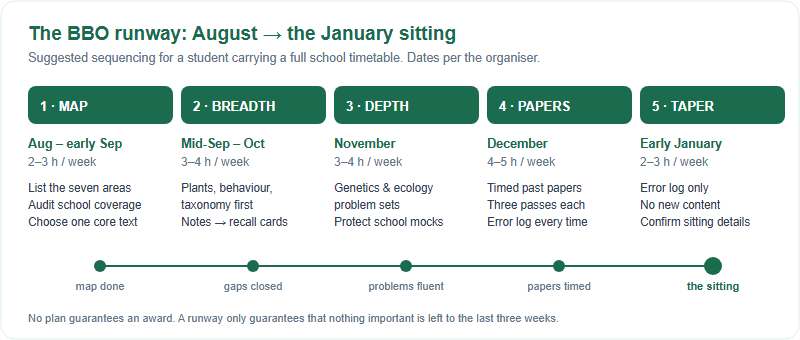
August to September: build the map before the detail
The most common August mistake is opening a 1,400-page general biology textbook at page one. It feels productive. By mid-September you are deep in the chemistry of life, you have read perhaps a tenth of the book, and you will never reach plants, behaviour or taxonomy before the paper. Breadth-led exams punish sequential reading.
Do the audit instead. Take one sheet of paper, write the seven content areas as headings, and under each write three columns: covered properly at school, met once, never seen. This takes about ninety minutes and it is the highest-value ninety minutes of the whole runway, because it converts a vague fear (“I don't know enough biology”) into a finite list of named gaps. Most students discover that two or three areas account for nearly all of their exposure, and that plant physiology, animal behaviour and biosystematics are almost blank.
Then choose your spine and stop shopping. One college-level general biology text is enough for five of the seven areas; add one plant-focused reference for the sixth. Students who collect four textbooks in August read none of them. Set a fixed weekly slot — two ninety-minute sessions beats six twenty-minute sessions, because the areas you are weakest in need continuous reading, not fragments.
One more August job that pays back in January: build a terminology list. BBO items lean on precise names — taxa, tissue types, hormone names, structures in cross-section. If any part of your school course is taught in Chinese, or if you moved into an English-medium programme recently, keep a running bilingual glossary from week one. Recognising parenchyma or ureotelic in half a second is worth real marks on a short paper where reading speed is part of the test.
Do not start past papers in this phase. Papers are both a diagnostic and a rehearsal, and you have a limited supply of them. Working them in August, before you have covered the content, turns a scarce resource into “questions I vaguely remember seeing” and destroys their diagnostic value in December.
October to December: breadth first, then timed papers
Order matters more than intensity. Work the thin areas while your energy and your calendar are still free, not in December when they are not. For most international-school students the thin list is short and predictable: plant anatomy and physiology, animal behaviour, biosystematics, and comparative animal physiology across taxa rather than human systems alone.
Use the same loop on every area, and give each one about three weeks:
- One source. One chapter, not four. Reading three accounts of the same material feels thorough and teaches you nothing new.
- One summary sheet. A single side of A4 that you produced yourself. If it does not fit on one side, you are copying rather than compressing.
- Twenty recall cards. Written as questions, not statements. “Which tissue system produces secondary xylem?” beats a card that simply says “vascular cambium”.
- A probe. Find ten past-paper items in that area and work them. The probe, not the reading, tells you whether the area is closed.
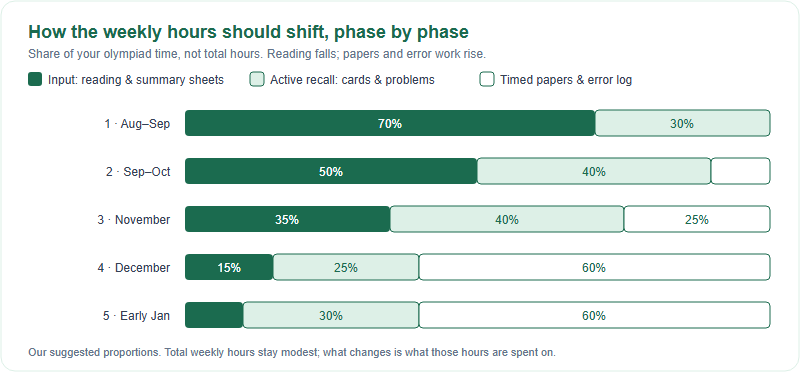
November has one rule: protect your school mocks. Drop olympiad hours to a floor of fifteen minutes of recall cards a day during the mock fortnight, and do not stop entirely — the restart cost after a full stop is much higher than the maintenance cost. Your predicted grades matter to universities in a way that no competition does, and a student who trades a mock grade for an olympiad medal has made a bad trade.
December is when past papers earn their keep. Work each paper in three passes: first untimed, to see what the paper actually asks; then a fresh paper under strict timing; then a review pass in which every wrong answer goes into an error log with four columns — item, content area, error type (recall, misread, reasoning, timing), and the one-line fix. By the third paper the error log, not the score, is the useful output: a shrinking spread of content areas means the runway is working; a score that bounces around while the same area keeps reappearing means you have a content hole, not a technique problem.
On materials: past papers from earlier years are the single best rehearsal available, and we keep a gathered set for our own cohort with worked solutions for some years — coverage varies by year, so treat solutions as a bonus rather than an entitlement. For the method behind working a paper properly, see our guide on how to prepare for the BBO.
January: the last fortnight, the sitting, and what comes next
In the final two weeks, learn nothing new. New content this late competes for retrieval strength with material you already half-know, and it almost always loses. Spend the fortnight on the error log, on the twenty cards per area you built in the autumn, and on one final timed paper no later than five days before the sitting.
Then handle the logistics, which are easy to postpone and expensive to get wrong. Because this is an online paper, your checklist looks different from a normal school exam: a device you have actually tested, a stable connection, a quiet room booked for the whole window, a charger, and whatever identification your centre requires. Confirm the sitting date, the start time and the time zone with your exam centre and against the official pages — a time-zone assumption is one of the very few mistakes that can cost you the whole paper. In the 2026 cycle the China-region sitting fell in January, ahead of the home window later that month, but the arrangement for the new season is confirmed by the organiser, so check rather than assume.
Two things not to budget your effort around. First, award thresholds are set and published by the organiser after marking each year; a boundary you read on a forum from three years ago is not a target. Second, whatever happens after the paper — further rounds and eventual national team selection — is administered by the organiser, and how students outside the UK feature in any onward stage is a question for the official pages, not for a coaching site.
Finally, do not stop in January. Because the BBO and the USABO overlap heavily in content — roughly 70–90% depending on the year and the content area — and the USABO's opening round sits later in the same academic year, the weeks between your BBO paper and the USABO round are the cheapest second competition you will ever get: the content is already loaded, the recall cards already exist, and only the exam format changes. That sequencing is the whole logic of the BBO-then-USABO double plan. Check the current USABO dates with its own organiser before you commit.
One honest note on outcomes. Across the students our teachers coached in the 2026 BBO cycle, one teaching group recorded 26 gold, 21 silver and 5 bronze awards (figures per Hanlin; award thresholds are set by the organiser each year, and results vary from student to student). What those cohorts had in common was not talent alone but a runway: they were reading plant physiology in September, not in the first week of January.
Frequently asked questions
When should I start preparing for the BBO?
Give yourself about five months. Map the seven content areas in August and September, close your thin areas by December, then run timed past papers.
When is the next BBO exam?
The China-region sitting has fallen in January, but the new-season dates are set by the organiser — confirm them on the official pages before planning.
How many hours a week does this plan take?
Our suggested load is 2–3 hours a week in August, rising to 4–5 in December. Drop to a floor during your school mock fortnight.
Should I start with past papers?
No. Papers are a limited diagnostic. Map the content areas first, close your thin areas, then use timed papers from December onwards.
This is an independent guide operated by Hanlin Education for China-based international-school students. We are not affiliated with, endorsed by, or sponsored by UK Biology Competitions (UKBC) or the Royal Society of Biology; official competition administration rests with the organiser. Entry routes, eligibility, dates, exam format and award thresholds are confirmed each year by the organiser and can change — confirm current details on the UKBC official pages before acting on anything here. Factual corrections are made within 7 working days of being reported.