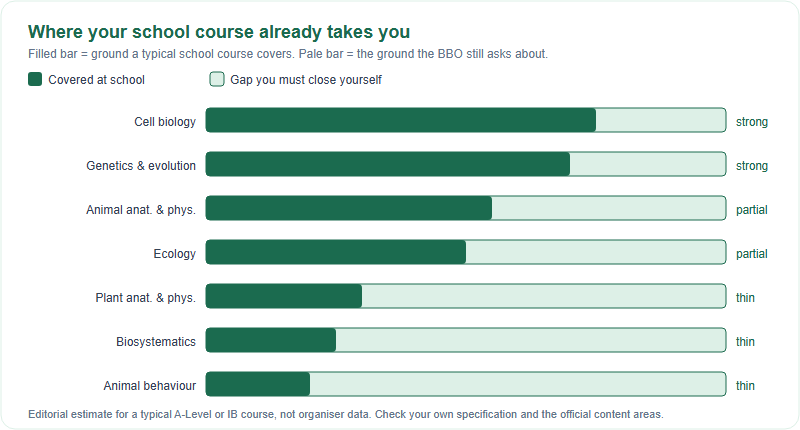
The British Biology Olympiad samples seven content areas. Most A-Level and IB Diploma biology courses cover two of them properly, touch two more, and barely visit the rest. That mismatch — not raw difficulty — is where most avoidable marks go. This article sets the seven areas against a typical school course, names what actually sits inside the widest gaps, and gives a three-week routine for closing one.
The mismatch, in one sentence
School biology is engineered to be examined in depth on a narrow, fixed core. The BBO is engineered to sample breadth across seven areas: cell biology, plant anatomy and physiology, animal anatomy and physiology, animal behaviour, genetics and evolution, ecology, and biosystematics (taxonomy). Your A or your 7 is strong evidence that you can go deep. It is not evidence that you have been anywhere near plant secondary growth, kin selection, or how to read a cladogram.
The practical consequence is easy to miss. When students review a past paper and find they scored below expectation, they usually conclude that the questions were “too hard”. Look at the items one by one and a different pattern appears: a large share of the losses are recognition failures, not reasoning failures. The student could have reasoned perfectly well about phloem loading — they had simply never met the term. Recognition failures are the cheapest of all gaps to close, because closing them requires exposure rather than talent.
There is a second reason to take the gap list seriously. Because the BBO and the USABO overlap heavily in content — roughly 70–90% depending on the year and the content area — every area you close counts twice in the same academic year. That is the entire arithmetic behind the BBO-then-USABO double plan: you are not preparing for one paper, you are building a content base that two papers draw on.
The seven content areas against your school course
| BBO content area | Typical coverage on a school course | What the olympiad adds | Your first two hours |
|---|---|---|---|
| Cell biology | Strong. Membranes, organelles, respiration and photosynthesis are core on both A-Level and IB. | More organelle-level detail, more cross-taxa comparison, more diagram recognition. | Skip. Probe it with ten past-paper items and move on. |
| Plant anatomy & physiology | Thin. Transport in plants is usually covered; anatomy in cross-section and most hormone families are not. | Tissue systems, primary versus secondary growth, stomatal control, phloem loading, photoperiodism, C4 and CAM. | Read one plant-structure chapter and draw a labelled stem and root cross-section from memory. |
| Animal anatomy & physiology | Partial. Human systems are covered well; comparative physiology across taxa usually is not. | Open versus closed circulation, gas exchange in fish and insects, osmoregulation, nitrogenous waste strategies. | Build one comparison table: gas exchange in a fish, an insect, and a mammal. |
| Animal behaviour | Thin. Often a page, an option, or nothing at all. | Innate versus learned behaviour, fixed action patterns, imprinting, conditioning, foraging, mating systems, altruism. | Learn the vocabulary first — most items here are recognition, not reasoning. |
| Genetics & evolution | Strong. Inheritance, gene expression and selection are core. | Multi-step crosses, linkage and mapping, population genetics arithmetic done at speed. | Twenty timed problems, not more reading. |
| Ecology | Partial. Concepts are covered; the quantitative layer often is not. | Growth models, energy flow arithmetic, diversity and sampling measures, succession detail. | Work through the calculation-style ecology items in a past paper. |
| Biosystematics (taxonomy) | Thin. Classification hierarchy and species concepts, then it stops. | Domains and major phyla, diagnostic features, naming conventions, reading and interpreting cladograms. | One page of phylum diagnostic features; one hour on cladogram reading. |
The four widest gaps — and what actually sits inside them
Plant anatomy and physiology. School courses generally get you as far as water transport, transpiration and one or two hormones. The olympiad expects the structural layer underneath: the three tissue systems (dermal, ground and vascular), what a stem, root and leaf look like in cross-section and how those sections differ between monocots and dicots, primary versus secondary growth and the role of the cambia, the mechanism of stomatal opening, pressure-flow loading and unloading in phloem, the hormone families beyond auxin (gibberellins, abscisic acid, ethylene, cytokinins), photoperiodism and phytochrome, and the C4 and CAM adaptations that most syllabuses mention in a single line. This is the single largest block of unfamiliar material for most international-school students, and it is also the most learnable, because it is heavily diagram-based.
Animal behaviour. Almost pure vocabulary and concept recognition: innate versus learned behaviour, fixed action patterns and sign stimuli, imprinting, habituation, classical and operant conditioning, taxis and kinesis, optimal foraging, territoriality, mating systems and sexual selection, communication modalities, and altruism explained through kin selection. Very few of these items require calculation. They require having met the words once, which is why this area rewards a fortnight of concentrated reading more than any other.
Biosystematics. Your school course probably taught you the hierarchy and one or two species concepts. The olympiad wants the working skills: the three domains and the major phyla with their diagnostic features (what makes an annelid an annelid, an arthropod an arthropod, a chordate a chordate), the conventions of binomial nomenclature, and above all the ability to read a cladogram — which taxa share a most recent common ancestor, what a node means, the difference between a shared derived character and convergent similarity. Cladogram items are common, quick to answer once the skill exists, and unanswerable without it.
Comparative animal physiology. School teaches human systems. The olympiad asks the same questions across the animal kingdom: open versus closed circulatory systems, countercurrent exchange in fish gills, insect tracheal systems, osmoregulation in freshwater versus marine fish, ammonotelic versus ureotelic versus uricotelic excretion and why habitat predicts which, hydrostatic versus exo- versus endoskeletons. The efficient way in is not to reread human physiology but to build comparison tables organised by function — one function, several taxa, one row each.
An editorial observation from our own teaching groups: the two areas that produce the most avoidable losses are plant physiology and biosystematics, and in both cases the loss is concentrated in recognition items rather than reasoning items. Across the students our teachers coached in the 2026 BBO cycle, one teaching group recorded 26 gold, 21 silver and 5 bronze awards (figures per Hanlin; award thresholds are set by the organiser each year and results vary from student to student). The students who moved up a band between mock papers were, almost without exception, the ones who had spent September on plants rather than on rereading cell biology they already knew.
A three-week routine for closing one area
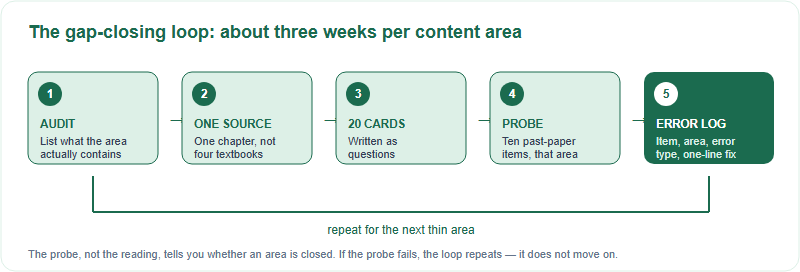
Week one — audit and read. Write down what the area contains before you read anything, using the sub-topic lists above as a checklist. Then read one chapter from one source. Students who assemble four textbooks in September finish none of them; students who commit to one general biology text plus one plant reference finish both.
Week two — compress and encode. Produce a single side of A4 in your own handwriting or typing. If it will not fit on one side, you are transcribing rather than compressing, and transcription is the least efficient study activity available. Then write twenty recall cards phrased as questions. “Which tissue does the vascular cambium produce to the inside?” is a card; “secondary xylem” is not.
Week three — probe. Find ten past-paper items in that content area and work them cold. This is the step students skip, and it is the only step that produces evidence. If you get seven or more right at speed, the area is closed for now; if you do not, repeat weeks one and two on the specific sub-topics that failed rather than the whole area. We keep a gathered past-paper set for our own cohort with worked solutions for some years — solution coverage varies by year, so plan on doing the reasoning yourself. The mechanics of working a paper properly are covered in our guide to how to prepare for the BBO, and the format of the China-region sitting itself is set out in our BBO China exam guide.
Four ways students waste the autumn
- Reading a general biology textbook cover to cover. It is a reference, not a course. Sequential reading spends September on material you already know and never reaches the areas that are actually costing you marks.
- Chasing extra depth in your strongest area. Going from good to excellent in cell biology moves a small number of marks. Going from nothing to competent in biosystematics moves more, for less effort. Marginal return, not comfort, should set the order.
- Skipping ecology because it “feels easy”. The conceptual layer is easy; the quantitative layer — growth models, energy-flow arithmetic, diversity and sampling measures — is where confident students quietly leak marks.
- Treating your syllabus as the ceiling. The most damaging assumption is that anything outside the specification is “not fair”. The paper is designed to reach beyond school courses; the students who accept that in September stop being surprised in January.
A final note on honesty. Nothing in this article, and no preparation plan, guarantees an award — award thresholds are set and published by the organiser each year, and the pool of entrants changes annually. What a gap list does guarantee is that you stop spending your best autumn hours on the two areas you already know.
Frequently asked questions
Is A-Level or IB biology enough to prepare for the BBO?
It is a strong base for cell biology and genetics, but plant physiology, animal behaviour and biosystematics usually need self-study beyond the specification.
Which BBO content area should I start with?
Start with your thinnest area, not your strongest. For most international-school students that means plant anatomy and physiology or biosystematics.
How many textbooks do I need?
One college-level general biology text plus one plant-focused reference is enough. Collecting four books in September usually means finishing none.
Does closing these gaps help with the USABO too?
Yes. The two syllabuses overlap heavily, so content closed for the January BBO carries into the USABO round later in the same academic year.
This is an independent guide operated by Hanlin Education for China-based international-school students. We are not affiliated with, endorsed by, or sponsored by UK Biology Competitions (UKBC) or the Royal Society of Biology; official competition administration rests with the organiser. Content areas, exam format, eligibility, dates and award thresholds are confirmed each year by the organiser and can change — confirm current details on the UKBC official pages, and check your own school specification, before acting on anything here. Factual corrections are made within 7 working days of being reported.