
A British Biology Olympiad award is one line on an application. What it is worth depends almost entirely on the paragraph around it. This article covers the three-layer sentence that turns a medal into evidence, where the information actually belongs in UK and US applications, and — the section most readers need — how to write about the BBO honestly when you did not medal at all.
What an award is, and what it is not
An externally marked biology olympiad is a comparable signal. It says that you chose to be assessed on material beyond your school syllabus, against a national field, under timed conditions, and that a body outside your school marked the result. That is genuinely useful information about you, and it is information a transcript cannot carry.
It is not an admissions credential. No competition guarantees an offer, a place, a scholarship or an interview; universities do not publish conversion rates from medals to offers; and any programme that implies otherwise is selling you something. Entry requirements, contextual policies and admissions tests are set by each university and each course — the course page is the authority, not a coaching site.
Two practical consequences follow, and they shape everything below. First, the award is one line and the story is the paragraph: the medal tells a reader what happened, only your writing tells them what it required. Second, an honest silver described precisely reads better than a gold described as a boast, because the reader is assessing your judgement as much as your biology.
The three-layer sentence
Nearly every weak paragraph about a competition fails the same way: it states the outcome and then asserts a virtue. “I won a gold medal in the British Biology Olympiad, which demonstrates my passion for biology and my excellent analytical ability.” That sentence contains one fact and two claims the reader has no reason to accept. Rebuild it in three layers.
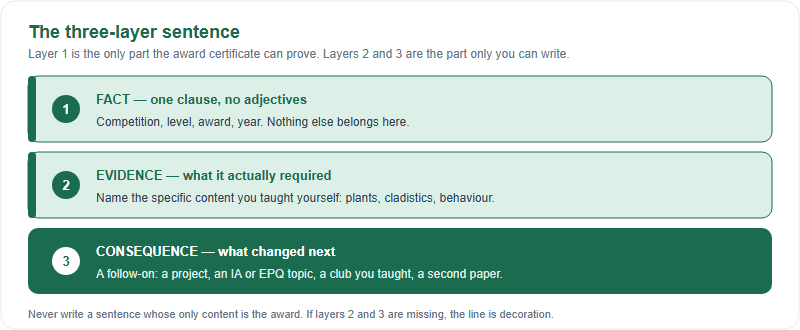
Layer 1 — the fact. Competition, level, award, year. One clause, no adjectives. Resist “prestigious”, “highly competitive” and “national-level”; a reader who knows the competition does not need them, and a reader who does not will not take your word for it.
Layer 2 — the evidence. Name what the preparation actually required. This is where specificity does all the work: “the syllabus reaches into plant secondary growth and cladistics, neither of which my A-Level course covers, so I worked through a plant anatomy chapter and taught myself to read cladograms” is a sentence only someone who really did it can write. It also quietly proves the thing the boast was trying to assert.
Layer 3 — the consequence. What happened because of it? An extended essay or internal assessment topic that came out of the reading; a lab or field project; a junior biology club you ran; a second competition you entered because the content transferred. A consequence converts an event into a trajectory, and trajectories are what applications are read for.
Rewritten, the weak sentence above becomes: “Preparing for the British Biology Olympiad pushed me into two areas my A-Level course never reaches — plant secondary growth and cladistics. Learning to read cladograms changed how I understood classification, and I later used that reading to build my EPQ on convergent traits in desert plants.” Same event, no boast, considerably more information — and it names things that can be asked about at interview, which is the point.
Where the BBO actually goes: UK and US applications
| Slot | UK (UCAS) | US (Common App and supplements) |
|---|---|---|
| The award line | Mentioned once inside your written statement; there is no separate awards form. | The honors section, kept factual: competition, level, year. Check current field limits on the form. |
| The process story | The written statement — check the current format and question structure for your entry cycle on UCAS. | A “why this major” or academic-interest supplement, where the self-taught content belongs. |
| The short version | Not applicable. | The activities list, which gives you a very short description field — verbs and specifics, no adjectives. |
| Third-party confirmation | Your teacher reference. Give your teacher the specifics; they cannot write what they were never told. | Teacher recommendation and, where relevant, counsellor letter. Same principle. |
| Where it gets tested | Interviews for medicine, veterinary and Oxbridge-style courses: expect to be asked about anything you claimed. | Alumni or admissions interviews where offered; also any programme-specific written response. |
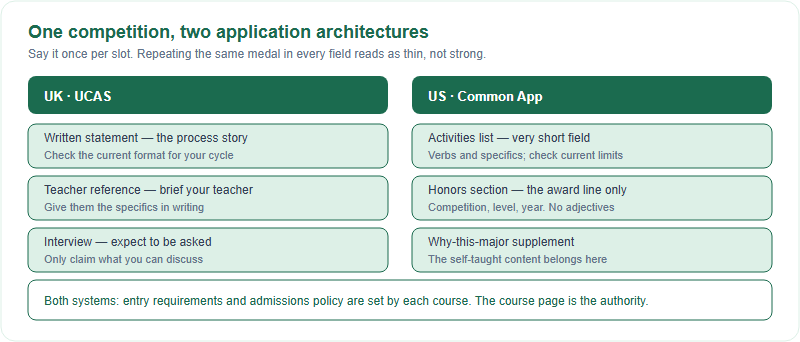
The rule that saves the most words is say it once per slot. If the award sits in the honors section, the essay should carry the process, not repeat the medal. A reader who meets the same gold three times in one application does not think you are three times as good; they think you have one thing to say.
A related discipline: only claim what you can discuss. For UK medicine, veterinary science and Oxbridge-style courses, a competition mentioned in a statement is a legitimate interview prompt. If you write “taught myself cladistics”, be ready to sketch a cladogram and explain what a node represents. Students are rarely caught out by their weakest sentence; they are caught out by their most impressive one.
What to write if you did not medal
Most entrants in any olympiad do not medal. That is arithmetic, not failure — award thresholds are set by the organiser each year against the whole field — and it does not make the experience unusable. It only means the fact layer changes: you write about participation and preparation rather than an award. Three framings work honestly.
- The self-taught syllabus. Name the areas you covered that your school course does not reach — plant anatomy and physiology, animal behaviour, biosystematics. “I spent an autumn teaching myself the parts of biology my syllabus skips” is a true and rather good sentence, and it is available to every entrant regardless of score.
- The diagnostic. Describe what your error log revealed and what you did about it. A student who can say “my errors clustered in quantitative ecology, so I spent January on growth models” is demonstrating exactly the self-assessment that university study requires.
- The sequence. If you followed the BBO with a second paper, say so. Because the two syllabuses overlap heavily, the BBO-then-USABO plan is a natural way to show that you treated January as a checkpoint rather than a verdict. If you sat the China-region paper, describe the process accurately — our BBO China exam guide sets out what that sitting involves.
What you must never do is inflate. Do not invent a placement, a percentile or an award tier; do not describe a certificate of participation as a medal; do not translate an award name into something grander in another language. Schools verify, teachers ask organisers, and award records exist. Beyond the integrity question, the practical risk is brutal: a single unverifiable claim invites a reader to doubt everything else in the file, including the true parts.
One first-party observation. Across the students our teachers coached in the 2026 BBO cycle, one teaching group recorded 26 gold, 21 silver and 5 bronze awards (figures per Hanlin; thresholds are set by the organiser, and outcomes vary from student to student). The students who wrote about it best were not always the golds. The most persuasive paragraphs we read came from students who could describe exactly which areas they had to build from nothing — and, more often than not, they were describing the work covered in our guide to how to prepare for the BBO.
Six phrases to delete
- “showed my passion for biology” — a claim, not evidence. Replace it with the specific thing you read or built.
- “top 5% nationally” without a published source — if the organiser did not publish it in a form you can point to, do not write it.
- “one of the world's most prestigious competitions” — an unsourceable superlative that costs you words and credibility together.
- “this has fully prepared me for a medical degree” — overreach; a short online biology paper prepares you for further study, not for a profession.
- “gold medal winner” as an identity — an award is something you did, not something you are. Keep it in the verb.
- “I have loved biology since childhood” — unverifiable and universal. Start where the evidence starts: the autumn you taught yourself plant physiology.
Every one of these deletions frees words for the layer-2 and layer-3 material that actually distinguishes you. That is the whole trade: less assertion, more specificity. Nothing here will make a competition count for more than it does — but it will stop a real achievement from reading like everyone else's.
Frequently asked questions
Does a BBO award improve my chances of admission?
No competition guarantees an offer or a place. It is one externally marked signal among many; entry requirements are set by each university and course.
Where should I mention the BBO in a UK application?
Once, inside your written statement, with the process rather than the boast. Check the current statement format for your entry cycle on UCAS.
Can I write about the BBO if I did not win a medal?
Yes. Write about the areas you taught yourself and what your errors told you. Participation described precisely beats an award described vaguely.
Should I list the BBO in the Common App honors section?
If you received an award, list it factually with competition, level and year, and check the current character limits on the form.
This is an independent guide operated by Hanlin Education for China-based international-school students. We are not affiliated with, endorsed by, or sponsored by UK Biology Competitions (UKBC) or the Royal Society of Biology; official competition administration rests with the organiser, and award records and thresholds are published by the organiser. Nothing here is admissions advice from any university: entry requirements, application formats and field limits are set by universities, UCAS and the Common App and change between cycles — confirm current details on the UKBC official pages and on the relevant application and course pages. Factual corrections are made within 7 working days of being reported.