
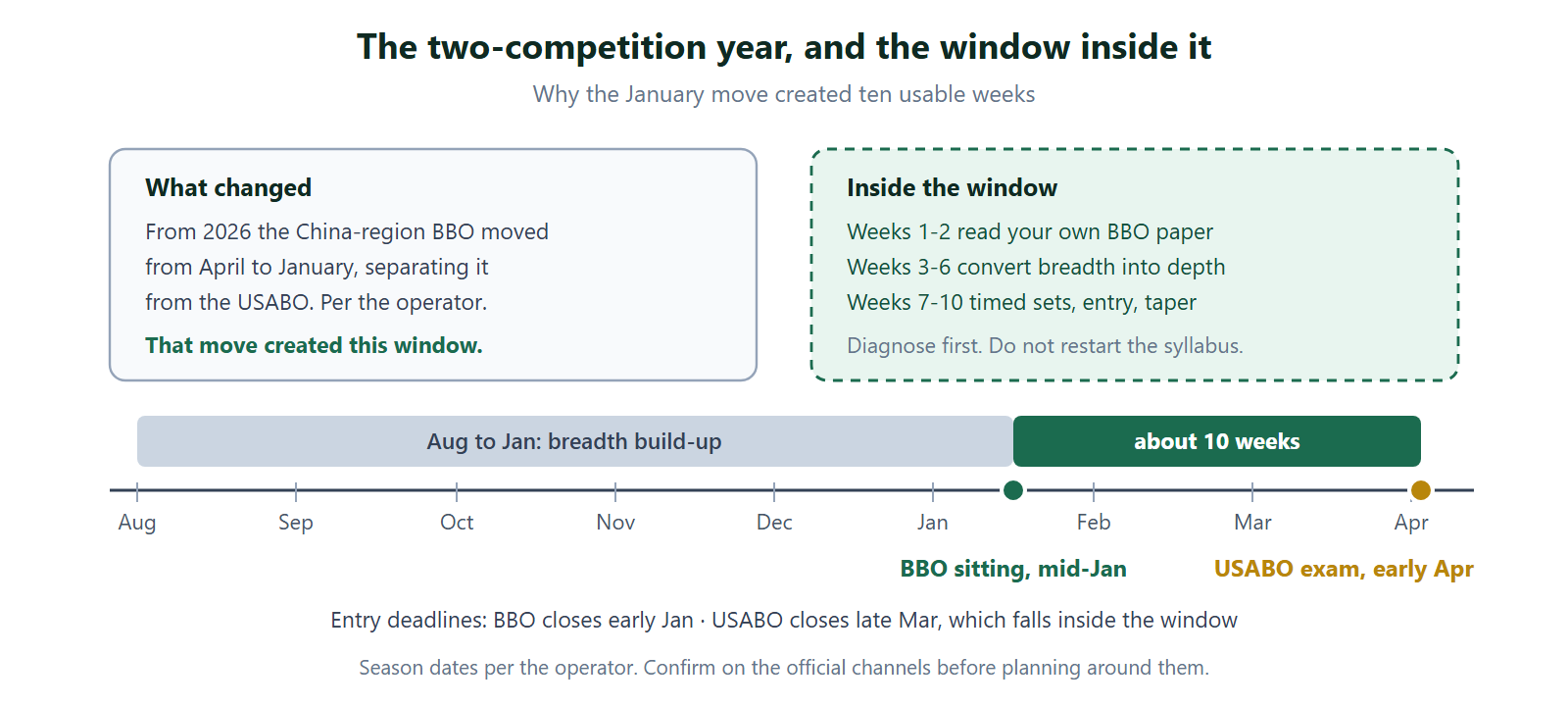
From 2026 the China-region British Biology Olympiad (BBO) sits in January rather than April, per the operator’s published season dates, which leaves roughly ten weeks before the USABO in early April. That gap is not dead time. It is the only point in the year when you hold a real, graded, figure-heavy biology paper of your own — and still have ten weeks to act on what it exposed. Most students spend it re-revising breadth they have already proven.
Why the window exists at all
For years the two big biology olympiads sat uncomfortably close together for students in the China region. That changed with a scheduling decision: from 2026 the China-region BBO sitting moved from April to January, separating it from the USABO — per the operator, and worth confirming on the official channels before you build a year around it. The date change was not cosmetic. It converted two competitions that competed for the same revision weeks into a sequence — one paper, then a run-up, then a second paper.
Per the operator, and always subject to confirmation on the official channels, the 2027 season runs like this: BBO registration closes in early January 2027 with the exam in mid-January 2027; USABO registration closes in late March 2027 with the exam in early April 2027. Count from the BBO paper to the USABO paper on those dates and you get roughly ten to eleven weeks, depending on exactly where each sitting falls. Plan it as a ten-week block and treat whatever spare days you get as buffer rather than as extra scope.
Nearly every planning article stops at “sit the BBO, then sit the USABO.” Almost none of them says what happens on the days in between — which is a shame, because those ten weeks are the highest-information period of the entire biology olympiad year. You are the only student who has your marked paper, and it is telling you something a syllabus checklist structurally cannot.
What a BBO paper tells you that a syllabus checklist cannot
A checklist asks one question: do I know topic X? You answer it in your own head, in your own time, using your own phrasing. It is a generous examiner. The BBO is not.
UKBC describes the BBO as two 45-minute multiple-choice papers, with no practical component; in the China region the paper is bilingual Chinese and English. UKBC does not publish a question count, so do not plan around one — build for pace and confirm the current format on the official channels. What the format does guarantee is pressure, because a substantial part of the paper is data and figure interpretation: a graph, a table, a pedigree, an experimental result you have never seen, from which you must extract biology against the clock. How large that share is varies from sitting to sitting, and no organiser publishes a mark split by question style.
So the paper does not measure whether you know cell biology. It measures whether you can retrieve cell biology at speed, from an unfamiliar figure, in a phrasing nobody taught you. Those are different skills, and only one of them shows up on a checklist. Which is why the first thing to do in the window is not to open a textbook — it is to read your own paper properly.
| What happened in the exam | What a checklist calls it | What it actually is | What the window is for |
|---|---|---|---|
| Ran out of time in the last stretch of questions | “Need more revision” | A retrieval-speed problem, not a knowledge problem | Timed retrieval drills on material you already know |
| Got the biology right but misread an axis, a unit or a control group | “Careless” | A figure-literacy gap, against the substantial share of the paper that is data interpretation | Deliberate data-and-figure question practice, not more content |
| Recognised the topic but not at the depth the question asked | “Covered it” | Shallow coverage, which the USABO will test harder | Depth passes through the core chapters, Campbell as reference |
| Blanked on an area you never formally studied | “Not on my A-Level or IB spec” | A genuine content hole shared by both papers | Prioritised content build in weeks 3-6 |
Notice that only one of those four rows calls for new content. The other three call for changes in how you practise. That is the single most common planning error in the window: treating every weakness as a knowledge gap, and answering all four with the same response — read more.
The ten weeks, phase by phase
The structure below assumes you sat the BBO in mid-January and are aiming at the USABO in early April. It is built around one principle: diagnose in the first fortnight, while the paper is still fresh in your head. Wait a month and you will only remember your final score, which is the least useful piece of information the paper produced.
| Phase | Focus | What you actually do | What you do not do |
|---|---|---|---|
| Weeks 1-2 | Diagnose | Reconstruct the paper from memory question by question. Sort each item into the four buckets above. Write a ranked list of three to five real weaknesses. | Start new content. You do not yet know what to study. |
| Weeks 3-6 | Depth on the exposed areas | Go deeper on the three to five areas the paper actually exposed, using Campbell as the common reference for both syllabuses. | Re-revise the entire syllabus from page one. |
| Weeks 7-9 | Applied and timed | Full timed sets under exam conditions, weighted toward data and figure questions. Complete USABO registration — the deadline sits in late March, at the end of this phase. | Leave entry admin to the last week. Diarise it in week 1. |
| Week 10 | Taper | Light retrieval, error log review, no new material. Protect sleep and exam-day timing. | Cram a new topic in the final seven days. |
The registration line in weeks 7-9 deserves emphasis because it is the one item on this page that can end your season without any biology being involved. USABO entry closes in late March, which falls near the end of that phase, around week nine or ten depending on where each sitting lands — precisely when you are deepest in timed practice and least likely to be checking dates. Put it in a calendar during week one. Our registration guidance page keeps the current entry steps for both papers.
Why depth, not more breadth
The BBO and USABO overlap in content by roughly 70% to 90% — our own estimate from comparing the two syllabuses, not a figure either organiser publishes, and a range rather than a fixed number because the real overlap depends on which topics each paper emphasises in a given year. Both are built on the same core: cell biology, genetics and evolution, animal and plant anatomy and physiology, and ecology, with Campbell Biology as the common reference text.
That overlap is the entire argument for depth. If seven to nine parts in ten of the USABO syllabus is material you demonstrated in January, then a full breadth re-run in the window mostly re-reads content you have already proven you hold. The marginal return sits in two much narrower places: the non-overlapping remainder, and the depth of the shared core — the level below where the BBO stopped asking.
| BBO (China region) | USABO | |
|---|---|---|
| Sitting | Mid-January, per the operator | Early April, per the operator |
| Entry closes | Early January, per the operator | Late March per the operator, inside the window |
| Format | Two 45-minute multiple-choice papers, no practical, per UKBC. Question count not published | Confirm on the official channels |
| Language | Bilingual Chinese and English in the China region | Confirm on the official channels |
| Data and figure questions | A substantial part of the paper; the split varies by sitting and is not published | Confirm on the official channels |
| Shared core | Cell biology; genetics and evolution; animal and plant anatomy and physiology; ecology. Campbell Biology is the common reference. | |
| Content overlap | Roughly 70% to 90% — our own estimate from comparing the two syllabuses, not a published figure | |
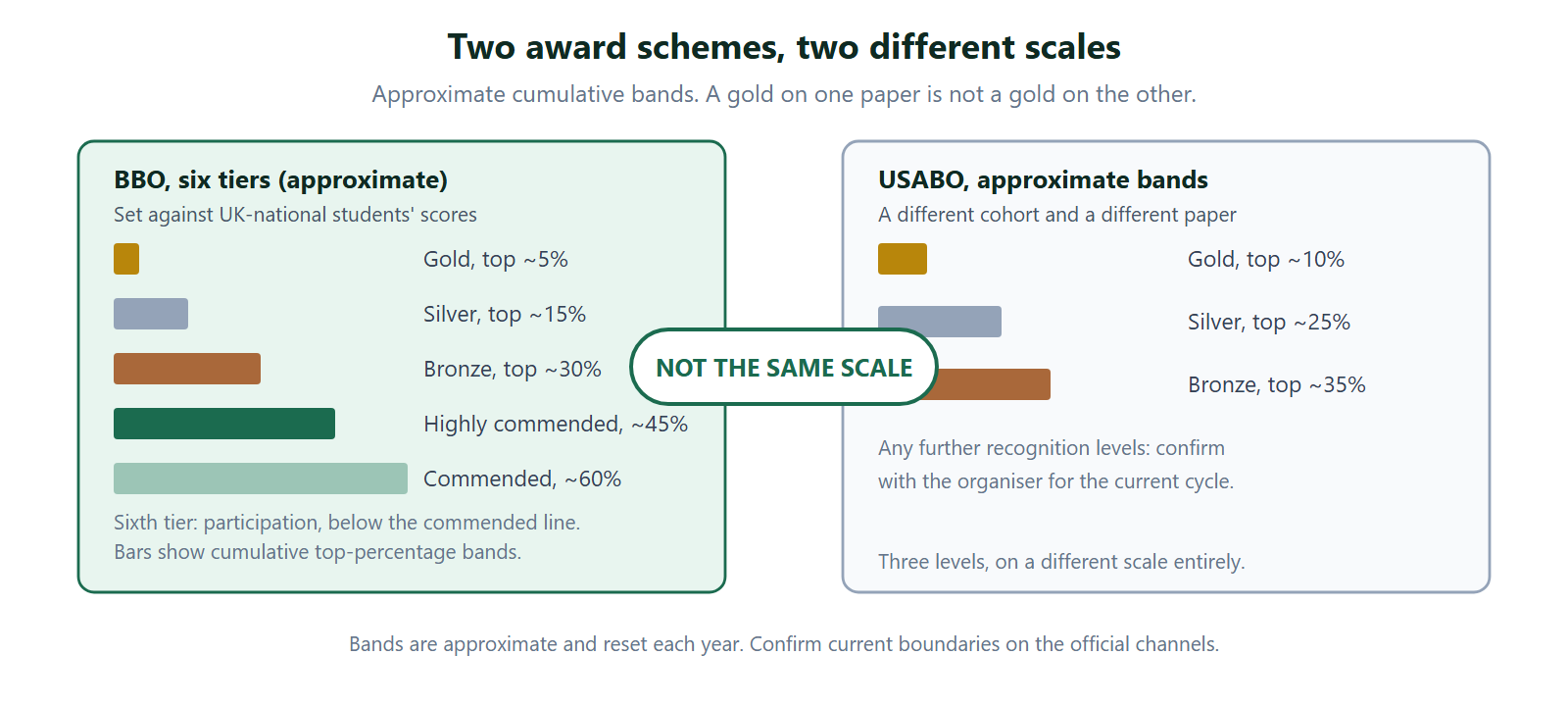
| Approximate award bands | Six tiers, cumulative against UK-national students’ scores: gold ~5%, silver ~15%, bronze ~30%, highly commended ~45%, commended ~60%, then participation | Gold ~10%, silver ~25%, bronze ~35% |
Working through past papers is the fastest way to feel the difference between the two levels of depth. Our team keeps a collected set of past papers with answer keys, plus worked solutions for some of the years rather than all of them — we are still adding to it. You can ask us for the current pack, and the past papers page explains what is in it and how to use it inside a ten-week block.
The honest caveat: a BBO gold does not predict a USABO gold
This is where the window strategy is most often oversold, so it is worth being blunt. The two award schemes are calibrated on different scales. The BBO ladder has six tiers — gold, silver, bronze, highly commended, commended and participation — and the boundaries are set against UK-national students’ scores. Read cumulatively, gold sits at roughly the top 5%, silver at the top 15%, bronze at the top 30%, highly commended at the top 45% and commended at the top 60%, with participation below that. USABO’s bands sit at approximately gold 10%, silver 25%, bronze 35%.
Those are different thresholds against different reference cohorts, on papers with different formats. A gold at roughly the top 5% and a gold at roughly the top 10% are not the same statement, and neither one converts into the other. Award boundaries also reset every year, so treat every percentage on this page as approximate and confirm current bands on the official channels.
The practical consequence: use your BBO result as a diagnostic instrument, not a forecast. A strong BBO tells you your breadth and speed are sound; it does not tell you that April is handled. A disappointing BBO tells you where to aim ten weeks of work; it does not tell you the USABO is out of reach.
What the window looks like in real numbers
Across the 2026 USABO and BBO cycle, Hanlin-prepared students earned 10 super-gold, 106 gold, 103 silver and 69 bronze results counted across the two competitions combined, and separately, six students took gold in both papers (per Hanlin, de-identified; individual results vary).
Read those two figures side by side rather than as a ratio. The award counts are a combined total across both competitions, so they include students who sat only one of the two papers and were never candidates for a double result at all — dividing the six by the gold count would put it over a denominator it does not belong to. What the six says on its own is enough: the double gold is a distinct achievement rather than an automatic follow-on from the first paper. It is difficult precisely because the second paper asks for something the first one did not, on a scale calibrated differently — which is what ten weeks of targeted depth is there to build.
If you are still deciding how the BBO fits alongside the USABO and other biology routes, our related competitions overview maps how the papers sit relative to one another across the year.
Frequently asked questions
Exactly how long is the window between the BBO and the USABO?
Roughly ten to eleven weeks, depending on exactly where each sitting falls. Per the operator, the BBO sits in mid-January 2027 and the USABO in early April 2027, so China-region students should plan a ten-week block and treat the spare days as buffer. The window exists because the China-region BBO moved from April to January from 2026, again per the operator. Confirm both dates on the official channels before you build a plan around them, as season dates can shift.
Should I keep revising the whole syllabus during those ten weeks?
Generally no. The two papers overlap by roughly 70% to 90% on our own estimate from comparing the syllabuses, so a full breadth re-run mostly repeats content you already demonstrated in January. The higher return is depth on the three to five areas your own BBO paper exposed, plus deliberate practice on data and figure questions, which are a substantial part of the BBO paper even though the exact share varies by sitting and is not published.
Does a BBO gold mean I will get a USABO gold?
No. The two award schemes are calibrated differently. The BBO ladder runs to six tiers benchmarked against UK-national students’ scores — cumulatively, gold at roughly the top 5%, silver 15%, bronze 30%, highly commended 45% and commended 60%, with participation below that — while USABO bands sit at approximately gold 10%, silver 25% and bronze 35%. Per Hanlin, six students took gold in both papers across the 2026 cycle; treat that as a standalone figure rather than a conversion rate, because the cycle’s award counts combine both competitions and include students who sat only one of them.
I missed the January BBO. Is the window still useful?
Yes, but you lose the diagnostic instrument that makes it powerful. Substitute a full past paper sat under exam conditions in week one, then treat the result exactly as you would a real BBO paper. Either way, note that USABO registration closes in late March, inside the window, so handle entry early rather than in the final fortnight.
This site is an independent guide to the British Biology Olympiad for international and China-region students. We are not affiliated with, endorsed by or sponsored by UK Biology Competitions, the Royal Society of Biology or the International Biology Olympiad, and we do not administer any round of the competition. Registration dates, exam formats, eligibility and award boundaries are set by the organisers and change between cycles — always confirm them on the official channels. Student results quoted are de-identified Hanlin data and individual outcomes vary. Confirmed errors are corrected within 7 working days.