
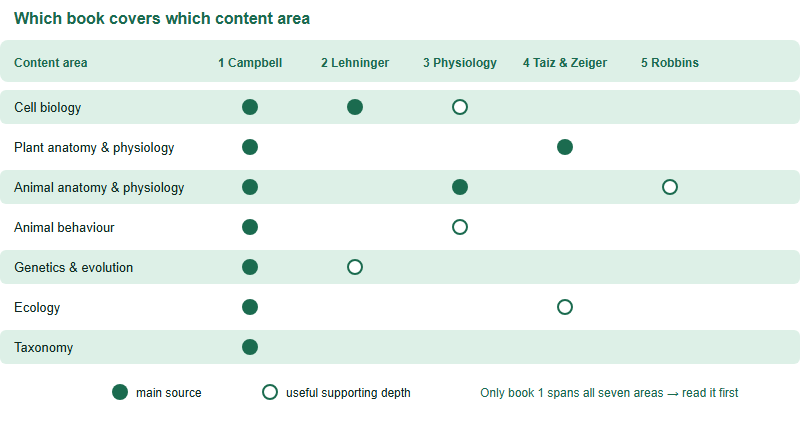
Open Campbell first and finish the framework before anything else. Then add Lehninger for the molecular block, a human physiology text for the animal block, and Taiz & Zeiger for plants. Robbins only if you are heading toward medicine. The order is the point: each later book assumes the vocabulary and the map that the earlier one gives you.
Why the order matters more than the page count
Most students who ask us “which book should I read for the BBO” have already been told the answer, several times, by several people. The list is not a secret. What almost nobody gives them is the sequence, and the sequence is where the preparation is won or lost.
Here is the failure mode we see every autumn. A student decides that biochemistry is their weak area, so they start with Lehninger in August. Six weeks later they can draw glycolysis from memory and they still cannot answer a question about why a plant in a saline soil wilts, because they never built the whole-organism map that the rest of the paper is written against. They have depth in one shaft and no ground level.
The British Biology Olympiad is run by UK Biology Competitions (UKBC), a registered charity, and the official description of the entry is short and specific: two, 45-minute multiple-choice papers, taken online while on-site at a registered school or college. The official pages also say the papers ask “students to use their biological intuition, logic and imagination to answer questions,” and that the exam assumes knowledge of A-level biology syllabi.
Read that again, because it drives the reading order. Intuition is not something you read into existence page by page. Intuition is what you get when you have a coherent map of the whole subject and can move around it quickly. A framework text gives you the map. The specialist texts deepen specific regions of it. Reversing that order gives you a very detailed map of one street and no idea which city you are in.
The five books, in order, and what each one is actually for
This is the order our biology coaches use with students preparing for the January sitting. We are deliberately not giving edition numbers — editions change, and the reasoning below does not depend on which one you own. Nor do we distribute these textbooks; they are commercial publications, and you should get them through your school library or a legitimate seller.
| Order | Book | What it is for | How to read it | Stop when |
|---|---|---|---|---|
| 1 | Campbell Biology | The framework. Builds the whole-subject map across all seven content areas. | Cover the full arc once, chapter summaries and figures first, then the body text for anything that surprises you. | You can name what lives in each of the seven areas and say roughly how they connect. |
| 2 | Lehninger Principles of Biochemistry | Depth for the molecular and metabolic block that Campbell compresses. | Targeted, not cover to cover. Energetics, enzyme behaviour, membrane transport, the major pathways as logic rather than as lists. | You can predict what happens to a pathway when one input changes, without recalling a diagram. |
| 3 | A human physiology text | The animal anatomy and physiology block. UKBC does not publish area weightings, so treat all seven areas as examinable. | System by system, always asking “what is being regulated, by what, toward what set point.” | You can reason through an unfamiliar regulatory loop from first principles. |
| 4 | Taiz & Zeiger, Plant Physiology and Development | The plant block, where English-medium students most often have real gaps. | Water relations, transport, photosynthesis beyond the light and dark reactions, hormones and development. | Plant questions stop feeling like a different subject from animal questions. |
| 5 | Robbins Basic Pathology | Optional. Only if you are heading toward medicine and want the disease framing. | Skim the general pathology chapters. It is a bonus, not a requirement. | It stops being enjoyable — this book is not on the critical path. |
Our coaches do not insist on one single human physiology title. Any standard undergraduate human physiology textbook will do the job, and the one your school library already holds is usually the right one, because a book you can open today beats a better book that arrives in six weeks.
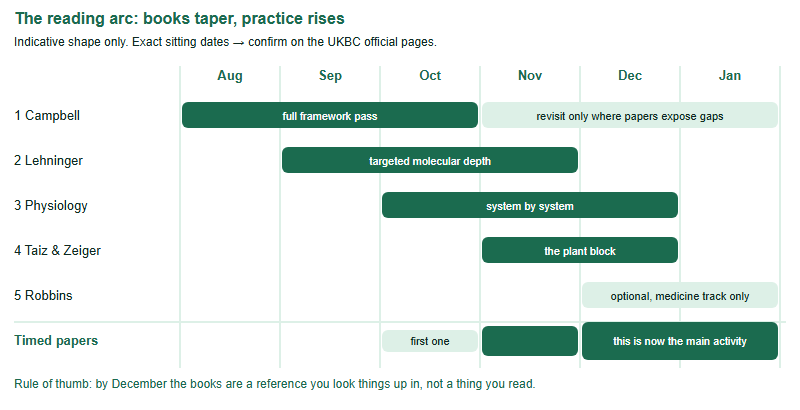
The reading arc from August to the January sitting
Reading order is not the same as reading calendar. The order tells you what to open first; the calendar tells you when to stop reading and start practising. If you are reading a textbook in the last three weeks before the paper, something has gone wrong upstream.
The 2026 UK window ran from 19 to 28 January, with the China-region sitting running to its own date and arrangements. The 2027 dates are not confirmed on this page — confirm both tracks on the UKBC official pages and, for the China-region sitting, with whoever administers it locally, because the two tracks are genuinely different and do not always share a date.
Reading is necessary and it is not sufficient
The official framing is worth taking literally. A paper that asks for “biological intuition, logic and imagination” is not a paper you can finish by recall alone, and it is certainly not a paper where a fifth textbook rescues you. Two 45-minute multiple-choice papers means the pressure is on speed of reasoning, and a multiple-choice format gives you no credit for working — so the gap between “I understood that chapter” and “I chose the right option in ninety seconds” is exactly the gap that practice closes and reading does not.
Three things reading will not do for you:
- It will not build exam pace. Ninety minutes of paper, which UKBC says may be taken together or on separate occasions, punishes hesitation. The only cure is timed papers under something close to real conditions.
- It will not teach elimination. On a multiple-choice paper, being able to kill two wrong options fast is worth as much as knowing the right one slowly. That is a trained skill.
- It will not fix vocabulary. A term you have only met in Chinese, or only in the American spelling, still costs you the whole mark when it appears in the stem. Build your own glossary as you read — this is the single highest-return habit in the whole plan.
For the practice half of the plan, our guide to preparing for the BBO sets out how to sequence syllabus work against timed papers. We maintain our own gathered pack of past papers, with worked solutions for some of the years and our own topic notes and vocabulary lists alongside them — the pack is our material, not the textbooks above, which stay where they belong with their publishers.
Where this reading order pays a second dividend
If you are also planning to sit the USA Biology Olympiad later in the same academic year, the reading order above is doing double duty. Our own content comparison puts the overlap between the two syllabuses at roughly 70 to 90 per cent depending on how strictly you count — that is our comparison, not an official figure from either organiser — and the overlap sits almost entirely in the blocks that books one to four cover.
In practice this means the autumn reading you do for a January sitting is most of the reading you need for a spring one, which is the whole logic behind the BBO-first-then-USABO sequence. It also means the honest answer to “should I read more before USABO” is usually no: you should re-run the practice loop on a second syllabus, not open a sixth book.
A note on the numbers people quote at you. Across our own coached cohorts from 2020 to 2026 we have recorded 91 students taking gold in both competitions — that is a cumulative figure across seven seasons, not an annual one. In the 2026 season alone the number was 6. We mention it because the cumulative figure gets repeated as if it were a yearly result, and a student setting targets against a misread number will set the wrong target. All results de-identified, per Hanlin, and results vary.
Four reading-plan mistakes worth avoiding
- Starting with the hardest book. Lehninger in August feels productive and is the most common way to arrive in December with no framework.
- Reading Campbell cover to cover, slowly, twice. One structured pass plus targeted returns beats two linear passes. You are building a map, not memorising a phone book.
- Skipping the plant block. It is the block students most often decide is “less likely to come up,” and it is one of the seven named content areas. Taiz & Zeiger exists in this list for a reason.
- Treating Robbins as a requirement. It is a genuine pleasure if medicine is your direction, and it is not on the critical path to any award. Do not let it displace timed papers.
One last piece of logistics that shapes every reading plan: entry is made by schools, not by students or by tutoring companies. The official pages state that only recognised educational institutions may register, and that private tutoring companies and individuals cannot. Whatever your reading plan looks like, the entry conversation has to happen with your school — our China-region exam guide walks through how that works for international-school students. Confirm the current registration rules and fees on the UKBC official pages.
Frequently asked questions
Do I need to finish Campbell before starting Lehninger?
Finish the framework pass, yes. You do not need to have memorised it — you need the map before you dig the shafts.
Can I skip the textbooks and just do past papers?
Not from a standing start. Papers diagnose gaps efficiently but do not build the framework that the questions assume.
Which human physiology textbook do you recommend?
Our coaches do not prescribe one title. Any standard undergraduate human physiology text works; use the one your school library already holds.
Is Robbins Basic Pathology worth reading for the BBO?
Only if you are heading toward medicine and enjoy it. It is a bonus book, never a prerequisite for any award band.
This is an independent guide operated by Hanlin Education for China-based international-school students. We are not affiliated with, endorsed by, or sponsored by UK Biology Competitions (UKBC) or the Royal Society of Biology, and official competition administration rests with the organiser. Dates, fees, eligibility, registration rules and award boundaries change between seasons — confirm current details on the UKBC official pages before acting on anything here. Cohort figures are our own de-identified records, per Hanlin; results vary and no outcome is guaranteed. Errors reported to us are corrected within 7 working days.