
On a multiple-choice paper you are not marked on the biology you know — you are marked on the biology you can recognise in the sixty seconds you are looking at it. For students whose earlier biology was taught in Chinese, or in American-spelled textbooks, a real share of lost BBO marks are vocabulary failures wearing the costume of knowledge failures. They are also the cheapest gap to close.
Why vocabulary is unusually expensive on this particular paper
The British Biology Olympiad, run by UK Biology Competitions (UKBC), is two, 45-minute multiple-choice papers, taken online while on-site at a registered school or college. UKBC also states that the exam assumes knowledge of A-level biology syllabi, and that the questions ask students “to use their biological intuition, logic and imagination.”
Three consequences follow, and together they explain why a vocabulary gap hurts more here than in your school exams:
- There is no part credit. In a school paper you can write “the pigment in red blood cells” and pick up the mark. In multiple choice, the word either unlocks the option or it does not. The examiner never learns that you understood the physiology and missed the noun.
- The clock is unforgiving. Two 45-minute papers means every second spent decoding an unfamiliar term is a second stolen from the reasoning the paper is actually testing.
- Distractors are built out of near-neighbours. Wrong options in a well-written biology multiple-choice item are usually plausible-sounding relatives of the right one. If two options differ only by a term you half-know, a coin-flip is what is left.
None of this is a criticism of your biology. We have watched strong students — students who can explain countercurrent exchange fluently at a whiteboard — lose items because the stem said “counter-current multiplier” and their brain spent nine seconds asking whether that was a different thing.
The four failure modes, and how to tell them apart
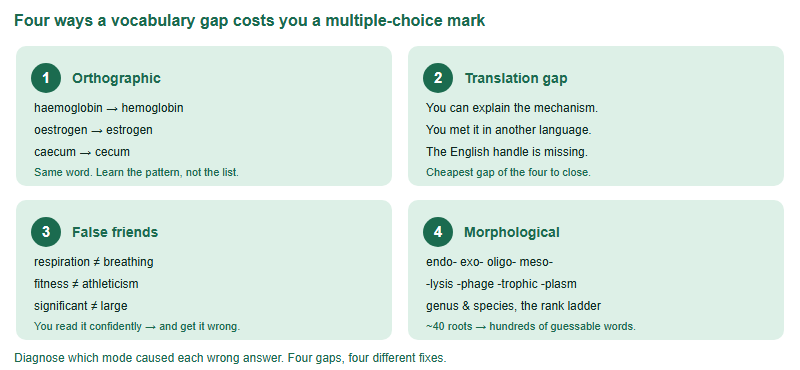
Not all vocabulary gaps are the same gap, and they need different fixes. When you get an item wrong, the useful question is not “did I know this word” but “which of these four things happened.”
| Failure mode | What it feels like | Worked examples | The fix |
|---|---|---|---|
| 1. Orthographic — British vs American spelling | The word looks almost right, and you hesitate over whether it is the same thing | haemoglobin / hemoglobin; oestrogen / estrogen; anaemia / anemia; oesophagus / esophagus; caecum / cecum; leucocyte / leukocyte; foetal / fetal; oedema / edema | Learn the two patterns (ae/oe collapse to e; -ce/-se and -ogue/-og shifts), not eighty separate words |
| 2. Translation gap — you know the concept, not the English label | You can explain the mechanism in your first language and freeze at the term | Any concept you first met in a Chinese-medium classroom: the physiology is intact, the English handle is missing | A two-column glossary, English first, with the concept in your own words rather than a dictionary gloss |
| 3. False friends — everyday English vs technical English | You read the word confidently and apply the wrong meaning | respiration (cellular, not breathing); fitness (reproductive success, not athleticism); significant (statistical, not “big”); theory; control (an experimental comparison, not regulation); efficiency; potency | Write the everyday meaning and the biological meaning side by side, explicitly, once |
| 4. Morphological — Greek and Latin roots, and binomials | A word you have genuinely never seen, and nothing to guess from | Roots: endo-, exo-, -lysis, -phage, -trophic, -plasm, oligo-, meso-. Taxonomy: genus and species, and the rank ladder | Learn roughly forty morphemes and you can make an educated guess at hundreds of unseen words |
Mode 4 deserves a specific note, because taxonomy is one of the seven content areas in its own right. Root-learning is the highest-leverage vocabulary work available to you: it does not just add words, it converts unknown words into guessable words. A student who knows that -lysis means splitting and -troph relates to feeding can make a defensible attempt at a term they have never met, under time pressure, which is exactly the “biological intuition” the official description is describing.
The layer above words: qualifiers in the question stem
There is a second vocabulary that has nothing to do with biology, and it costs more marks than students expect: the small English words that control what the question is asking. On a paper written to test logic, these words are the logic.
- Negatives and exclusions: “which is least likely”, “all of the following except“, “which would not occur”. Reading past a negative turns a question you know into a question you get wrong, and it is the single most common self-inflicted error we see in review sessions.
- Strength qualifiers: “best explains” versus “explains”; “most directly”; “primarily”; “necessarily”; “sufficient” versus “necessary”. Several options may be true. Only one is the best answer to the question as written.
- Direction words: increase, decrease, unchanged, inversely, proportional. In a data item these determine the answer entirely.
- Figure furniture: axis labels, units, “per unit time”, “arbitrary units”, log scales, error bars. A figure you misread is not a knowledge failure either.
A practical habit that costs nothing: on every practice item, physically mark the qualifier before you look at the options. It slows you down for a week and speeds you up thereafter. Our guide to preparing for the BBO sets out where this fits alongside syllabus work and timed papers.
A 20-minute weekly routine that actually compounds
Vocabulary work fails when it becomes a separate project. It succeeds when it is a small, fixed loop bolted onto reading and papers you are doing anyway. Twenty minutes a week, every week, from August to the sitting, is more than enough — and it beats a frantic 300-word cram in January, because recognition speed is built by spacing, not by volume.
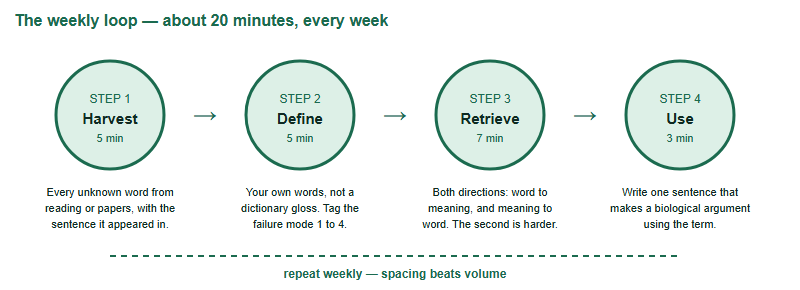
Keep the record in one place, in a format you can drill from. Five columns is enough:
| Term (British form) | Variant you have seen | Your own definition | Mode | Where it appeared |
|---|---|---|---|---|
| oestrogen | estrogen | Steroid hormone group; drives female reproductive cycling | 1 | Physiology reading, endocrine chapter |
| respiration | — | ATP production in cells — not breathing, which is ventilation | 3 | Past paper item, energy section |
| oligotrophic | — | Few nutrients; oligo = few + troph = feeding | 4 | Ecology figure, lake comparison |
Why your own list beats any list you download
We maintain our own gathered pack for BBO students — past papers with worked solutions for some of the years, plus our own topic notes and vocabulary lists. Even so, the honest advice is that our list is a cross-check, not a substitute. A downloaded word list is a record of somebody else’s gaps. Yours is a diagnostic record of what actually stops you, which is the only list short enough that you will really drill it.
The 300 words that matter to you are not the 300 words that matter to the student sitting next to you, and a generic list buries your real gaps inside terms you already own. Build yours from your own reading and your own wrong answers, then use anyone else’s list only to find blind spots you would never have noticed.
There is a second-order payoff worth knowing about. Our own content comparison puts the overlap between the BBO and the USA Biology Olympiad syllabuses at roughly 70 to 90 per cent depending on how strictly you count — our comparison, not an official figure from either organiser. That means the glossary you build for a January BBO carries into a later USABO sitting almost intact, which is part of the case for the BBO-then-USABO sequence. With one twist that catches people out: the spelling convention flips. The British paper is written against A-level syllabuses and their conventions, the American one is not, and students who drilled only one form get a second, milder version of failure mode 1. Record both forms from the start and the flip costs you nothing.
Two logistics facts that shape how you practise
First, the paper is sat online while on-site at your registered school or college, and entry is made by the institution: UKBC states that only recognised educational institutions may register, and that private tutoring companies and individuals cannot. Whatever your revision looks like, the entry conversation happens with your school — our China-region exam guide covers how that works for international-school students, and how the China-region sitting differs from the UK home rounds.
Second, the two tracks run to different dates. The 2026 UK window ran 19 to 28 January; the China-region sitting has its own date and its own arrangements. The 2027 dates are not confirmed here — confirm both on the UKBC official pages and with your school. Fees also differ by track and change between seasons; confirm the current figure rather than trusting last season’s number.
Frequently asked questions
Does the BBO use British spellings?
Expect British conventions, since it is a UK competition written against A-level syllabuses. Learn both forms so neither slows you down.
How many words should I aim to learn before January?
There is no target number. A list built from your own wrong answers and reading, drilled weekly, beats any fixed word count.
Is a dictionary allowed in the exam?
Permitted materials are set by the organiser and can change. Confirm on the UKBC official pages and with your school before the sitting.
Should I write definitions in English or in Chinese?
Define in English so recall runs in the exam language, but note the first-language term if that is how you originally learned the concept.
This is an independent guide operated by Hanlin Education for China-based international-school students. We are not affiliated with, endorsed by, or sponsored by UK Biology Competitions (UKBC) or the Royal Society of Biology, and official competition administration rests with the organiser. Dates, fees, eligibility, permitted materials, registration rules and award boundaries change between seasons — confirm current details on the UKBC official pages before acting on anything here. Syllabus-overlap figures are our own comparison, not official. Errors reported to us are corrected within 7 working days.