
August is when you pick a target, and most students pick badly — either an award band they cannot act on, or a number copied from someone whose starting point was nothing like theirs. The official award categories are Gold, Silver, Bronze, Highly Commended, Commended and Participation. What follows is how to choose between them honestly, using one cohort's real spread and a three-step diagnostic.
Start with what the organiser actually awards
UK Biology Competitions (UKBC), the registered charity that runs the British Biology Olympiad, lists six award categories: Gold, Silver, Bronze, Highly Commended, Commended, and Participation. That is a longer ladder than most students assume — a lot of people arrive believing there are three medals and then nothing, which quietly turns “not gold” into “failed.”
Two structural facts should shape any target you set:
- Boundaries are set per season. The score needed for a given category is decided against that year's papers and that year's field. Last season's cutoff is a historical fact, not a promise. Confirm current boundaries and categories on the UKBC official pages.
- You are targeting a band, not a score. Because the boundary moves, “I need X marks” is a fragile target. “I want to be comfortably inside a band rather than sitting on its edge” survives a year where the paper runs harder or easier than expected.
The format also constrains what a target can realistically mean. The entry is two, 45-minute multiple-choice papers, taken online while on-site at a registered school or college, and UKBC describes the questions as asking students “to use their biological intuition, logic and imagination.” There is no practical component and no written long-answer section to carry you. Ninety minutes of multiple choice is a narrow instrument, which is precisely why targets built on process rather than on a magic score hold up better.
One cohort's 2026 spread, and how to read it without fooling yourself
Here is what a single coached cohort looked like in the 2026 BBO season, as recorded in our own coaching records. These figures are de-identified, per Hanlin, and results vary — they are a description of one group of students, not a prediction about you.
| Recorded outcome | Count, 2026 season | What it does and does not tell you |
|---|---|---|
| Gold | 86 | Official UKBC award category. The largest single group in this cohort — which is itself the most important thing on this table, and not for the reason most people assume. |
| Silver | 66 | Official UKBC award category. |
| Bronze | 33 | Official UKBC award category. |
| Regional merit (label carried over from other competitions, not a BBO outcome) | not reported here | Our own internal record label, not a UKBC award category name. Do not quote it as an official tier. |
| Shortlisted | 6 | Our own internal record label, not a UKBC award category and not a BBO competition stage; confirm any progression route on the UKBC official pages. Again, not an official UKBC category name. |
Now the discipline. We are deliberately not converting these counts into percentages of a total, and neither should you. Our internal record labels are not guaranteed to be mutually exclusive with the medal categories, so adding them into a denominator would manufacture a statistic that does not exist. Any source that hands you a tidy percentage breakdown built from numbers like these is doing arithmetic the underlying data does not support.
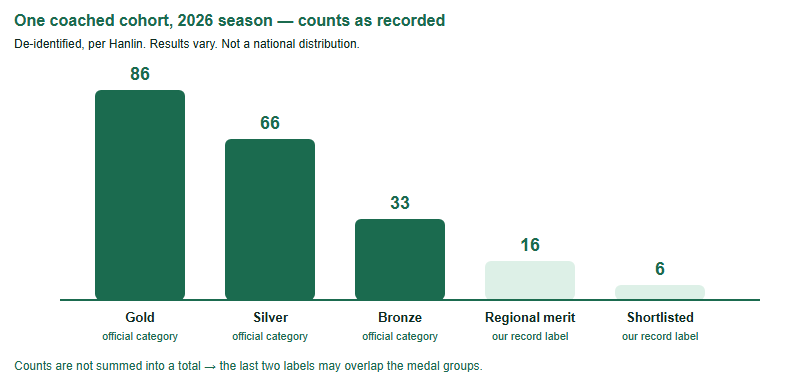
That top-heavy shape is the single most useful and most misleading thing on the chart, so read it carefully. A coached cohort is self-selected twice over: these are students who chose an optional olympiad, and then chose to prepare systematically for it. You would expect their distribution to lean upward relative to an open field. It tells you what a prepared group looked like. It does not tell you the odds facing a student who has not started.
The honest use of this chart is not “my chances of gold are good.” It is: a prepared cohort clusters at the top of the ladder, so the variable you control is whether you are in the prepared group, not whether you are lucky.
The number that gets misquoted, and why it wrecks targets
You will see the figure 91 dual-gold attached to our biology programme — students who took gold in both the BBO and the USA Biology Olympiad. It is a real number, and it is cumulative across the 2020 to 2026 seasons, not an annual one. In the 2026 season alone, the dual-gold count was 6.
We are flagging it because we have watched the cumulative number get repeated as if it were a yearly result, and the damage it does is specific. A student who believes ninety-odd people clear a double gold every year concludes that double gold is a routine outcome and sets it as a baseline expectation. A student who knows the annual figure is single digits sets it as a stretch goal, plans a realistic January target first, and gets further.
The same warning applies to any headline number you meet this autumn, including ours: ask whether it is annual or cumulative, whether it describes a self-selected group, and whether the categories in it overlap. If you are weighing up the two-competition route, our BBO-then-USABO plan sets out what the sequence actually demands rather than what the headline suggests.
Converting all this into your own August target
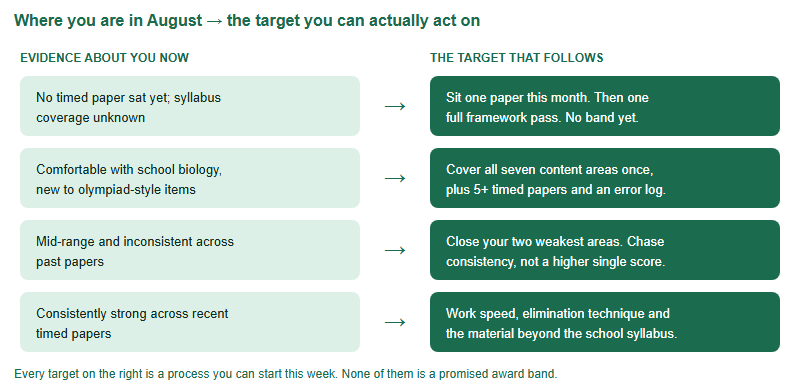
A target is only worth setting if it changes what you do on a Tuesday. Three questions get you there, and you answer them from evidence rather than ambition.
- Have you sat a full timed paper under real conditions yet? If not, you do not have a starting point, and any award band you name is a wish. Fix this first — it is a 45-minute job.
- Which of the seven content areas have you actually covered? Cell biology, plant anatomy and physiology, animal anatomy and physiology, animal behaviour, genetics and evolution, ecology, taxonomy. Count the ones you could teach, not the ones you have read.
- How many weeks of real study time do you have before the sitting? Not calendar weeks — weeks after mocks, internal assessments and application deadlines have taken their cut.
Process targets beat outcome targets, and not only for morale
“Get gold” fails as a target for a practical reason rather than a motivational one: it gives you no instruction. You cannot do gold on a Wednesday evening. You can do a timed paper, log the four items you lost to misread qualifiers, and spend Thursday on the content area that produced two of them.
Outcome targets also break when the boundary shifts. Because cutoffs are set against each year's paper and field, a student who trains to sit exactly on last year's gold line has built a plan with no margin, and a marginally harder paper takes the award away from them through no fault of their preparation. Aiming to be comfortably inside a band is the same work with a buffer.
The process targets that carry the most weight, in rough order of return on the hours:
- Number of full timed papers completed under something close to real conditions. This is the single best predictor we see of a student closing the gap between “understood it” and “chose it in ninety seconds.”
- Content-area coverage, counted honestly across all seven areas. The area you keep deferring is usually plants or taxonomy, and it is on the paper.
- Error-log discipline: every wrong item classified as content gap, vocabulary gap, misread qualifier, or pace. Four categories, four different fixes.
- Repeat-error rate: how often a mistake from three weeks ago comes back. This is the number that tells you whether your revision is working at all.
Our guide to preparing for the BBO sets out how to sequence these against the syllabus. We keep our own gathered pack of past papers with worked solutions for some of the years, plus our own topic notes and vocabulary lists, for the practice half of the plan.
What a target does not buy you
Three limits worth stating plainly before you commit to anything this month.
First, no preparation guarantees an award. Boundaries are set per season, the field changes, and ninety minutes of multiple choice, taken together or on separate occasions, carries real variance. Anyone promising you a band is describing a wish, and that includes any provider — ours included — that presents a cohort chart as if it were a forecast for you.
Second, you do not control entry on your own. UKBC states that only recognised educational institutions may register — state-funded or independent schools, further education colleges, and international schools recognised by their national education authority — and that private tutoring companies and individuals cannot. However good your plan is, the entry conversation happens with your school, and it needs to happen early enough to matter.
Third, the two tracks are not the same track. The UK home rounds and the China-region sitting run to different dates and different arrangements. The 2026 UK window ran 19 to 28 January; the China-region sitting had its own date. The 2027 dates are not confirmed on this page, and fees differ by track and change between seasons — confirm both on the UKBC official pages and with your school. Our China-region exam guide walks through how the international-school route works in practice.
Set the target in the first week of August, write the process version of it somewhere you will see it, and re-check it against a timed paper in October. A target you revise on evidence is worth more than one you defend.
Frequently asked questions
What are the official BBO award categories?
UKBC lists Gold, Silver, Bronze, Highly Commended, Commended and Participation. Confirm the current list on the UKBC official pages.
What score do I need for a BBO gold?
Boundaries are set each season against that year's paper and field, so there is no fixed figure. Target a band comfortably, not a number.
Is the 91 dual-gold figure an annual result?
No. It is cumulative across the 2020 to 2026 seasons in our own records. The 2026 season alone was 6.
Can I enter the BBO myself if my school does not?
UKBC states only recognised educational institutions may register; individuals and tutoring companies cannot. Raise it with your school early.
This is an independent guide operated by Hanlin Education for China-based international-school students. We are not affiliated with, endorsed by, or sponsored by UK Biology Competitions (UKBC) or the Royal Society of Biology, and official competition administration rests with the organiser. Dates, fees, eligibility, registration rules and award boundaries change between seasons — confirm current details on the UKBC official pages before acting on anything here. Cohort figures are our own de-identified records, per Hanlin; results vary and no award or outcome is guaranteed. Errors reported to us are corrected within 7 working days.