
For a family, the British Biology Olympiad is a small direct cost and a real time cost. Per UKBC, entry is made by the school — free for UK schools, a per-school fee for schools outside the UK — and, for entry made directly with UKBC, the exam is two 45-minute multiple-choice papers sat online at the registered school — the China/Asia region is run by a regional partner on different arrangements, so confirm which applies to your child’s school. The money is rarely the decision. The hours between August and January are, and so is what the award honestly signals.
What it is, in one paragraph you can use
The BBO is a national biology olympiad run by UK Biology Competitions for students in the sixth-form age range — per UKBC, Y12/Y13 in England and Wales, Y13/Y14 in Northern Ireland, S5/S6 in Scotland, and equivalent year groups in other countries. Entered directly with UKBC it is sat as two 45-minute multiple-choice papers, taken online while candidates are on-site at their registered school or college, with both papers required to receive an award; schools entering through a regional partner may sit a differently structured paper, so confirm the arrangement your child’s school uses on the official channels. Awards are issued as e-certificates in six bands: Gold, Silver, Bronze, Highly Commended, Commended and Participation.
Two features distinguish it from a school biology exam, and they are the reason it is worth a family's attention at all. First, the questions are designed to test problem-solving rather than pure recall — students are asked to apply biological intuition, logic and imagination to unfamiliar material, with some straightforward knowledge questions included. Second, per UKBC the award boundaries are set using only students from UK schools and are then applied to all participating students. That means a China-based student's award is benchmarked against a UK sixth-form cohort rather than a local one.
Dates move each cycle. The 2026 UK sitting window ran 19–28 January, with the China-region sitting on 17 January 2026. Dates for the 2027 season are not yet confirmed — check the UKBC official pages rather than relying on last year's calendar.
What it actually costs
This is usually the shortest conversation in the whole process, and it surprises parents who are used to competition entry fees running into four figures.
| Line item | What it is | Who pays | Typical scale |
|---|---|---|---|
| Competition entry | The school's registration with UKBC | The school, not the family | UK schools free; schools outside the UK paid a per-school fee — £30 per school in the last published cycle, not per candidate; schools entering through a regional partner are charged on a different basis. Confirm the current figure officially. |
| Past papers | Practice material | — | Not sold — our teachers keep a gathered pack, with worked solutions for some years only |
| Textbooks | One good general biology text, usually shared or borrowed | Family, optionally | One book, often already on the school reading list |
| Coaching | Entirely optional and entirely variable | Family | The one genuinely open-ended item — see the last section before committing |
| Travel | None for the paper itself | — | Sat at the student's own school; no venue costs |
Two things follow from that table. The first is that if your child's school already enters, the marginal cost of adding one more student is close to nothing — which is worth knowing if you are told the school “cannot afford” it. The second is that the only substantial number on the page is coaching, and it is optional. A motivated student with past papers, one textbook and a disciplined routine can prepare for this competition without any purchased support at all. Any provider who tells you otherwise, ourselves included, is worth questioning.
The time budget, honestly
This is the real price. Below is a realistic shape for a student starting in late August and sitting in January, based on what we see China-based cohorts actually sustain rather than what an idealised plan looks like on paper.
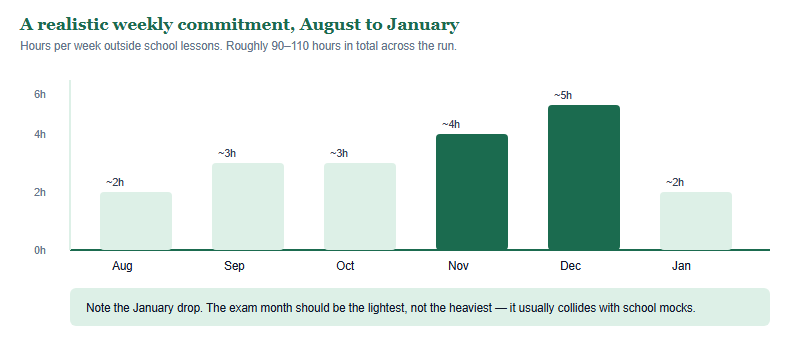
Three observations that matter more than the exact numbers.
- The total is modest but the timing is awkward. The heaviest months are November and December, which in most international schools collide with internal assessments, and in Y13 with university application deadlines. That clash, not the hour count, is what makes families abandon the plan in week nine.
- January should be light. By the sitting window the work is done. A student cramming in January has usually mis-planned the autumn, and the fix belongs in September.
- Compression does not work here. Because the paper rewards applying principles to unfamiliar situations rather than recalling facts, four weeks of intensive revision produces much less improvement than four months of light, regular practice. This is not a subject you can buy your way through in the final month.
If you want to see what the weekly work actually consists of, our guide to how to prepare for the BBO sets out the routine in detail, and the China exam guide covers what the sitting day itself involves.
What the award signals — and four things it does not do
This is where parents are most often mis-sold, in both directions. Some are told an olympiad award is decisive for admissions. Others are told it counts for nothing. Neither is right.
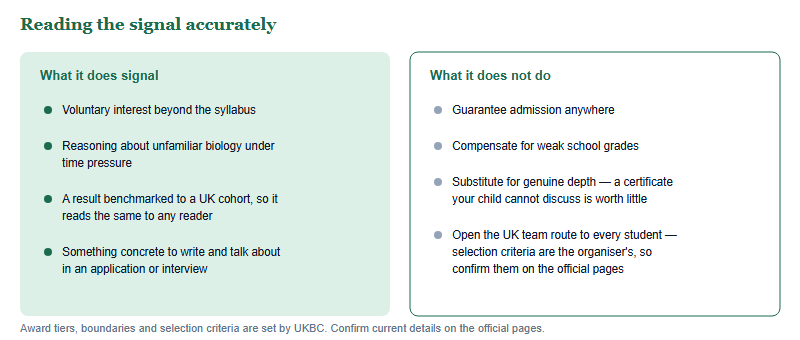
The fourth point on the right deserves expanding, because it is the one most often blurred in marketing aimed at Chinese families. Per UKBC, high-performing students may receive invitations for UK Team Selection, and those selected represent the UK at the International Biology Olympiad. That is a route to the UK team, and whether any individual student is eligible for it depends on the organiser's own criteria. If someone presents the BBO to you as a straightforward path to the international olympiad for a student at a Chinese international school, ask them to show you where the organiser says so.
What we would say honestly about the value: the BBO is a well-recognised, low-cost, externally-marked signal that a student chose to do difficult biology voluntarily. That is a genuinely useful thing for a biology, biomedical or medicine application to contain. It is one line in a picture, not the picture.
How to tell real engagement from performance
The most useful thing a parent can do is not to manage the preparation. It is to notice whether the interest is real, because a student doing this for the certificate will get less out of it than one doing it out of curiosity — and the paper is unusually good at exposing the difference, since it rewards reasoning about material nobody has taught.
Signals worth watching for, none of which require you to understand the biology:
- Does your child talk about a question after getting it wrong? Genuine interest shows up as arguing about why an answer was wrong, not as reporting a score.
- Does the reading drift sideways? A student who starts on the syllabus and ends up reading about something adjacent is engaged. One who reads only what is assigned is completing a task.
- Is the routine self-started? If every session begins with a reminder from you or a tutor, the ownership sits in the wrong place, and that will show up in an interview later.
- Would they do it again next year? Ask in February. The answer tells you more than the award band does.
If the honest answers are discouraging, that is useful information rather than a failure. A Commended certificate from a student who found the questions fascinating is a better foundation than a Silver from one who found the whole thing an imposition. Awards do not compound; interest does.
Questions to ask before you pay for coaching
Coaching is the one open-ended cost, and the market around Chinese international schools is uneven. The following checklist is deliberately written so that it applies to every provider including us — we would rather you use it on us than not use it at all. We are not going to tell you that our programme is the right answer; that is your judgement to make with the answers in hand.
| Ask this | A good answer looks like | Walk away if |
|---|---|---|
| Can you enter my child for the BBO? | “No — entry is made by a recognised school or college and the paper is sat there. We can help you approach your school.” | They claim they can register your child directly. Per UKBC, private tutoring companies and online-only providers cannot register. |
| What result are you promising? | No promise at all, plus a clear explanation of what is and is not in their control | Any guaranteed award band, guaranteed admission outcome, or refund-if-no-Gold framing |
| What materials do we get, and are they official? | A clear distinction between the organiser's published materials and the provider's own compiled notes and worked solutions | Compiled material is presented as official, or coverage claims are vague |
| How many hours per week, and when does it peak? | A specific number and an acknowledgement of the November–December clash with school assessments | They cannot say, or the plan ignores your child's school calendar entirely |
| What happens if my child's school does not enter? | “Then there is no sitting this cycle. Here is how to approach the school for next year.” | They suggest a workaround around the school-registration rule |
| Who is teaching, and what is the group size? | Named teachers, a stated group size, and a sample session you can observe | The teacher is unnamed until after payment |
One last framing that families find useful. Before committing to coaching, let the student attempt one past paper unaided in a timed 45-minute block. If they finish it interested and frustrated, the raw material is there and support will compound. If they finish it bored, the money would be better spent somewhere they actually want to go. And if the plan is to continue into other olympiads afterwards — the BBO-then-USABO sequence is the common next step because the content overlaps heavily — that decision is much easier to make in February with a real result in hand than in August on speculation.
Frequently asked questions
How much does the BBO cost our family?
Entry is made by the school: free for UK schools and a per-school fee for schools outside the UK. Confirm the current amount on the official pages.
How many hours will my child need?
Our guideline is roughly 90–110 hours spread from August to January, peaking at about five hours a week in December. This is our own estimate, not official.
Does a BBO award help with university applications?
It is a recognised signal of voluntary interest and reasoning ability. It does not guarantee any admission outcome and does not offset school grades.
Can my child sit the BBO if their school does not enter?
No. Per UKBC, recognised educational institutions register and the papers are sat on-site at that school or college.
This is an independent guide operated by Hanlin Education for China-based international-school students. We are not affiliated with, endorsed by, or sponsored by UK Biology Competitions (UKBC) or the Royal Society of Biology, and official competition administration rests with the organiser. Fees, dates, eligibility, award tiers and selection criteria change between cycles — confirm all current details on the UKBC official pages before making decisions. Errors reported to us are corrected within 7 working days.