
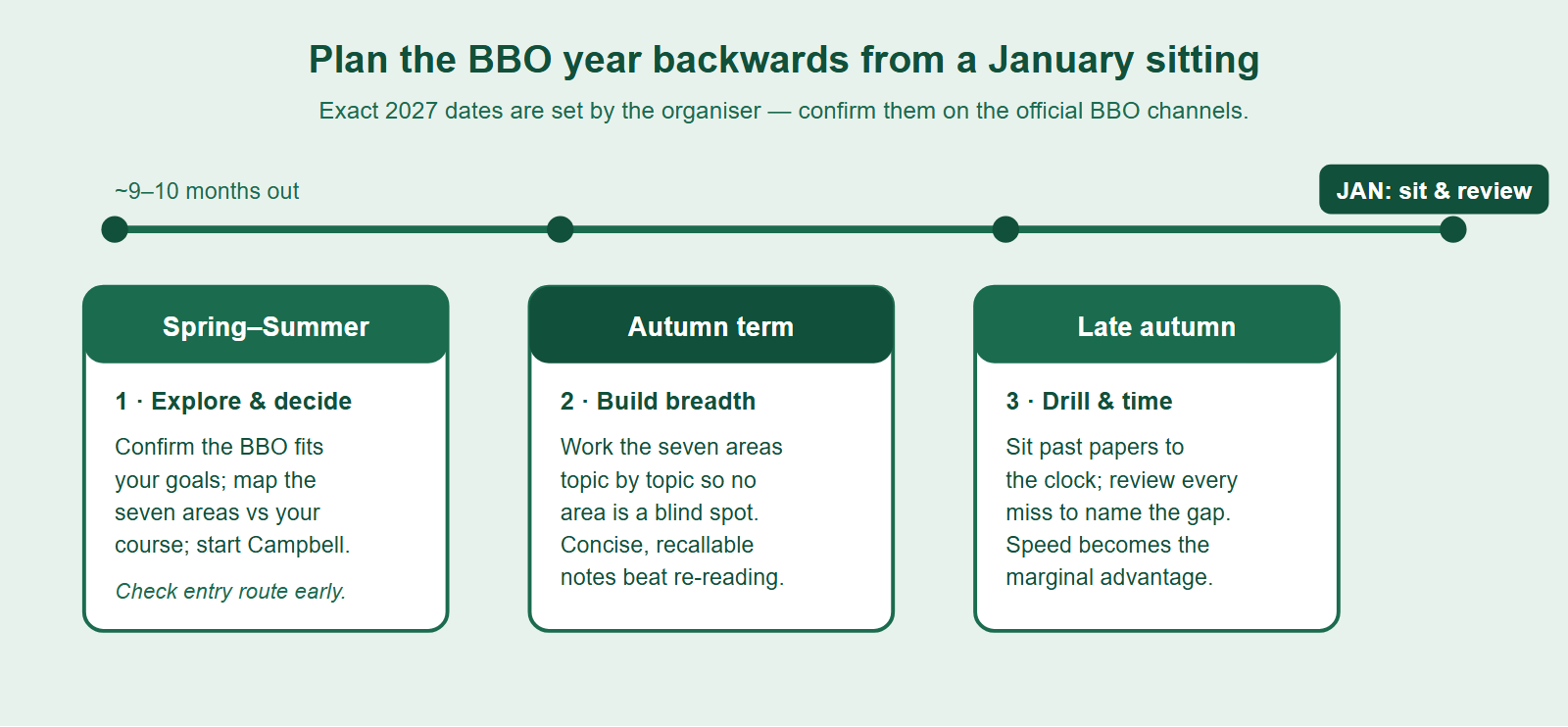
If you are aiming at the British Biology Olympiad (BBO) for the 2027 cycle, plan your year backwards from a winter sitting. The BBO is a short online exam, usually held in January, so a realistic plan starts the previous spring or summer, builds the seven syllabus areas over the autumn, and shifts to timed past papers before the exam. Exact 2027 dates are not yours to assume — confirm them on the official BBO channels.
Why the BBO rewards planning a year ahead
The BBO is organised by UK Biology Competitions (UKBC) / the Royal Society of Biology, a registered charity, and it is built for sixth-form and high-school students with a strong interest in biology. Crucially, it rewards applying biology to unfamiliar problems, not rote recall. You cannot cram that the week before. The syllabus spans seven core areas — cell biology; plant anatomy and physiology; animal anatomy and physiology; animal behaviour; genetics and evolution; ecology; and taxonomy — which maps onto a strong A-level or AP biology course plus some first-year university material. Covering that breadth, then drilling it until it is fast under pressure, is a months-long job, not a sprint.
The single most useful anchor for 2027 planning is the shape of a known year. For the 2026 cycle, the China-region exam was held on 17 January 2026, and the UK home competition ran over 19–28 January 2026. Treat those as a template for roughly when in the calendar things tend to fall — a winter sitting after the autumn term — but do not copy the 2026 dates onto 2027. The organiser sets each year’s dates, eligibility and registration windows, and they move; the dates that matter for you must come from the official channels.
Spring to summer: decide, then start the foundation
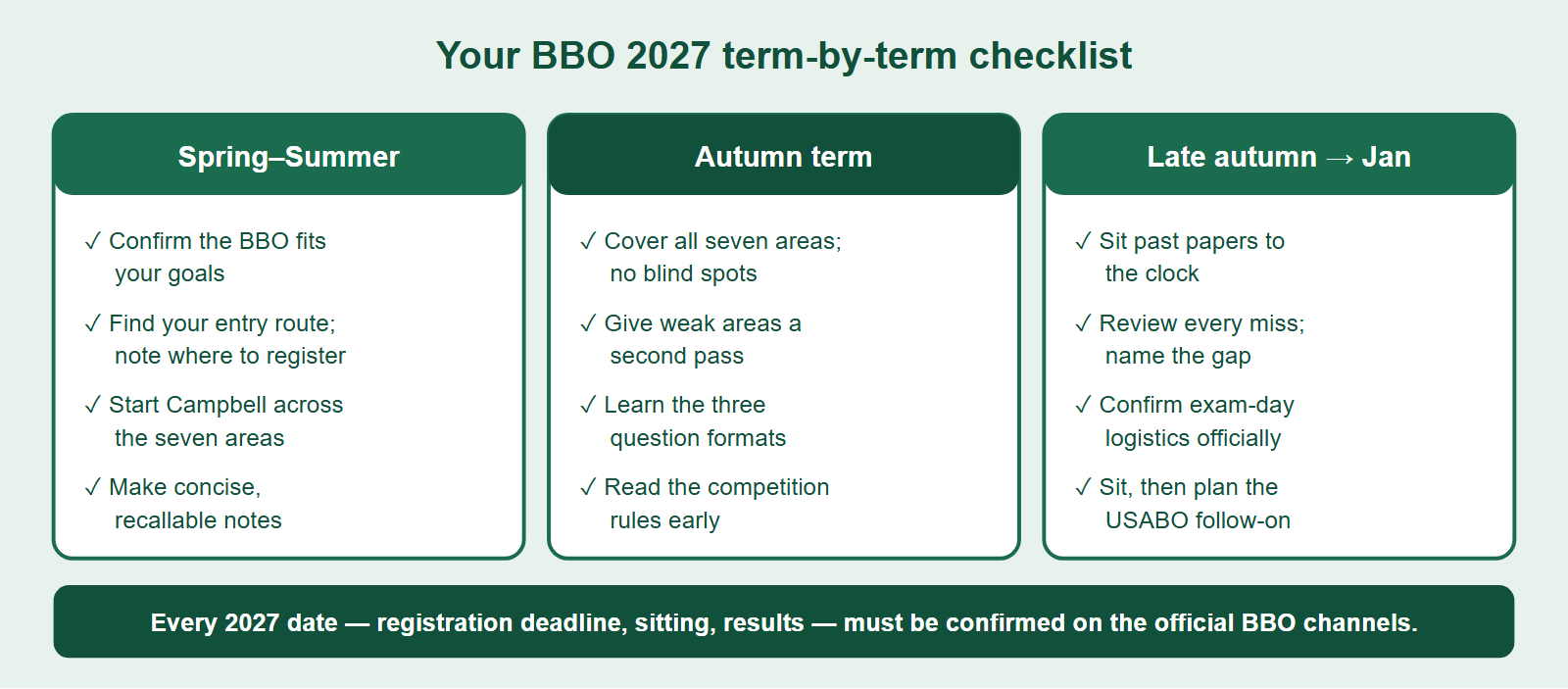
The earliest phase is about two decisions and one habit. First, decide whether the BBO genuinely fits your goals. It is a strong signal for biology, medicine and life-science applications, and it is excellent groundwork for the USABO, but it rewards depth of interest — if you are picking it up reluctantly, the months of breadth-building ahead will feel longer than they should. Second, work out your entry route. Whether you sit through a school, a registered centre, or the China-region arrangement, registration is run by the organiser and opens on the organiser’s timetable; do not assume last year’s window. Confirm how and when you can enter on the official channels, and do it early so a missed deadline never costs you the year.
The habit to start now is reading. The standard text is Campbell Biology, supported by AP and A-level resources. Beginning in spring or summer means you can read for understanding rather than panic, taking concise notes across the seven areas. If you are starting more or less from zero, our BBO study plan shows how to turn that reading into recall rather than just pages covered.
Autumn term: build breadth across the seven areas
With the foundation underway, the autumn term is for systematic breadth. The BBO ranges widely and moves quickly, so the danger is not lacking depth in one favourite topic — it is a blind spot in an area you quietly avoided. Work the seven areas deliberately: cell biology and genetics tend to carry a lot of weight, but plant physiology, ecology, animal behaviour and taxonomy all appear, and a clean sweep depends on none of them being a surprise on the day. Spread your strongest and weakest areas across the term so the weak ones get more than one pass.
This is also the term to read the exam’s shape, not just its content. The BBO is online with no lab component, and questions come as multiple-choice, fill-in, and ordering. Each format rewards a different reading habit, and getting fluent in all three is part of the autumn job, not an exam-week afterthought — a short, structured read of the competition rules early on means nothing about the format surprises you in January.
Late autumn to January: drill, time, and sit
As the sitting approaches, the work changes character. Knowledge is now mostly in place; the marginal marks come from speed and accuracy under time. That is built by timed past papers, reviewed honestly: for every question you missed, name whether it was a knowledge gap, a misread, or a pacing error, and let that decide what you drill next. This is the phase where a Gold separates from a Silver, and it is almost never about a missing topic.
On past papers, a note on honesty: there is no official free download, and we will not pretend otherwise. We keep a collected free BBO past-papers pack — scan the QR code on our past-papers page, or message us, to get it. Worked-solution coverage varies by year, and our teachers add more over time. Use the papers to rehearse pacing across a full sitting, not just to spot-check facts. Then, on exam day, confirm your own logistics — timing, platform and access — on the official channels, because those are administered by the organiser and are exactly the kind of detail you should never assume.
Build a two-medal year: BBO then USABO
One reason to plan early is that a single year of preparation can produce two results. The BBO and the USA Biology Olympiad (USABO) share roughly 90% of their content, and the USABO sits later — around late March. So a student who has built breadth for a January BBO is already most of the way to a USABO entry weeks later, with only a short top-up of the differences. If a two-medal year appeals, pencil the USABO into your plan from the start rather than treating it as a separate project; the BBO-then-USABO double-gold path sets out how the two slot together.
A point international and China-region students should plan around: you take the BBO for recognition against the published award boundaries, not as a route onto the UK’s International Biology Olympiad (IBO) team, which the BBO selects through a separate UK-based path. That does not lessen the value of the award — it simply sets the right expectation when you map your year. For how the China-region sitting works in practice, see our guide to the international and China-region exam.
Know what you are aiming at — but check this year’s numbers
BBO awards are decided by score against published boundaries — Gold, Silver, Bronze, and further tiers such as Highly Commended and Commended. As a rough orientation only, the 2024 boundaries sat near 113 for Gold, 103 for Silver and 96 for Bronze. Use those as a sense of scale when you plan, but never as a target to bank on: boundaries are re-set every year against how that year’s cohort performs, so confirm the current boundaries officially for your cycle. Planning to a fixed number from a past year is one of the easier ways to misjudge how close you are.
For scale, the BBO is large — last year over 15,000 students from more than 900 schools took part — which is a useful reminder that a clean, early plan is itself an edge in a big field. In our own coaching, that early structure shows up in results: across the 2026 season, Hanlin’s biology cohort earned 26 BBO Golds, 21 Silvers and 5 Bronzes, and five students reached the USABO US-region Semifinal (Hanlin’s own records). The biology behind those outcomes is standard; the difference was starting early enough to make the timed phase count.
Frequently asked questions
When is the BBO held for the 2027 cycle?
The BBO is usually a winter, January sitting — for reference, the 2026 China-region exam was on 17 January 2026 and the UK home competition ran 19–28 January 2026. The exact 2027 dates are set by the organiser; confirm them on the official BBO channels.
When should I start preparing?
Plan backwards from the January sitting: start the foundation in spring or summer of the previous year, build the seven syllabus areas through the autumn, and switch to timed past papers in late autumn. That is roughly nine to ten months of structured work.
How do I register for the BBO?
Registration is run by the organiser (through schools, registered centres, or the China-region arrangement) and opens on the organiser’s timetable. Check the route and deadline early — confirm on the official channels, and don’t assume last year’s window.
Can I do the BBO and the USABO in the same year?
Yes — they share about 90% of content and the USABO sits around late March, so one year of BBO preparation sets up a USABO entry weeks later with only a short top-up of the differences.
This is an independent English-language guide to the British Biology Olympiad for international and China-region students, operated by Hanlin Education. It is not affiliated with, endorsed by, or sponsored by UK Biology Competitions (UKBC) or the Royal Society of Biology. Rules, dates, eligibility and results are set by the organiser — always confirm current details through the official BBO channels.