
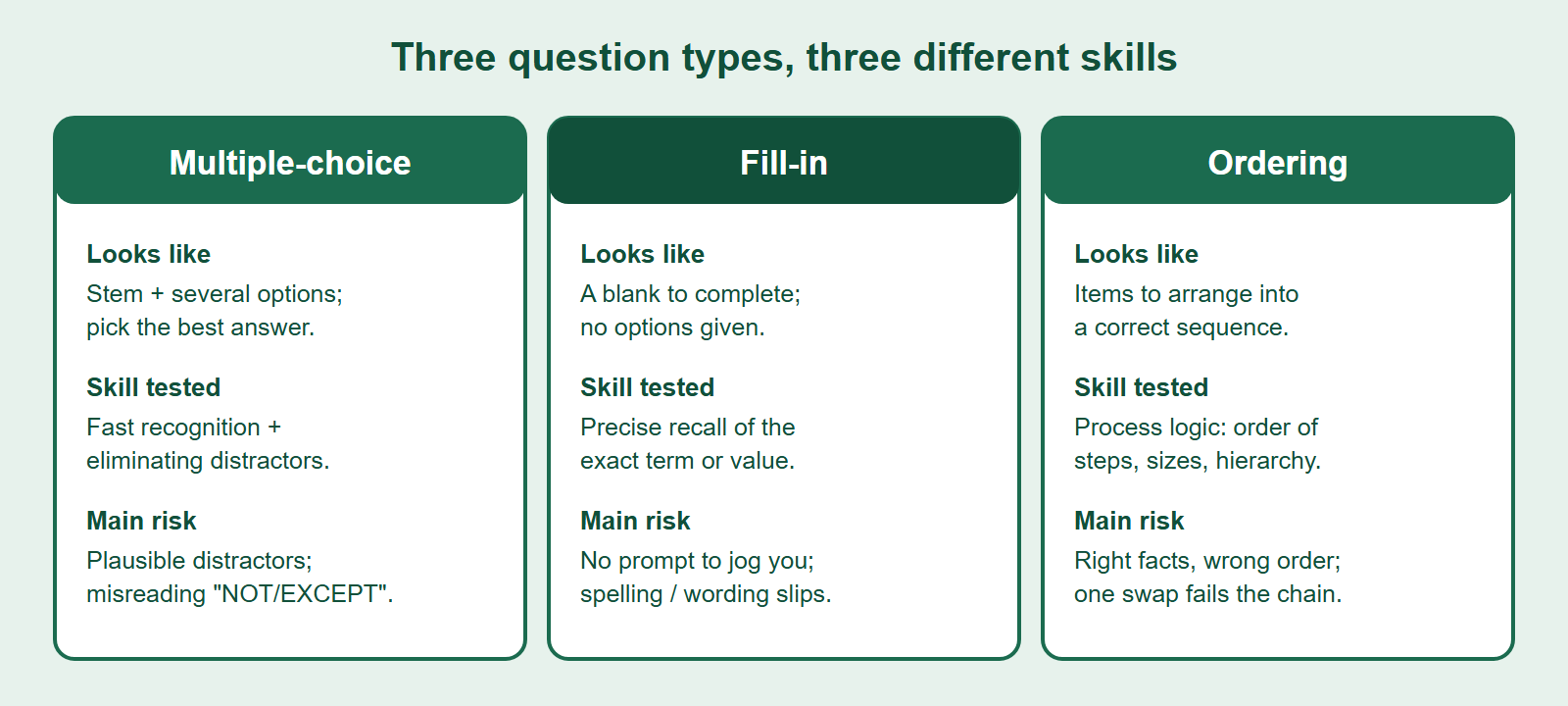
The British Biology Olympiad (BBO) is a short online exam with no lab component, built from three question formats: multiple-choice, fill-in, and ordering. Multiple-choice tests recognition under time; fill-in removes the safety net of options; ordering asks you to arrange steps or items into a correct sequence. Knowing how each behaves — and where each catches people out — is half the battle.
Why the format matters more than it looks
The BBO is organised by UK Biology Competitions (UKBC) / the Royal Society of Biology and aimed at sixth-form and high-school students with a strong interest in biology. Crucially, it rewards applying biology to unfamiliar problems, not rote recall. That design choice changes how each question type plays. A multiple-choice item is rarely a straight definition; a fill-in often hinges on a single precise term; an ordering question can be wrong even when you know every individual fact — because the sequence is the answer. Reading the three formats the same way is how strong biologists leave marks on the table.
Multiple-choice: recognition under pressure
Most BBO questions are multiple-choice: a stem followed by several options, where you select the best answer. Because the exam favours applied reasoning, the wrong options are usually plausible distractors — statements that are true in isolation but do not answer the stem, or that swap one mechanism for a near neighbour (think active vs facilitated transport, or mitosis vs meiosis outcomes). Your job is to spend more energy eliminating than searching for the perfect match.
Two reading habits save marks here. First, watch for negative stems — “which is NOT” or “all of the following EXCEPT” — which flip what a correct option means and are the single most common careless loss. Second, treat the options as data: if two options are mirror images, the answer is often one of them, and the question is really testing which direction you understand. Practising this on real papers from our BBO past-papers pack is the fastest way to learn the house style of the distractors.
Fill-in: no safety net
Fill-in questions ask you to complete a blank with no options to choose from. That removes the recognition crutch entirely: you cannot reverse-engineer the answer from the choices, so the term, structure name, or value has to come from memory — precisely. This is where shallow learning shows. You may “know” that a particular hormone regulates a process, but a fill-in wants the exact name, not a paraphrase.
Approach fill-ins by being decisive and literal. Write the most specific correct term you can justify, and keep it tight — a precise one- or two-word answer is safer than a vague sentence that might miss the intended word. If a fill-in references a number or convention you are not certain about, do not guess a fact you cannot anchor; on administration specifics (exactly how answers are entered or marked, for instance) always confirm on the official channels. Because fill-ins reward exact vocabulary, building from a college-level text such as Campbell Biology pays off more here than anywhere — see our BBO study plan for how to turn that reading into recall.
Ordering: the sequence is the answer
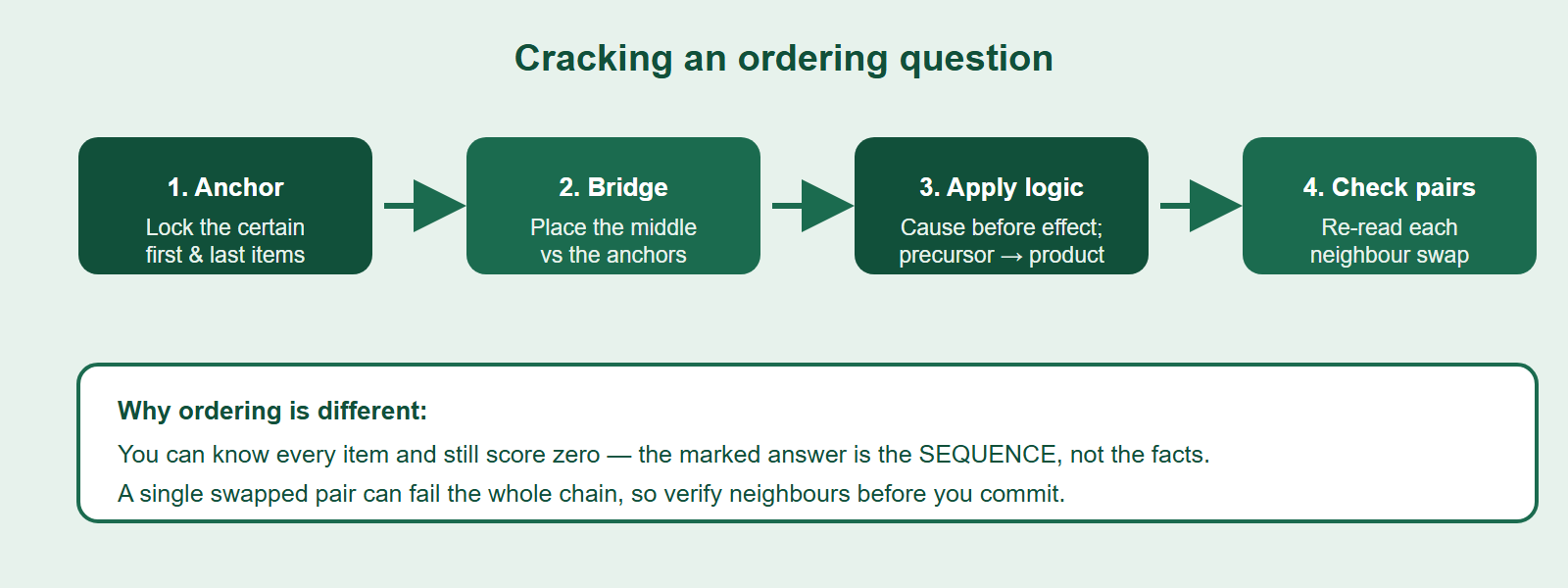
Ordering questions give you a set of items and ask you to arrange them correctly — the steps of a pathway, stages of a process, levels of a hierarchy, or a size/magnitude ranking. The trap is subtle: you can know every individual item and still score zero, because what is being marked is the relationship between them. One swapped pair can break the whole chain.
The method is different from the other two types. Do not order from the top down by guesswork; instead, anchor the parts you are certain of first — the definite first step and the definite last step — then place the middle relative to those anchors. Biology gives you logical handles: cause precedes effect, a precursor precedes its product, a smaller taxonomic rank nests inside a larger one. Sequences from the seven syllabus areas recur often, so drilling the classic chains (cell cycle, signal cascades, ecological succession, classification hierarchy) until the order is automatic is the highest-value ordering practice you can do.
One exam, three reading habits
Treat the three formats as three modes. On multiple-choice, eliminate and watch the negatives. On fill-in, be precise and decisive. On ordering, anchor-then-bridge and verify pairs. All three draw on the same seven core areas — cell biology, plant anatomy and physiology, animal anatomy and physiology, animal behaviour, genetics and evolution, ecology, and taxonomy — so your underlying biology, built from Campbell plus AP/A-level resources, serves every type. The format simply decides how that knowledge is examined.
Two final notes worth keeping straight. First, awards are decided by score against published boundaries — Gold, Silver, Bronze and further tiers such as Highly Commended and Commended — and those boundaries move every year (as a guide only, 2024 Gold sat around 113); confirm current boundaries officially. Second, the BBO’s question style is excellent preparation for the USABO, which shares roughly 90% of the content and sits in late March, so the same three-format fluency carries over — see the BBO-then-USABO double-gold path. International and China-region students take the BBO for recognition rather than the UK IBO team; the China-region exam is on 17 January 2026 (other years — confirm officially).
In our own coaching, format fluency is a measurable edge: across the 2026 season, Hanlin’s biology cohort earned 26 BBO Golds, 21 Silvers and 5 Bronzes, and five students reached the USABO US-region Semifinal (Hanlin’s own records). The biology behind those results is standard; the marginal marks came from reading each question type correctly under time.
Practise on the real thing. The fastest way to internalise these three formats is timed past papers. Our collected free BBO past-papers pack brings the papers together — scan the QR code on our past-papers page, or message us, to get it (worked-solution coverage varies by year, and our teachers add more over time).
Frequently asked questions
What question types does the BBO use?
Three: multiple-choice (pick the best option), fill-in (complete a blank with no options), and ordering (arrange items into the correct sequence). It is a short online exam with no lab component.
How is ordering different from multiple-choice?
In multiple-choice the answer is one correct option you can reach by elimination. In ordering, the marked answer is the whole sequence — you can know every item and still lose the mark if one pair is in the wrong order.
Why are fill-in questions harder than they look?
They give no options to recognise from, so you must recall the exact term or value precisely. Build that exact vocabulary from a college-level text like Campbell Biology; for how answers are entered and marked, confirm on the official channels.
Where can I practise these formats?
Timed past papers are best. Our collected free past-papers pack gathers the BBO papers; scan the QR code or message us to receive it, with worked solutions for many years.
This is an independent English-language guide to the British Biology Olympiad for international and China-region students, operated by Hanlin Education. It is not affiliated with, endorsed by, or sponsored by UK Biology Competitions (UKBC) or the Royal Society of Biology. Rules, dates, eligibility and results are set by the organiser — always confirm current details through the official BBO channels.