
Two kinds of British Biology Olympiad (BBO) question cost strong students more marks than any others: ordering/sequencing items, where the whole sequence is the answer, and data-interpretation items, where a graph, table or figure carries the information you need. Both punish rushing and reward a fixed method. This guide gives you one repeatable method for each, the traps to expect, the elimination logic that saves time, and how to control the clock on them.
Why these two formats are where marks leak
The BBO is organised by UK Biology Competitions (UKBC) / the Royal Society of Biology for sixth-form and high-school students, and it is a short, timed online exam with no lab component. Its confirmed formats include multiple-choice, fill-in and ordering/sequencing; alongside straight recall, questions frequently ask you to read information from a graph, table or figure and reason from it. That second style — data interpretation — can appear inside a multiple-choice or fill-in question rather than as a separate labelled section; for the exact structure of your sitting, confirm on the official BBO channels.
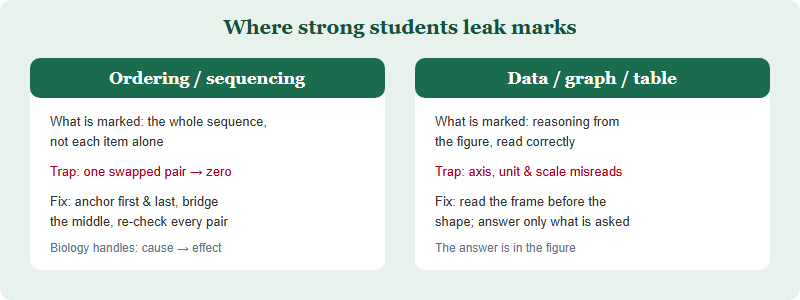
Here is the pattern we see in coaching. On recall questions, a well-prepared student either knows it or does not, and moves on. On ordering and data questions, the same student knows all the underlying biology and still drops the mark — because ordering marks the relationships between items, and data questions mark whether you read the figure correctly before you reason. The biology is not the bottleneck; the reading habit is. Fix the habit and these become some of the most reliable marks on the paper, because the answer is sitting in front of you.
Ordering questions: anchor, bridge, verify
An ordering question hands you a set of items — steps of a pathway, stages of a process, levels of a hierarchy, or a ranking by size or magnitude — and asks you to arrange them correctly. Because the mark is the sequence, guessing top-to-bottom is the worst possible approach: a single early mistake cascades. Use a three-move method instead.
- Anchor. Identify the one item you are certain comes first and the one you are certain comes last, and lock them. These are your fixed points; everything else is placed relative to them.
- Bridge. Fill the middle using biological logic rather than memory of a list: a precursor comes before its product, a cause before its effect, a smaller taxonomic rank nests inside a larger one, a signal comes before the response it triggers. Ask “what has to be true before the next step can happen?” at each gap.
- Verify pairs. Before you commit, check every neighbouring pair in isolation: is A really immediately before B? Pairwise checking catches the one inversion that would otherwise break the chain.
The elimination logic is different from multiple-choice. If the question is presented as ordered options (several candidate sequences to choose from), you rarely need the full order to eliminate: find one pair you are sure about — say, that step X must precede step Y — and strike out every option that violates it. Two confident relationships usually reduce four or five candidate orders to one. That turns an intimidating sequence into a couple of true/false checks.
The highest-value preparation here is drilling the recurring chains from the seven core areas until their order is automatic — the cell cycle and its checkpoints, signal cascades, stages of respiration and photosynthesis, ecological succession, and the classification hierarchy. When the canonical order is reflex, you spend your exam time on the unfamiliar twist the question adds, not on rebuilding the backbone. The broader format map is covered in our BBO question-types overview; this guide is the deep-dive on the hard two.
Data-interpretation questions: read the frame before the shape
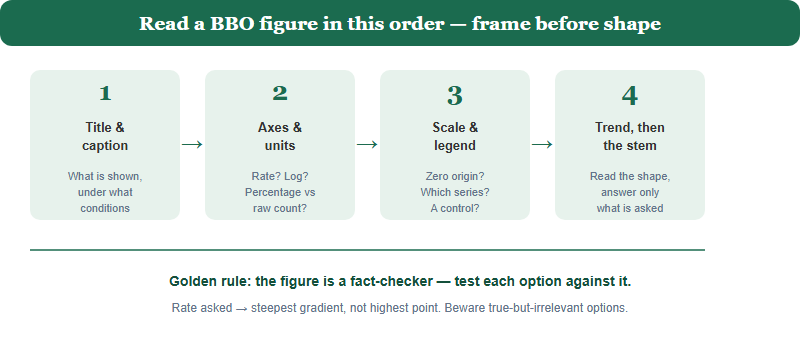
A data question shows you a graph, table or figure and asks you to reason from it. The instinct is to look at the shape of a curve or the biggest number and answer fast. That instinct is exactly what the question is testing — and where the traps live. Discipline yourself to read the frame first, in a fixed order, every time:
- Title and caption — what is this figure actually showing, and under what conditions?
- Axes and units — what is on each axis, in what units, and is any axis a rate, a log scale, or a percentage rather than a raw count?
- Scale and origin — does the axis start at zero? A truncated axis makes a small change look dramatic.
- Legend and series — which line, bar or column is which group, and is there a control to compare against?
Only after the frame is clear do you read the shape: the trend, the turning points, where two series cross, and whether a relationship is correlation or a controlled difference. Then — and this is the mark-saving step — answer only the question asked. Data questions frequently supply more information than any single sub-question needs, precisely to tempt you into reasoning about the wrong variable. If the stem asks about the rate of change, the steepest gradient is your answer, not the highest point; if it asks which group differs from the control, comparisons between two treatment groups are a distractor.
Elimination logic on data questions is powerful because the figure is a fact-checker. Test each option directly against the graph or table: an option that claims a rise where the data plateau, or that confuses an absolute value with a change, can be struck out with one glance. A common BBO-style trap is the true-but-irrelevant option — a statement that is genuinely correct biology, and even consistent with the figure, but does not answer the specific stem. Reading the stem twice, once before and once after you read the figure, is the cheapest way to avoid it.
The traps, side by side
Most losses on these two formats come from a short, predictable list. Knowing the trap by name is half the defence — you start to feel it coming.
| Format | Common trap | What it looks like | Defence |
|---|---|---|---|
| Ordering | Cascade from a bad start | One early item misplaced pulls the rest out | Anchor first & last before placing the middle |
| Ordering | Right items, wrong direction | Sequence reversed (e.g. product before precursor) | Use cause → effect logic, not list memory |
| Ordering | Adjacent swap | Two neighbours transposed near the end | Verify every neighbouring pair before committing |
| Data | Axis / unit misread | Reading a rate as a total, or a log scale as linear | Read the frame (axes, units, scale) first |
| Data | Truncated-axis illusion | A tiny change looks huge on a non-zero axis | Check the origin before judging magnitude |
| Data | True-but-irrelevant option | Correct biology that does not answer the stem | Re-read the stem after reading the figure |
Time management on the hard two
The BBO is short and tight, so how you spend seconds on these questions matters. Two principles keep them from eating the clock. First, these formats reward a small, fixed upfront investment: the five seconds you spend reading a graph's axes, or locking an ordering question's first and last anchors, are the cheapest marks on the paper because they prevent a confident wrong answer. Skipping that step to “save time” is the false economy that produces careless losses.
Second, cap your losses. Ordering questions in particular can suck you into re-arranging endlessly. Decide a personal ceiling — place your anchors, bridge once, verify pairs once, and if it is still not resolving, take your best-supported order and move on rather than burning minutes. The exam does not publish a fixed question count you can plan around, so pace by time blocks, not by question number, and treat these harder items as points to return to if a block ends. Our fuller clock strategy is in the BBO pacing guide; the technique here is what makes each of those minutes convert.
One structural note to keep the stakes clear: awards are decided by score against published boundaries — Gold, Silver, Bronze and further tiers such as Highly Commended and Commended — and those boundaries move every year (as a rough guide only, 2024 Gold sat around 113). Confirm the current boundaries, and the exact format and length of your sitting, on the official BBO channels. Because the BBO shares roughly 90% of its content with the USABO, this same ordering-and-data fluency carries straight into that exam; the reasoning style transfers even where the paper differs.
How to practise this, not just read it
Technique only sticks under a clock. The fastest way to internalise anchor-bridge-verify and read-the-frame-first is timed past papers, where you meet the real house style of BBO ordering and data questions and train the habits until they are automatic. Do not simply mark right or wrong: for every ordering or data question you miss, write down which trap caught you from the table above — that error log is where the improvement comes from. In our own coaching, this format-specific drilling is a measurable edge; across the 2026 season Hanlin's biology cohort earned 26 BBO Golds, 21 Silvers and 5 Bronzes (Hanlin's own records). The biology behind those results is standard; the marginal marks came from reading these two hard formats correctly under time.
Practise on the real thing. Our collected free BBO past-papers pack gathers the papers so you can drill ordering and data questions to the clock — scan the QR code on our past-papers page, or message us, to get it (worked-solution coverage varies by year, and our teachers add more over time). If you are still deciding where you sit in the wider picture, start from the BBO guide home page.
Frequently asked questions
How do I approach a BBO ordering question?
Anchor the items you are sure are first and last, bridge the middle with biological logic (cause before effect), then verify every neighbouring pair before you commit.
What is the biggest trap in BBO data questions?
Misreading the frame — the axes, units and whether the origin is zero — then answering the wrong variable. Read the figure's frame before its shape, and answer only what the stem asks.
Does the BBO have a separate data-interpretation section?
Data reading can appear within multiple-choice or fill-in questions rather than as a labelled section. For the exact structure of your sitting, confirm on the official BBO channels.
How much time should one hard question take?
Cap it: place anchors or read the frame once, reason once, then move on. Pace by time blocks, not question number, and return to unresolved items later.
This is an independent English-language guide to the British Biology Olympiad for international and China-region students, operated by Hanlin Education. It is not affiliated with, endorsed by, or sponsored by UK Biology Competitions (UKBC) or the Royal Society of Biology. The syllabus scope and score boundaries change each year — confirm current details through the official BBO channels. Any errors will be corrected within 7 working days.