
UK Biology Competitions runs three papers, not one. Alongside the British Biology Olympiad in January, it runs the Biology Challenge for younger students and the Intermediate Biology Olympiad in June for Year 12. A Year 12 student is eligible for both the BBO and the Intermediate in the same academic year, and almost nobody outside the UK realises it.
Three papers, one ladder
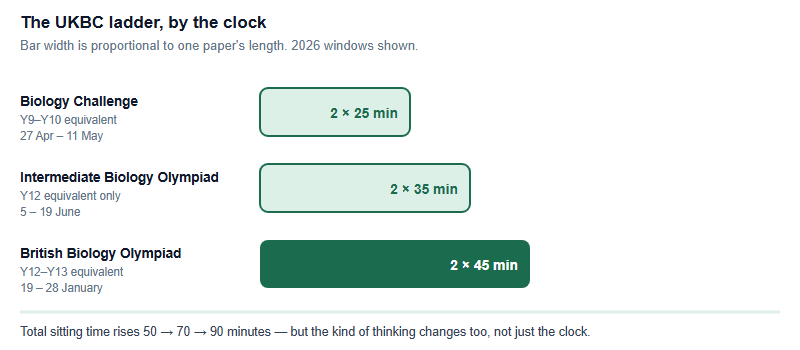
Most guides written for international students treat the BBO as a standalone event. It is not. It sits at the top of a three-rung UKBC ladder, and the rungs are separated by more than difficulty — they differ in year group, month, paper length and, most importantly, in what they are built to test.
Here is what UKBC publishes for the 2026 season across all three.
| Competition | Year groups | Format | 2026 window | Built on | Fee |
|---|---|---|---|---|---|
| Biology Challenge | Y9/Y10 England & Wales; Y10/Y11 Northern Ireland; S2/S3 Scotland; “equivalent year groups worldwide” | Two 25-minute multiple-choice papers, online; both papers required for an award | 27 April – 11 May | School-curriculum biology, rewarding broader biological knowledge | £30 per school |
| Intermediate Biology Olympiad | Y12 England & Wales; Y13 Northern Ireland; S5 Scotland; “equivalent year groups worldwide” | Two 35-minute papers, online | 5 – 19 June | “Topics students are likely to have covered at GCSE and in their first year of A level”, with “some additional ideas” introduced that require problem solving and core principles | £30 per school |
| British Biology Olympiad | Y12/Y13 England & Wales; Y13/Y14 Northern Ireland; S5/S6 Scotland; equivalent year groups in other countries | Two 45-minute multiple-choice papers, online while on-site; both papers required; no practical component | 19 – 28 January | “Not primarily a test of knowledge” — unfamiliar topics, basic principles applied | Free to UK schools; £30 for schools outside the UK, unlimited students |
Two things in that table are worth pausing on. The first is the phrase “equivalent year groups worldwide”, which UKBC uses for the Challenge and the Intermediate and which mirrors the equivalent-year wording on the BBO page. Your school's own label — DP1, AS, Grade 11 — is not the label on the page, so the mapping is a question for your biology department and for UKBC, not something to assume.
The second is that the fee structure is identical for the two lower papers and unusual for the BBO: free for UK schools, £30 for a school outside the UK to enter an unlimited number of students. For an international school, that means the marginal cost of entering a second, third or thirtieth student is zero. It also means the entry decision is a school decision, not a student one: UKBC states that only recognised educational institutions may register candidates, and that private tutoring companies and individuals cannot.
The real difference is not difficulty — it is what is being tested
Students assume the three papers are the same exam at three levels of hardness. They are not, and the distinction shows up in UKBC's own descriptions.
The Intermediate Biology Olympiad is described as covering “topics students are likely to have covered at GCSE and in their first year of A level”. That is a largely syllabus-anchored paper, so much of it can be revised for in the ordinary sense: identify the topic list, close the gaps, practise recall and application on material you have been taught. UKBC adds, though, that “some additional ideas will be introduced requiring their problem solving skills and understanding of core principals”, so it is not purely a coverage test.
The BBO leans much further in that second direction. UKBC states that it is “not primarily a test of knowledge”, that “students will be presented with topics and ideas which they are not familiar with”, and that they are expected to apply basic principles to that unfamiliar material. You cannot revise your way to a comfortable position on a paper whose design point is that some of it will be new to everyone.
That difference has a practical consequence most planning advice misses. Preparation that works for one does not fully transfer to the other. Grinding the seven BBO content areas — cell biology, plant anatomy and physiology, animal anatomy and physiology, animal behaviour, genetics and evolution, ecology, taxonomy — builds the base for both, but the Intermediate weights coverage more heavily, while the BBO leans hardest on the reasoning you do when coverage runs out. Our guide to preparing for the BBO sequences those two kinds of work rather than treating them as one.
There is a second consequence, and it is the argument for sitting both. A mostly syllabus-anchored paper is a useful audit of whether the year's teaching landed. A paper built mainly on unfamiliar material audits whether you can think when the ground shifts. The emphasis differs, even though UKBC says both involve applying core principles, and a student who only ever sits one of them is only ever measuring half of what a competitive biology application rests on.
The Year 12 pairing: January and June in one academic year
Line up the eligibility rules and something useful falls out. A student in the Y12-equivalent year is eligible for the BBO, which runs in January, and for the Intermediate, which runs in June. Both fall inside the same academic year.
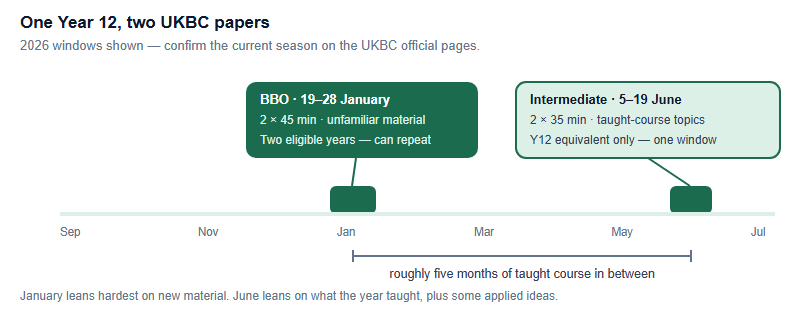
Three reasons that pairing is worth considering, and one reason to be careful.
- It closes a long gap. A student who sits only the January BBO in Year 12 then goes roughly a year without another timed biology paper under external conditions. In our own coaching records, that gap is where January's diagnosis quietly evaporates — the error log gets written, the term gets busy, and nothing tests whether the fixes stuck.
- The June window sits in a different part of the school year. A January olympiad competes with mocks and internal assessments. A June one falls after AP and IB written exams have finished, though it can catch the tail of an A-Level series. Check it against your own timetable rather than assuming it is clear.
- It is a fair test of the taught year. Because the Intermediate is set mainly on GCSE and first-year A-level content, a weak result in June often points fairly directly at coverage — far easier to act on than a mid-table BBO score, which could mean thin content, slow retrieval or unfamiliar phrasing.
- But the Intermediate is a single window for most students. UKBC lists it for the Y12-equivalent year only, where the BBO spans two years. If your school does not run it in the year you are eligible, there is no second chance the following June.
If you are weighing the June Intermediate against a spring push toward a second olympiad, note that these are different kinds of commitment. Our BBO-then-USABO plan covers what the two-competition route actually demands of a spring, and the Intermediate is a much lighter addition than that sequence.
A naming warning: two different things are called “IBO”
This trips up a genuinely large number of students, so it is worth stating plainly.
Intermediate Biology Olympiad is a UKBC competition sat in June by Year 12 students, over two 35-minute online papers, for a £30 school fee. International Biology Olympiad is the global competition that national teams are selected for. Both get shortened to “IBO” in forum posts, agency marketing and even in some school newsletters.
The consequences of the confusion run in both directions. A student who reads “IBO” and pictures the international competition concludes the June paper is out of reach and does not enter. A student who reads it the other way concludes that entering a £30 school paper puts them on a national-team pathway, which it does not. Nothing on the UKBC Intermediate page states that it feeds team selection, and we are not going to imply that it does — if progression matters to you, confirm the route on the UKBC official pages rather than on the strength of an abbreviation.
Write the name out in full whenever it matters. It is a clumsy habit that will save you a planning error.
What to check before you plan around any of this
Four checks, in order, and the first two are not optional.
1. Does your school run the Intermediate at all? This is the check most likely to end the conversation. Many international schools enter the BBO because it is the one they have heard of, and have never looked at the other two papers. Registration is institutional either way — UKBC requires a recognised educational institution, and both lower papers carry a £30 school fee — so it is a departmental decision that someone has to actually make. September is the month to ask.
2. Is it available on your regional route? Our own coverage of the China-region BBO sitting explains how the international route works for the January paper. Whether the same route offers the Intermediate is a separate question that we cannot answer from the official pages, and you should not assume it does. Ask your school and confirm on the UKBC official pages.
3. Can your school meet the supervision rule? UKBC is unusually blunt here. Papers must be sat under the direct supervision of staff on the institution's physical premises; on the Intermediate page, remote invigilation is not permitted under any circumstances, and on the Biology Challenge page remote supervision will result in disqualification. If your plan involves sitting anything at home, there is no plan.
4. Are this season's dates confirmed? Every window on this page is from the 2026 season. Next season's dates are not confirmed here. Confirm them on the UKBC official pages before you build a revision calendar, and re-check in the autumn, because windows move.
For the practice half of all this, we keep our own gathered pack of past papers with worked solutions for some of the years, plus our own topic notes and vocabulary lists. The most useful thing you can do this month is not to decide between the three papers — it is to sit one timed paper properly and find out which of them you are actually ready for.
Frequently asked questions
What is the Intermediate Biology Olympiad?
A UKBC competition for the Y12-equivalent year: two 35-minute online papers, sat 5–19 June 2026, £30 per school. Confirm on the official pages.
Can I sit both the BBO and the Intermediate in one year?
Both list the Y12-equivalent year as eligible, and they fall in January and June of the same year. Whether your school runs both is the real question.
Is the Intermediate the same as the International Biology Olympiad?
No. They are different competitions that share the abbreviation IBO. Nothing on the UKBC page states the Intermediate feeds team selection.
Can I enter the Intermediate myself if my school does not?
No. UKBC states only recognised educational institutions may register candidates; individuals and tutoring companies cannot.
This is an independent guide operated by Hanlin Education for China-based international-school students. We are not affiliated with, endorsed by, or sponsored by UK Biology Competitions (UKBC) or the Royal Society of Biology, and official competition administration rests with the organiser. Eligibility, dates, fees, formats, supervision rules and award boundaries change between seasons — confirm current details on the UKBC official pages before acting on anything here. Cohort observations are our own de-identified records, per Hanlin; results vary and no award or outcome is guaranteed. Errors reported to us are corrected within 7 working days.