
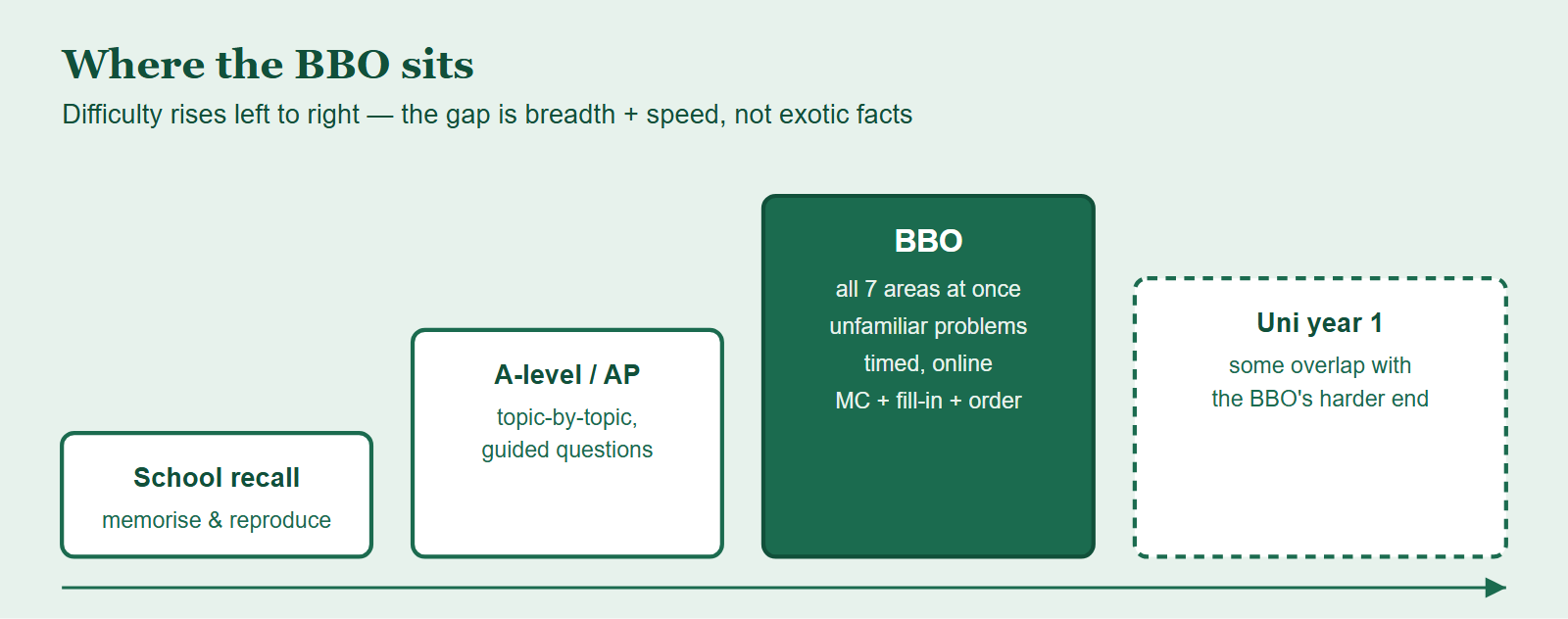
How hard is the BBO, really? Honestly: harder than A-level or AP biology, but not because the facts are exotic. The British Biology Olympiad is an online exam that rewards applying biology to unfamiliar problems across seven broad areas, under time pressure. The content sits at strong A-level/AP level plus some first-year university material — the difficulty is breadth and speed, not obscurity.
The short answer: a step up, not a different planet
Plenty of students arrive expecting the BBO to be a wall of facts no school covers. It isn’t. The British Biology Olympiad — run by UK Biology Competitions (UKBC) under the Royal Society of Biology — is designed for sixth-form and high-school students with a strong interest in biology, and it explicitly rewards applying biology to unfamiliar problems rather than rote recall.
That single design choice is the whole story of its difficulty. If you have studied biology well at A-level or AP, you have met most of the underlying concepts. What the BBO asks is whether you can take those concepts into a question you have never seen, reason through it, and do so quickly — because it is a short online paper with no lab component, mixing multiple-choice, fill-in, and ordering questions.
Where it sits versus A-level and AP
The BBO’s seven core syllabus areas are: cell biology; plant anatomy and physiology; animal anatomy and physiology; animal behaviour; genetics and evolution; ecology; and taxonomy. Taken together, this maps onto a strong A-level or AP biology course, with some first-year university material layered on top.
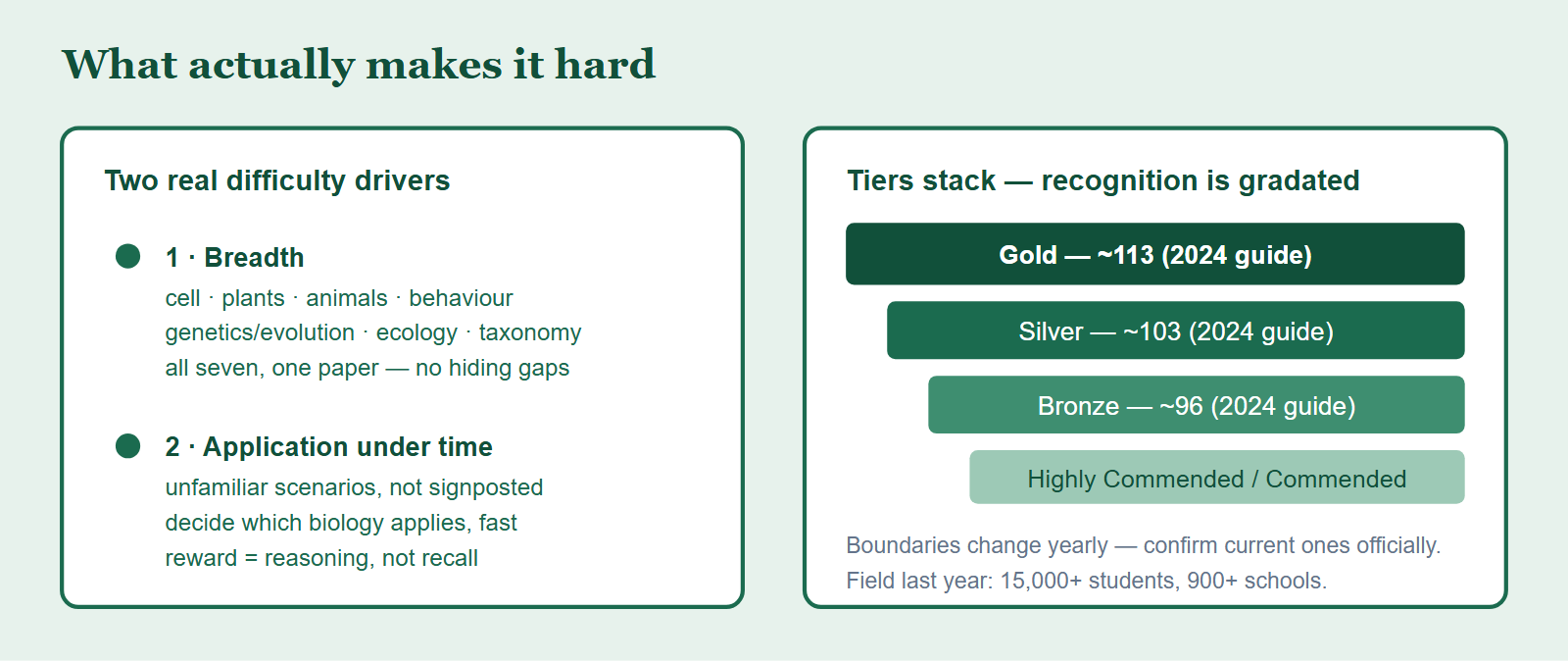
So the raw difficulty of any single fact is usually “A-level, maybe a notch above.” The jump comes from two things your school exams rarely test at once:
- Breadth. A-level and AP let you prepare topic by topic. The BBO can pull from all seven areas in one sitting, so a weak spot in, say, plant physiology or taxonomy has nowhere to hide.
- Application under time. School questions often signal exactly which concept to use. BBO questions hand you an unfamiliar scenario and expect you to decide which biology applies — then move on fast.
Why “online, no lab” doesn’t mean “easy”
A common misread: because the BBO is a short online exam with no practical lab, it must be gentle. The format actually concentrates the difficulty. There is no coursework to buffer your score and no lab session to show different strengths — everything rides on a single timed paper. Multiple-choice rewards confident elimination, fill-in punishes vague half-knowledge, and ordering questions test whether you truly understand a process (a sequence, a pathway, a hierarchy) rather than a single fact about it.
In other words, the format strips away the places where weaker preparation usually hides. That is exactly why it discriminates well between students who have merely revised and students who can reason.
What the scores tell you about difficulty
Awards are given by score against published boundaries — Gold, Silver, Bronze, and further tiers such as Highly Commended and Commended. As a rough guide, 2024 boundaries were around 113 for Gold, 103 for Silver, and 96 for Bronze. Treat those as illustrative only: boundaries move every year, so always confirm current boundaries officially.
The useful takeaway from boundaries isn’t the exact number — it’s the shape. Because tiers stack from Commended up to Gold, the paper is built so that a keen biologist can earn some recognition while the top of the paper stays genuinely hard. You do not need a perfect score to come away with a medal, which is encouraging; you do need real fluency to reach Gold. With roughly 15,000+ students from 900+ schools taking part last year, the boundaries also sit within a large, competitive field.
Who tends to do well
From coaching China-region and international students, a pattern repeats. The students who do well are rarely the ones who memorised the most — they are the ones who:
- Have genuine breadth. They are comfortable in plants and taxonomy, not just the popular human-physiology and genetics topics, so no whole syllabus area is a blind spot.
- Practise reasoning, not recall. They have trained on unfamiliar problems — working through past-style questions and explaining why an answer is right — rather than re-reading notes.
- Manage time and uncertainty. They make decisions under the clock, skip-and-return sensibly, and aren’t rattled by a question type (ordering, fill-in) that punishes hesitation.
- Read a serious text properly. Campbell Biology, alongside AP/A-level resources, gives the conceptual depth that turns “I’ve heard of this” into “I can reason about this.”
For context on what to do with all that fluency: the BBO and the USA Biology Olympiad (USABO) share roughly 90% of their content, and USABO sits in late March — so the same preparation can serve two competitions in one season (see our BBO → USABO double-gold route). Note one eligibility point: the BBO selects the UK’s International Biology Olympiad (IBO) team via a separate UK-based path; international students take part for BBO recognition, not the UK IBO team. For exactly how the China-region sitting works, see the international & China-region exam guide, and always confirm registration and eligibility on the official channels.
So — is it worth attempting?
If you genuinely enjoy biology and are studying it seriously, yes. The BBO is hard in the most useful way: it asks you to think with biology rather than recite it, and the gradated tiers mean strong effort is recognised even short of Gold. The honest preparation question isn’t “can I learn enough facts?” — it’s “can I apply what I know to problems I’ve never seen, quickly, across all seven areas?”
To calibrate where you stand, work through real past-style questions before you decide it’s too hard (or too easy). We’ve put together a free pack of collected BBO past papers — scan the QR in the site footer or message us to get it. Worked-solution coverage varies by year, and our teachers add more over time. Then map a study plan with how to prepare for the BBO, and check format details against the competition rules.
FAQ
Is the BBO harder than A-level or AP biology?
Yes, but mainly because of breadth and speed rather than harder facts. Its seven syllabus areas map onto strong A-level/AP biology plus some first-year university material, and it rewards applying biology to unfamiliar problems under time — not rote recall.
Do I need to know more than my school syllabus to get a medal?
You need fluency, not encyclopaedic recall. Awards run on a stacked scale from Commended up to Gold against published boundaries, so a keen biologist can earn recognition without a perfect score; Gold demands real reasoning ability. Boundaries change yearly — confirm current ones officially.
Does “online, no lab” make the BBO easier?
No. With no coursework or practical to balance your score, everything rests on one short timed paper of multiple-choice, fill-in, and ordering questions. The format concentrates the difficulty by removing the places weaker preparation usually hides.
Can international students enter, and does it count toward the UK IBO team?
International and China-region students take part for BBO recognition. The UK’s International Biology Olympiad team is selected via a separate UK-based path, so the IBO team route is not open to international entrants. Confirm registration and eligibility on the official BBO channels.
This is an independent English-language guide to the British Biology Olympiad for international and China-region students, operated by Hanlin Education. It is not affiliated with, endorsed by, or sponsored by UK Biology Competitions (UKBC) or the Royal Society of Biology. Rules, dates, eligibility and results are set by the organiser — always confirm current details through the official BBO channels.