
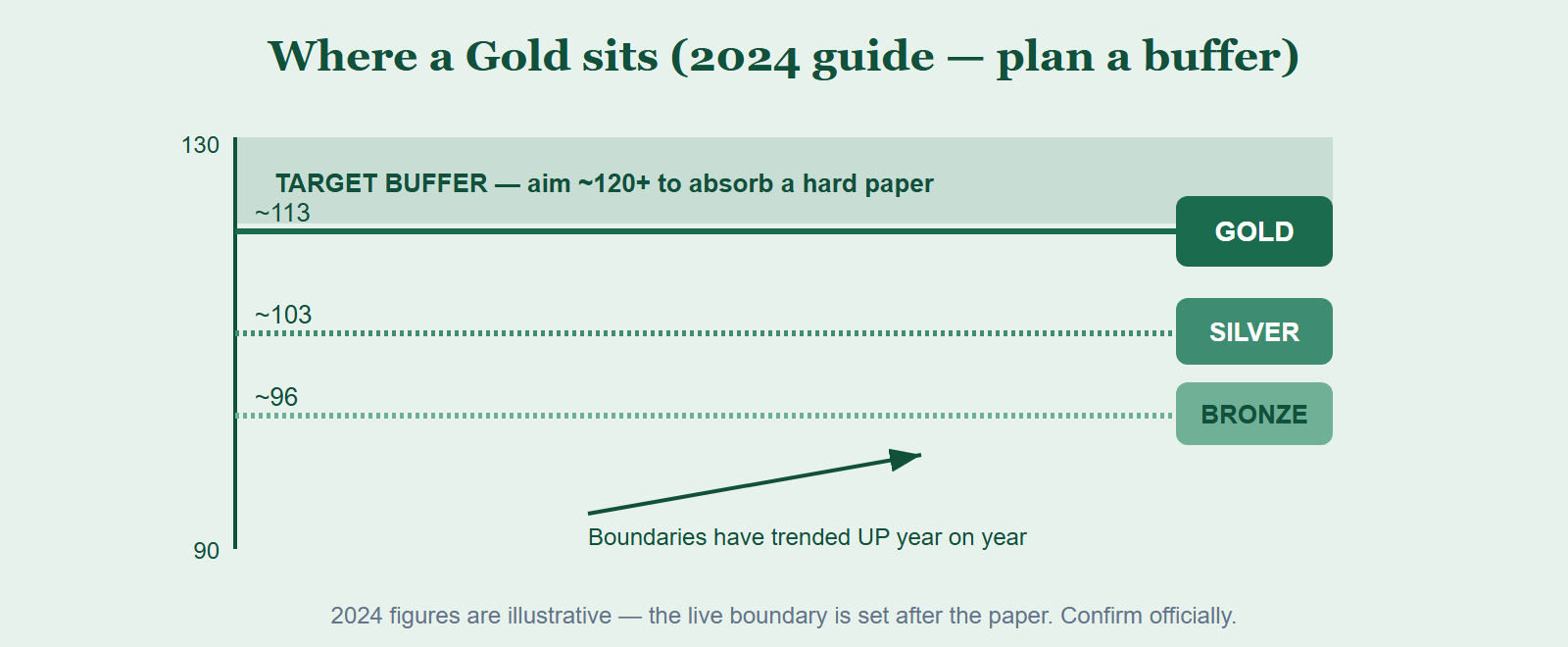
As a working guide, a BBO Gold in 2024 took roughly 113 points (Silver ~103, Bronze ~96). But the British Biology Olympiad sets boundaries after each paper is sat, and they have been climbing as the field grows — so treat 113 as a target to plan around, not a guarantee, and confirm the current boundary on the official BBO channels.
The short answer: aim well past 113, not exactly at it
There is no fixed “Gold number.” BBO awards are decided by score against published boundaries, and those boundaries are released each season after the papers are marked — the organiser’s own results page notes that recent boundaries have “climbed, reflecting a stronger, larger field.” The most useful anchor we have is the 2024 guide: approximately 113 for Gold, 103 for Silver, and 96 for Bronze. Because the trend is upward and the cut-off is unknown until results day, the right mindset is to build a buffer: prepare to score in the 120s so a Gold-level performance survives a tougher-than-expected paper. Plan for the buffer, confirm the live boundary, and never assume last year’s number carries over.
Why the Gold boundary moves — and what that means for you
The boundary is not a passing mark set in advance; it is calibrated to the cohort. With more than 15,000 students from over 900 schools sitting recently, a larger and stronger field tends to push the Gold cut-off upward. That is why a number that earned Gold one year can fall short the next. Two practical takeaways follow. First, relative performance matters: you are effectively competing to land in the top band, so consistency across all question types counts. Second, because the BBO rewards applying biology to unfamiliar problems rather than recall, raw memorisation plateaus quickly — the points that separate Silver from Gold usually come from data interpretation and reasoning under time pressure, not from one more fact learned.
How the marks are actually won
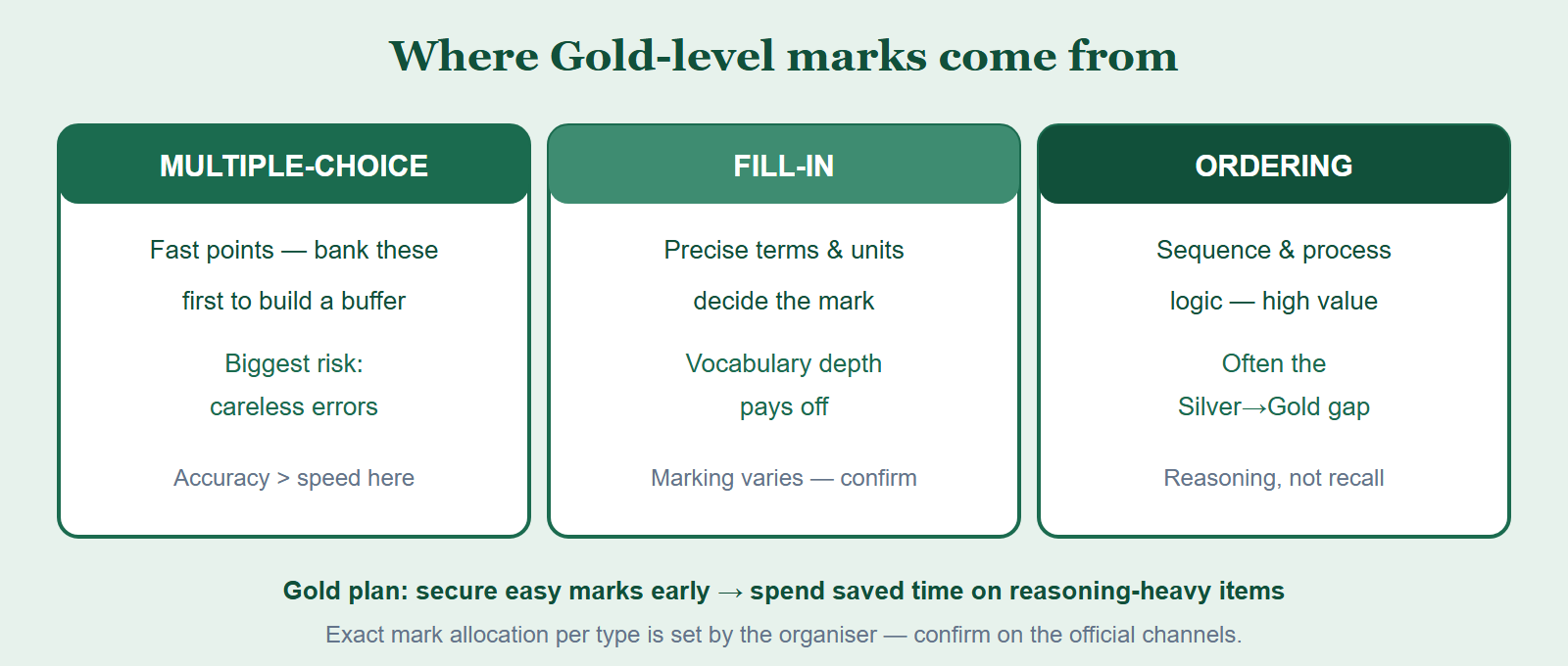
The BBO is a short online exam with no lab component, built from three question types: multiple-choice, fill-in, and ordering. Each behaves differently when you are chasing a Gold-level total, and knowing the difference is where a score plan earns its keep.
The exam ranges across seven core syllabus areas — cell biology; plant anatomy & physiology; animal anatomy & physiology; animal behaviour; genetics & evolution; ecology; and taxonomy — which together map onto a strong A-level / AP biology course plus some first-year university material. A Gold-level total is rarely built by mastering one area; it is built by having no weak area to bleed marks from. The standard text is Campbell Biology, supported by AP and A-level resources.
A score plan that targets Gold
Treating the ~113 figure as a planning anchor, here is how strong candidates close the gap to it:
- Set your working target above the guide. Aim to score in the 120s in practice so a real Gold boundary — even a risen one — sits comfortably below your level.
- Diagnose with real papers. Sit a full BBO paper under time, mark it, and find which of the seven areas and which question types are costing you. The gap to Gold is almost always concentrated, not spread evenly.
- Convert reasoning into reflex. Because the exam tests application, drill unfamiliar data-interpretation and ordering items until the method is automatic. This is the reliable Silver→Gold lift.
- Protect easy marks. A Gold total is as much about not dropping multiple-choice points to carelessness as it is about cracking the hard items.
- Confirm the live boundary. Each season’s real cut-off is published after results — check it on the official channels rather than assuming the prior year carries over.
Across our own 2026 season, Hanlin’s biology cohort earned 26 BBO golds, 21 silvers and 5 bronzes, and 5 students reached the USABO US-region Semifinal (per our own records). The Golds had one thing in common: they walked in able to score well clear of a typical boundary, so a hard paper never put the medal in doubt.
One more lever: a Gold-ready BBO score doubles as USABO prep
If you are putting in the work to clear a Gold boundary, you are also building most of what the USA Biology Olympiad (USABO) needs — the two share roughly 90% of their content, and USABO sits in late March, after the January BBO. That means a single, well-aimed preparation block can target two results in one season; we map that route in the BBO-then-USABO double-gold strategy. One distinction to keep straight: the BBO selects the UK’s International Biology Olympiad (IBO) team through a separate, UK-based path, so international and China-region students take part for BBO recognition, not for a place on the UK IBO team — we explain that fully in our guide to the BBO international / China-region exam.
Practise against a real boundary
You cannot judge whether you are Gold-ready in the abstract — you have to score a real paper and compare. We have collected a free BBO past-papers pack (papers, answer keys and topic notes), with worked-solution coverage that varies by year — our teachers add more over time. It is not an official download; it is our own gathered set. Scan the QR code on our past-papers page, or message us, to get it. Once you can sit a paper under time, our step-by-step BBO preparation guide shows how to turn those papers into a score, and the official competition rules page covers the formal details that the organiser sets.
Frequently asked questions
What score do you need for a BBO Gold?
There is no fixed mark — boundaries are set each year after papers are sat. As a 2024 guide, Gold was around 113 (Silver ~103, Bronze ~96), and boundaries have been rising. Aim well above the guide (the 120s in practice) and confirm the current boundary on the official BBO channels.
Why does the BBO Gold boundary change every year?
The boundary is calibrated to the cohort, not fixed in advance. With 15,000+ students from 900+ schools competing, a larger and stronger field tends to push the Gold cut-off upward, so last year’s number may not earn Gold this year.
How is a Gold score actually built?
By having no weak area across the seven syllabus topics and by turning reasoning — data interpretation and ordering — into reflexes, since the BBO rewards application over recall. Banking easy multiple-choice marks without careless errors is just as important as cracking the hard items.
Do international / China-region students need the same Gold score?
Awards are score-based against published boundaries, which apply to the relevant cohort; confirm the exact boundary and route on the official channels. Note that international students take part for BBO recognition, not for selection to the UK IBO team.
This is an independent English-language guide to the British Biology Olympiad for international and China-region students, operated by Hanlin Education. It is not affiliated with, endorsed by, or sponsored by UK Biology Competitions (UKBC) or the Royal Society of Biology. Rules, dates, eligibility and results are set by the organiser — always confirm current details through the official BBO channels.