The summer break is the single biggest block of uninterrupted study time you get before a January British Biology Olympiad (BBO) sitting. Used well, it is enough to read Campbell Biology cover-to-cover, build the seven core syllabus areas, and bank weeks of timed practice — so the autumn term is for sharpening, not cramming. Here is a realistic week-by-week plan.
Why summer is the decisive term, not January
Students who do well in the BBO rarely “revise” for it in the usual sense. The exam rewards applying biology to unfamiliar problems rather than reciting facts, and that kind of fluency is built slowly — by reading widely and solving a large volume of varied questions until the reasoning becomes automatic. You cannot manufacture that in the two weeks before the paper. The long summer holiday is where the depth gets laid down.
Two dates anchor the plan. For the 2026 season the China-region exam is 17 January 2026 and the UK home competition runs 19–28 January 2026. Counting back from there, a summer that ends in late August leaves roughly a full autumn term as a buffer. (For any other year, or for the precise window that applies to your school, confirm on the official BBO channels — administration and registration are set by the organiser, not by us.)
One more reason to start now: the BBO and the USA Biology Olympiad (USABO) share roughly 90% of their content, and USABO sits in late March. A strong summer of Campbell-level biology is effectively a shared foundation for both papers, so the work compounds. We walk through sequencing the two in BBO then USABO: building toward a double gold.
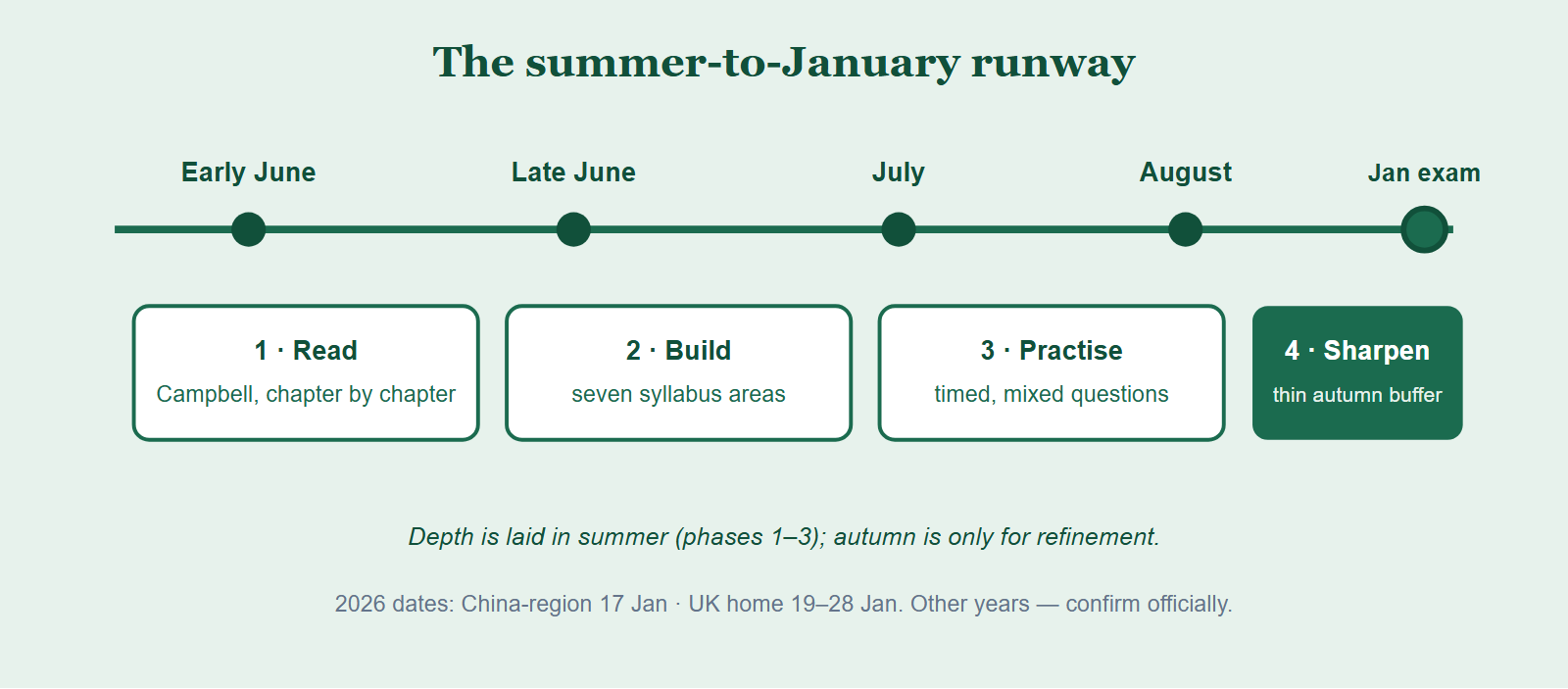
Phase 1 (early–late June): read Campbell, don’t memorise it
The standard text for serious BBO preparation is Campbell Biology, supplemented with your AP or A-level resources. In June, your job is a first read for understanding, not a vocabulary-cramming exercise. Read each chapter once, draw the key processes from memory afterward (photosynthesis, the cardiac cycle, meiosis, an action potential), and mark anything that didn’t click for a second pass.
Pace it: Campbell is long, so a chapter every day or two keeps you moving without burning out. The point is breadth of exposure — the BBO can pull from across biology, and an unfamiliar question is far easier when you have at least met the underlying concept once. Skim our overview of what the exam expects in how to prepare for the BBO before you start, so you read with the right lens.
Phase 2 (July): build the seven core areas deliberately
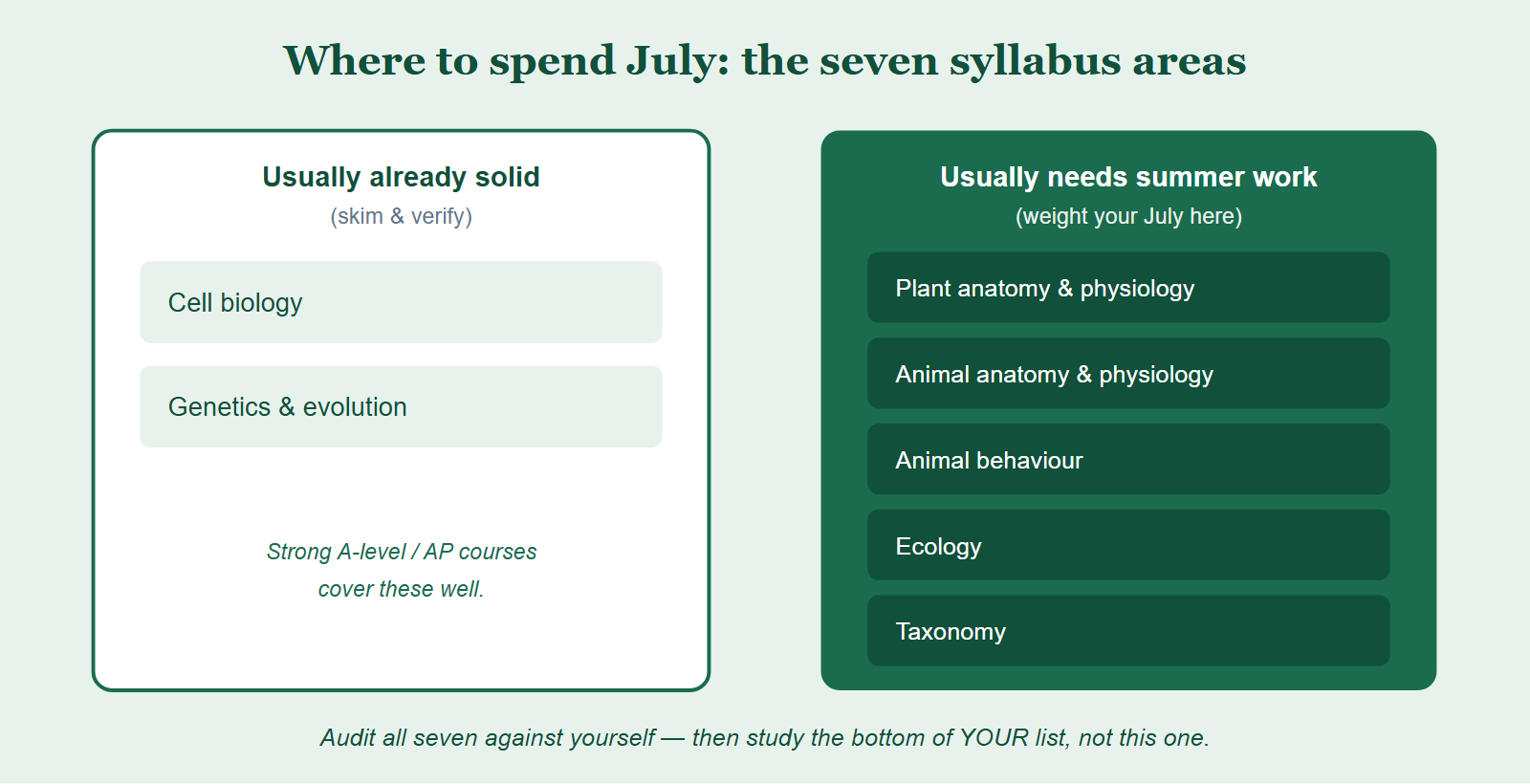
The BBO syllabus maps to strong A-level/AP biology plus some first-year university material, organised into seven areas: cell biology; plant anatomy & physiology; animal anatomy & physiology; animal behaviour; genetics & evolution; ecology; and taxonomy. Most students arrive strong in cell biology and genetics and weak in plant physiology, animal behaviour, and taxonomy — the areas A-level courses tend to under-serve. July is for closing those gaps on purpose rather than re-reading what you already know.
Audit yourself honestly against all seven, then weight your July study toward the bottom of your own list. The figure below shows the typical strong/weak split we see in first-year cohorts — use it as a prompt, not a verdict on you.
Phase 3 (August): make practice timed and mixed
By August, switch from input to output. The BBO is a short online exam with no lab component, and the question types are multiple-choice, fill-in, and ordering. That format rewards two specific habits: reading a stem carefully under time pressure, and recognising a concept fast enough to apply it. Both improve only with repetition under the clock.
Work in mixed sets that pull from several syllabus areas at once, rather than topic-by-topic — the real paper does not announce which area a question belongs to, and “context-switching” is itself a skill. After every set, review not just what you got wrong but why: a misread stem, a genuine knowledge gap, or a too-slow pace each calls for a different fix.
For volume, our past papers are the most realistic material. We’ve gathered a free pack of BBO past papers — to get it, scan the QR code on the past-papers page or message us. Worked-solution coverage varies by year, and our teachers add more over time, so check the pack for which years currently include them. (We frame these as our own collected resource; for official materials and administration, defer to the organiser.)
A note for international and China-region students
If you are sitting from outside the UK, the summer plan is identical — the content and standard are the same. What differs is the pathway, not the preparation: the BBO selects the UK’s International Biology Olympiad (IBO) team through a separate UK-based route, so international students take part for BBO recognition (awards against the published score boundaries) rather than for a UK IBO team place. We explain this distinction in the BBO for international and China-region students, and you should always confirm your specific eligibility and the registration route on the official BBO channels.
Awards are decided purely by score against published boundaries — Gold, Silver, Bronze, and further tiers such as Highly Commended and Commended. As a rough guide, 2024 boundaries fell near 113 for Gold, 103 for Silver, and 96 for Bronze, but boundaries change every year, so confirm the current boundaries officially. With well over 15,000 students from 900+ schools taking part last year, a strong summer is exactly what separates a Gold from a near-miss.
For context on what a focused summer can lead to: per Hanlin’s own records, our 2026-season biology cohort earned 26 BBO Golds, 21 Silvers and 5 Bronzes, and 5 students reached the USABO US-region Semifinal. The plan above is the same one those students started from in June.
Frequently asked questions
Is the summer really enough to prepare for the BBO?
Yes — for most students it is the decisive block. A summer is long enough to read Campbell Biology once, build the seven syllabus areas, and bank weeks of timed practice, which leaves the autumn term for sharpening rather than cramming.
What should I read over the summer?
Campbell Biology is the standard text, supplemented with your AP or A-level resources. Read for understanding in June, then in July and August target the syllabus areas your school course under-serves (often plant physiology, animal behaviour, and taxonomy).
When is the BBO, so I can plan backward from it?
For the 2026 season the China-region exam is 17 January 2026 and the UK home competition runs 19–28 January 2026. For other years, or your school’s exact window, confirm on the official BBO channels.
Can international students take part, and does the summer plan change?
International and China-region students take part for BBO recognition (awards by score), while the UK IBO team is selected through a separate UK-based path. The preparation is identical; confirm your eligibility and registration route officially.
This is an independent English-language guide to the British Biology Olympiad for international and China-region students, operated by Hanlin Education. It is not affiliated with, endorsed by, or sponsored by UK Biology Competitions (UKBC) or the Royal Society of Biology. Rules, dates, eligibility and results are set by the organiser — always confirm current details through the official BBO channels.