Of the seven areas the British Biology Olympiad (BBO) draws on, two repay focused study more than the rest: cell biology and genetics & evolution. They are dense, mechanistic, and reward the kind of applied reasoning the BBO is built to test. This guide breaks down exactly what to master in each — and the gaps that quietly cost marks.
Why these two areas earn their keep
The BBO is a short online exam — multiple-choice, fill-in and ordering questions — with no lab component, and it rewards applying biology to unfamiliar problems rather than rote recall. Cell biology and genetics are where that pays off most: both are mechanistic. A question rarely asks you to name a structure; it gives you a novel scenario (a drug that blocks a pump, a pedigree you have never seen) and asks what follows. If you understand the machinery, you can reason your way to the answer even when the context is new. That is also why these two areas overlap so heavily with the USABO, which shares roughly 90% of the BBO’s content — time invested here works twice.
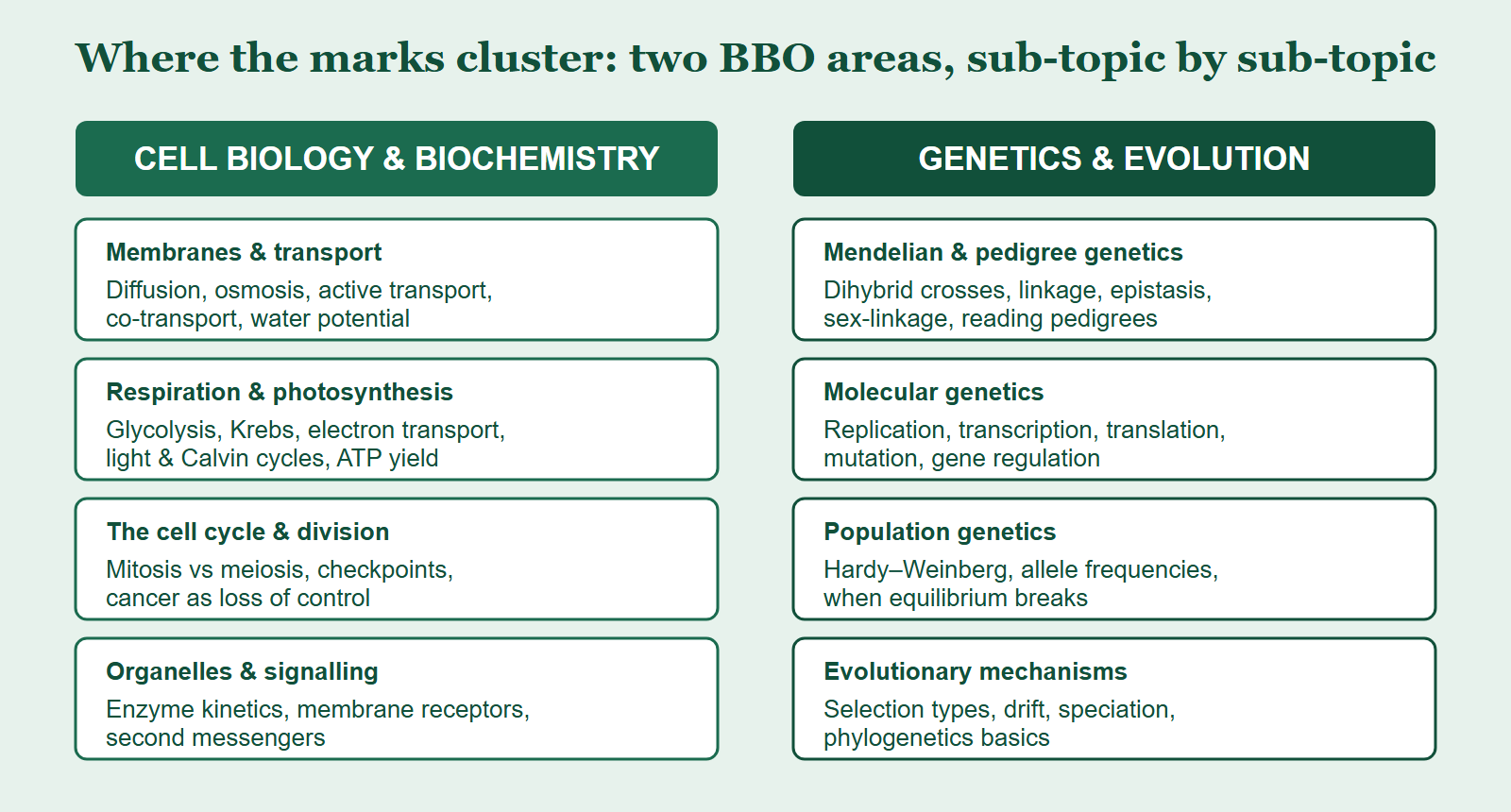
Both map onto a strong A-level or AP biology course plus some first-year university material, with Campbell Biology as the standard text. Below is the realistic weighting of sub-topics within each area, so you spend study time where the questions cluster.
Cell biology: what to master
Cell biology questions reward a working model of how a cell does things, not a labelled diagram. Four blocks carry most of the marks:
- Membranes and transport. Be fluent in passive vs active transport, osmosis and water potential, and co-transport. The classic BBO move is to give you a poisoned pump or a changed concentration gradient and ask what happens to a downstream process — you must trace the chain.
- Respiration and photosynthesis. Know glycolysis, the Krebs cycle, oxidative phosphorylation, and the light-dependent and Calvin cycles as pathways with inputs, outputs and locations — including where ATP and reducing power are made. Memorising the steps without their logic leaves you stuck the moment a question perturbs one stage.
- The cell cycle and division. Distinguish mitosis from meiosis crisply (and why meiosis generates variation), and understand checkpoints — cancer is frequently framed as a checkpoint failing, which links straight into genetics.
- Enzymes and signalling. Enzyme kinetics (competitive vs non-competitive inhibition), receptors, and second-messenger ideas come up as applied scenarios. This block is the bridge between biochemistry and physiology.
Common cell-biology gaps
Three gaps recur in students we coach. First, treating respiration and photosynthesis as lists to recite rather than connected energy systems — so a question about where the proton gradient forms throws them. Second, blurring osmosis and diffusion under pressure, especially water-potential sign conventions. Third, knowing organelle names but not organelle jobs, which is exactly what applied questions test.
Genetics & evolution: what to master
Genetics is the most calculable area on the paper, which makes it a reliable source of marks if your technique is clean — and a reliable source of dropped marks if it is not.
- Mendelian and pedigree genetics. Go beyond monohybrid crosses to dihybrid ratios, linkage and recombination, epistasis, and sex-linkage. Reading an unfamiliar pedigree and deducing the mode of inheritance is a signature BBO skill — practise it until it is automatic.
- Molecular genetics. Replication, transcription and translation in mechanistic detail, plus mutation types and the basics of gene regulation. Expect questions that hand you a mutation and ask for its consequence at protein and phenotype level.
- Population genetics. The Hardy–Weinberg principle is high-yield: be able to calculate allele and genotype frequencies, and — more importantly — state the assumptions and recognise when a population is not at equilibrium. That conceptual half is where strong candidates separate from the pack.
- Evolutionary mechanisms. Natural selection (directional, stabilising, disruptive), genetic drift, gene flow, speciation, and an introductory grasp of phylogenetics. These tie population genetics to the big picture.
Common genetics gaps
The recurring slip is mechanical, not conceptual: students set up a cross correctly, then mis-handle the probabilities — multiplying when they should add, or forgetting a sex-linked term. Hardy–Weinberg trips people who plug numbers into p² + 2pq + q² without checking whether the assumptions hold. And many can define drift and selection but cannot say which is acting in a described population — the exact judgement applied questions demand.
How to study these two areas
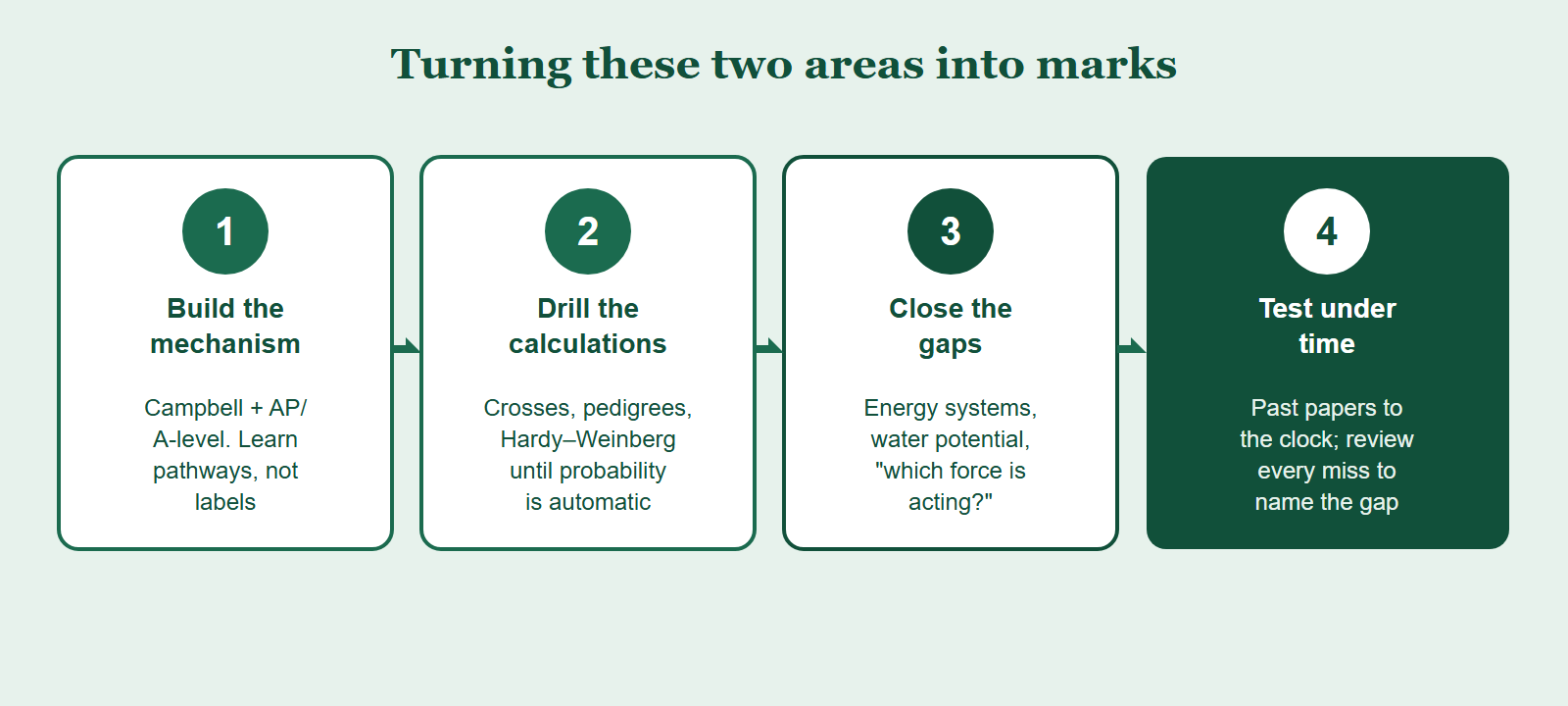
Work the mechanism from a college-level text — Campbell Biology, with AP and A-level resources alongside — then drill the calculable parts (genetics ratios, pedigrees, Hardy–Weinberg) until probability handling is automatic. Deliberately close the gaps above before you move on. Finally, convert it all to marks under time. Our collected BBO past-papers pack is free — scan the QR code or message us to get it; worked-solution coverage varies by year, and our teachers add more over time.
Because the USABO shares about 90% of this content and sits in late March, the depth you build here carries straight into a second medal — see the BBO-then-USABO double-gold strategy, and for the wider plan across all seven areas, how to prepare for the BBO. China-region students can read about the separate international / China-region exam. The 2026 China-region exam is on 17 January 2026 and the UK home competition runs 19–28 January 2026; for registration and any other dates, confirm on the official BBO channels.
A real-world signal that this depth works: across the 2026 season, Hanlin’s biology cohort earned 26 BBO golds, 21 silvers and 5 bronzes, and 5 students reached the USABO US-region Semifinal (per Hanlin’s own records). Awards are decided by score against published boundaries — as a guide the 2024 BBO Gold boundary was around 113 — but boundaries change yearly, so confirm current boundaries on the official channels.
Frequently asked questions
Which BBO topics are worth the most study time?
Cell biology and genetics & evolution. Both are mechanistic and overlap heavily with the USABO, so they reward focused preparation more than the descriptive areas. Master membranes/transport, respiration & photosynthesis, the cell cycle, and enzymes/signalling in cell biology; and Mendelian/pedigree genetics, molecular genetics, Hardy–Weinberg, and evolutionary mechanisms in genetics.
Is Hardy–Weinberg actually tested in the BBO?
Population genetics, including Hardy–Weinberg, is part of the genetics & evolution area. Be ready to calculate allele and genotype frequencies and, crucially, to state the assumptions and recognise when a population is not at equilibrium.
What is the single most common genetics mistake?
Setting a cross up correctly but then mishandling the probabilities — for example multiplying independent events when you should add mutually exclusive ones, or dropping a sex-linked term. Timed past-paper practice fixes it faster than re-reading theory.
Which textbook covers these areas?
Campbell Biology is the standard college text and covers both areas in the depth the BBO needs; AP and A-level resources are useful companions for exam-style questions.
This is an independent English-language guide to the British Biology Olympiad for international and China-region students, operated by Hanlin Education. It is not affiliated with, endorsed by, or sponsored by UK Biology Competitions (UKBC) or the Royal Society of Biology. Rules, dates, eligibility and results are set by the organiser — always confirm current details through the official BBO channels.