On the British Biology Olympiad (BBO), the genetics-and-evolution area rewards a very specific skill: reading an unfamiliar cross, pedigree or population and calculating the answer under time pressure, not just recognising a term. This guide shows how to approach natural selection, phylogenetic logic, genetic crosses and pedigrees, and the Hardy-Weinberg principle — the quantitative core that separates a Silver from a Gold.
Where evolution and genetics sit on the BBO
The BBO draws on seven core areas — cell biology, plant anatomy and physiology, animal anatomy and physiology, animal behaviour, genetics and evolution, ecology, and taxonomy — roughly A-level or AP biology plus some first-year university material. It is a short, timed online exam with no practical or lab component, and questions come as multiple-choice, fill-in and ordering or sequencing formats. The exact number of questions, timing and the mark split between areas vary by sitting, so treat any breakdown as indicative and confirm the current format on the official BBO channels.
What matters for preparation is that genetics-and-evolution is the area where the exam most often makes you do something — predict offspring ratios, deduce an inheritance pattern, order events in a phylogeny, or plug numbers into an allele-frequency equation. Because the BBO shares roughly 70-90% of its content with the USA Biology Olympiad (USABO) on our own syllabus comparison, the problem-solving muscle you build here transfers directly to a second competition.
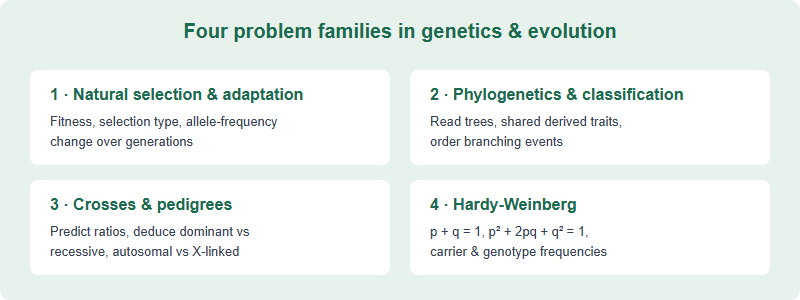
Natural selection and adaptation: think in populations
Selection questions test whether you can reason about how allele frequencies shift, not whether you can define “survival of the fittest”. The key move is to read fitness as reproductive success — the number of viable offspring an organism leaves — and then ask which phenotypes that favours across generations. A short worked mini-example: if a dark-shelled snail leaves more offspring than a pale one on a dark shore, the frequency of the dark allele rises over time; reverse the shore colour and the trend reverses. Nothing is memorised; it is deduced.
You should be fluent in the three classic modes of selection, because the exam often shows a distribution and asks which one is acting:
| Mode of selection | What it favours | Effect on the distribution |
|---|---|---|
| Directional | One extreme phenotype | Mean shifts toward that extreme |
| Stabilising | Intermediate phenotypes | Variance narrows around the mean |
| Disruptive | Both extremes | Two peaks appear; intermediates decline |
Also keep clear the difference between selection and the other forces that change allele frequencies — genetic drift (random change, strongest in small populations), gene flow (migration between populations) and mutation (the ultimate source of new variation). A common exam trap is to attribute a frequency change to selection when the scenario actually describes drift in a tiny founder population.
Phylogenetics and classification: read the tree
Taxonomy overlaps with evolution here, and the questions are usually about logic: given a phylogenetic tree, which species share the most recent common ancestor, or which trait is a shared derived character that defines a clade? Work these by reading the branch points, not the tip order — two species can sit far apart on the page yet share a recent node. A quick mini-example: if mammals and birds both have four-chambered hearts but their nearest shared ancestor did not, the trait evolved twice (convergence), so it is not evidence of a single clade.
Be comfortable with the vocabulary the exam assumes: a monophyletic group (an ancestor and all its descendants), homology (similarity from common ancestry) versus analogy (similarity from convergence), and ordering events along a branch. Sequencing-format questions frequently ask you to place branching events or geological or developmental stages in order, so practise turning a tree or a scenario into a correct sequence quickly. For a fuller map of how this area connects to the rest of the syllabus, see our what-is-the-BBO overview.
Genetic crosses and pedigrees: a repeatable method
Crosses and pedigrees are the most “calculable” part of the area, which means a fixed method saves time and prevents careless errors. For a cross, the reliable sequence is: assign symbols, write the parental genotypes, use a Punnett square or the product rule for the gametes, then read off the genotype and phenotype ratios. For a monohybrid cross of two heterozygotes (Aa × Aa) the expected phenotype ratio is 3:1; for a dihybrid cross of two double heterozygotes it is 9:3:3:1 when the genes assort independently. Watch for the twists the BBO likes — codominance, incomplete dominance, multiple alleles, sex linkage and epistasis — each of which changes the expected ratio.
Pedigrees ask you to run the logic backwards: from a family diagram, deduce the mode of inheritance. Use a small checklist and eliminate patterns that are impossible given the data.
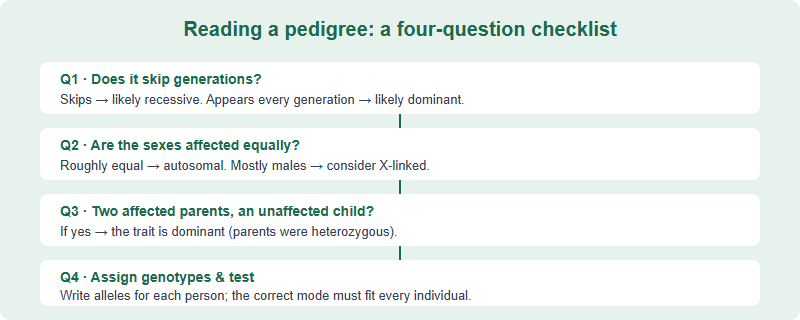
The single most useful habit is to assign trial genotypes to every individual and check for a contradiction. If a proposed pattern forces an impossible genotype anywhere in the family, discard it and try the next. This turns a fuzzy “it looks recessive” into a defensible answer you can trust under time.
Hardy-Weinberg: population genetics you can calculate
The Hardy-Weinberg principle is the most reliably examinable calculation in the whole area, because it is a fixed pair of equations. For two alleles with frequencies p and q: allele frequencies satisfy p + q = 1, and genotype frequencies satisfy p² + 2pq + q² = 1, where p² is the homozygous-dominant frequency, 2pq the heterozygous (carrier) frequency and q² the homozygous-recessive frequency. The usual entry point in a problem is the recessive phenotype, because that gives you q² directly.
A short worked mini-example: if 1 in 100 individuals shows a recessive condition, then q² = 0.01, so q = 0.1 and p = 0.9. The carrier frequency is 2pq = 2 × 0.9 × 0.1 = 0.18 — about 18% of the population carries one copy without showing the trait. That “carriers greatly outnumber affected individuals” result is a classic BBO talking point, and being able to produce it in a few seconds is exactly the speed the exam rewards.
| Term | Meaning | Typical use in a question |
|---|---|---|
| p, q | Allele frequencies (dominant, recessive) | Solve from q², then find p = 1 − q |
| p² | Homozygous-dominant genotype frequency | Proportion showing the trait, non-carriers |
| 2pq | Heterozygous (carrier) frequency | Hidden carriers of a recessive allele |
| q² | Homozygous-recessive genotype frequency | Given as the affected proportion |
Two guardrails: the equilibrium assumes a large, randomly mating population with no selection, migration or mutation, so a question that describes any of those may be testing whether you notice the assumptions are broken. And keep p and q as allele frequencies distinct from the genotype frequencies p², 2pq and q² — mixing them up is the most common error we see in coaching. To turn this into marks, drill it against real papers; our BBO past-papers pack gathers the papers with a method for timed practice.
Turning the method into marks
BBO awards are decided by score against published boundaries — Gold, Silver, Bronze, Highly Commended and Commended — and those boundaries shift each year (as a guide, the 2024 Gold boundary was around 113; confirm current boundaries on the official BBO channels). In the genetics-and-evolution area, the gap to Gold is almost never a missing fact; it is calculation speed and accuracy under a ticking clock. The fix is deliberate practice: a fixed method per problem family, then timed past papers, then a review pass that names the exact slip on every miss. In Hanlin's BBO track, that error-review loop — deciding what to drill next from a student's own mistakes — is where a coach adds the most over self-study (our 2026 cohort recorded 26 golds, per Hanlin); a disciplined self-studier can run the same loop alone.
Frequently asked questions
Is Hardy-Weinberg tested on the BBO?
Population genetics falls within the genetics-and-evolution area, so allele- and genotype-frequency calculations are fair game. Confirm the current scope on the official BBO channels.
How do I read a pedigree quickly?
Assign trial genotypes to everyone and eliminate any inheritance pattern that forces an impossible genotype. The correct mode must fit every individual in the diagram.
What phenotype ratio does a dihybrid cross give?
Two double heterozygotes (AaBb × AaBb) give a 9:3:3:1 phenotype ratio when the two genes assort independently.
Does BBO genetics prep help with the USABO?
Yes. The BBO shares roughly 70-90% of its content with the USABO on our own syllabus comparison, so the same problem-solving method transfers to a second competition.
This is an independent English-language guide to the British Biology Olympiad for international and China-region students, operated by Hanlin Education. It is not affiliated with, endorsed by, or sponsored by UK Biology Competitions (UKBC) or the Royal Society of Biology. The syllabus scope and score boundaries change each year — confirm current details through the official BBO channels. Any errors will be corrected within 7 working days.