If you study A-level, IB or AP biology, you already hold most of what the British Biology Olympiad (BBO) tests. The seven BBO syllabus areas map closely onto a strong school course plus a slice of first-year university material. The difference is not what you know but how you use it: BBO rewards applying biology to unfamiliar problems, not rote recall. This guide shows where each curriculum aligns — and where it leaves a gap to close.
What BBO actually asks of you
The BBO is a short online exam with no lab component, organised by UK Biology Competitions (UKBC) under the Royal Society of Biology. Questions come in three forms — multiple-choice, fill-in, and ordering — and the seven core areas are cell biology; plant anatomy & physiology; animal anatomy & physiology; animal behaviour; genetics & evolution; ecology; and taxonomy. Last year more than 15,000 students from over 900 schools took part. Awards (Gold, Silver, Bronze and further tiers such as Highly Commended and Commended) are set purely by your score against published boundaries, so there is no quota and no interview — just biology applied well under time pressure.
That format matters for course mapping. Because BBO never asks you to recite a definition cold, the parts of your syllabus that train reasoning — interpreting an unfamiliar graph, predicting the effect of a mutation, ranking events in a pathway — are worth far more than the parts you memorised for a unit test. Below, each curriculum is graded on coverage, depth and exam style.
A-level biology: deepest physiology, thinnest on breadth
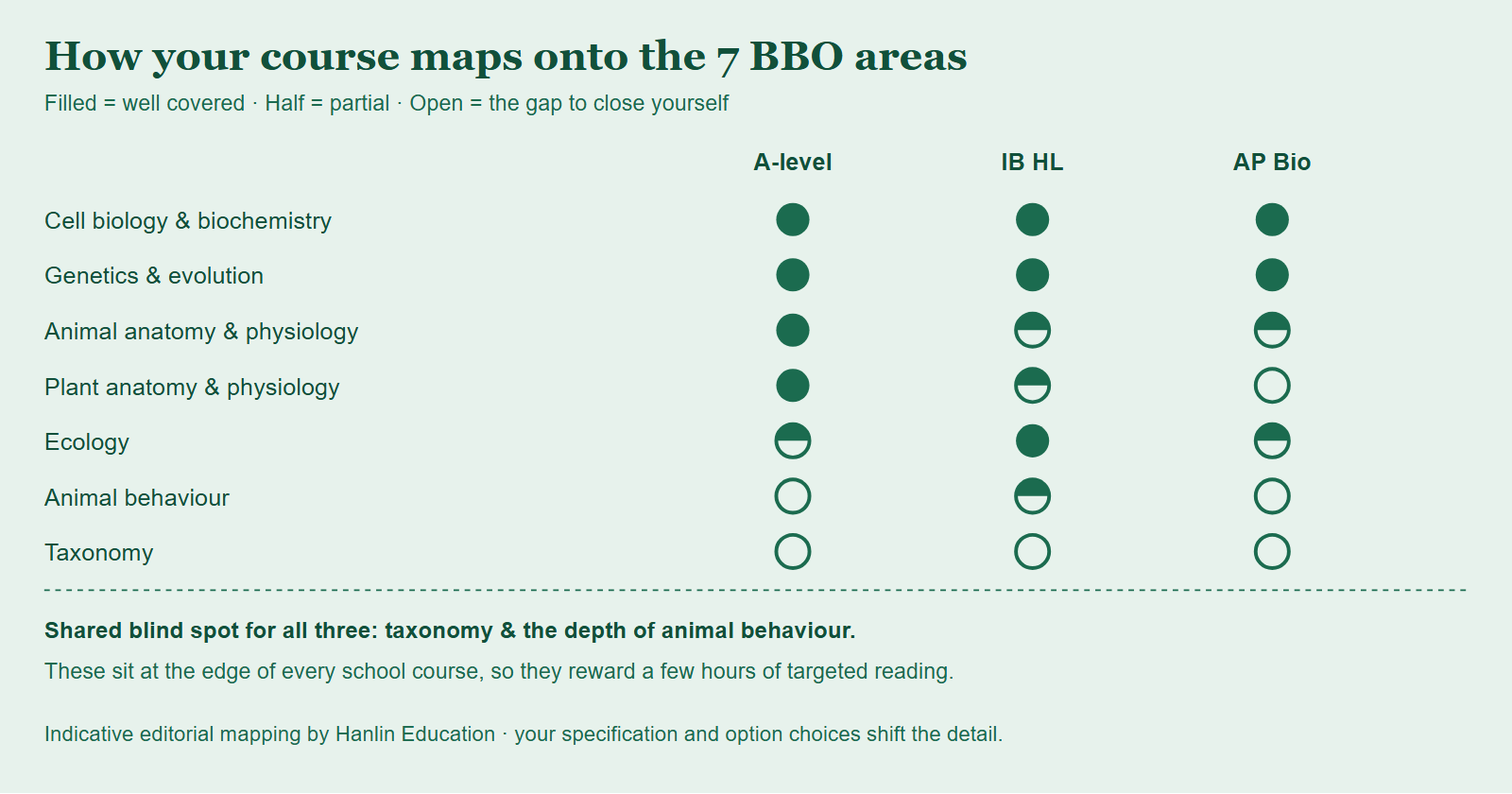
A-level (AQA, OCR, Edexcel and similar) is arguably the closest single fit to BBO. Its strength is depth in animal physiology, biochemistry, and genetics — control of heart rate, kidney function, respiration and photosynthesis are taught at a level that BBO questions reward directly. The exam culture also helps: A-level papers already test data interpretation and unfamiliar-context questions, which is exactly BBO’s style.
The gap is breadth at the margins. Taxonomy and the formal study of animal behaviour are light in most A-level specifications, and plant physiology can feel secondary after the human-biology emphasis. If you are an A-level student, your highest-return additions are: a structured pass over classification, and behaviour topics (innate vs learned behaviour, signalling, foraging). Both are short to learn and frequently appear.
IB biology (HL): broad and ecology-strong, less drilled on speed
IB Higher Level biology is built around big concepts and gives ecology genuine weight — energy flow, populations and conservation are covered more thoroughly than in many A-level or AP courses, which directly serves the BBO ecology strand. HL also pushes synthesis across topics, useful when a BBO question stitches genetics into evolution into ecology in one item.
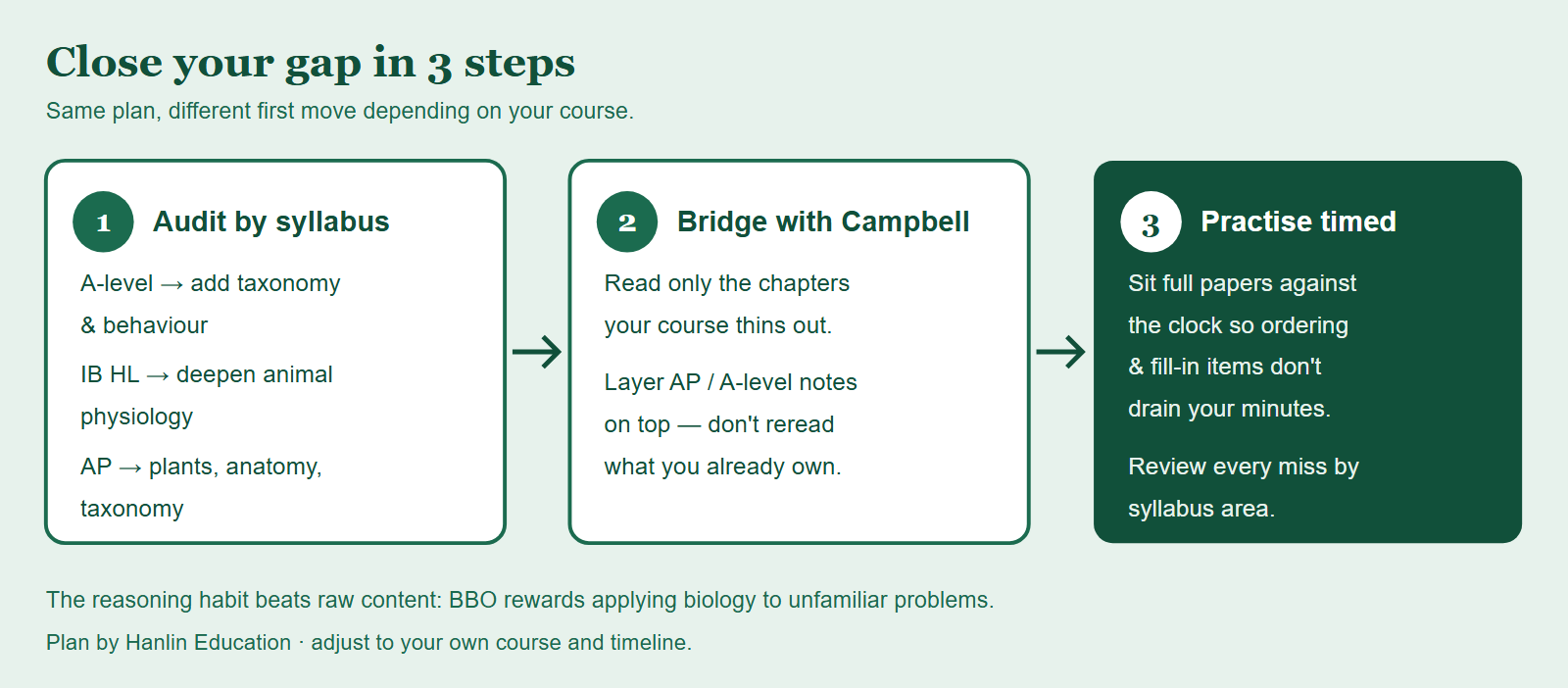
Two gaps tend to show. First, the per-topic depth in pure physiology can sit just below A-level, so HL students benefit from pushing one level deeper on animal systems. Second, IB’s internal assessment rewards extended investigation rather than rapid recall under tight timing — and BBO is a fast, no-second-chances exam. The fix is not more content but timed practice: sit questions against the clock so the ordering and fill-in items don’t eat your minutes.
AP Biology: strong on principles, US-style multiple choice helps
AP Biology centres on the four “big ideas” (evolution, energy, information, interactions) and trains exactly the reasoning BBO wants — interpreting data and applying a principle to a new scenario. AP students are also already comfortable with dense multiple-choice papers, which lowers the friction of BBO’s format. Coverage of genetics, evolution and cell biology is solid.
The recurring AP gap is detail in organism-level anatomy and physiology, plus plant biology and taxonomy, which the AP framework treats more lightly than a UK or IB course. If you are an AP student aiming high, treat Campbell Biology as your bridge: it is the standard reference for both AP and BBO, and the chapters on plant structure, animal organ systems and diversity are where you will most often find the extra marks.
The reasoning habit beats the syllabus
Whichever course you take, the single biggest predictor of a BBO award is not coverage — it is whether you have practised thinking like the exam. BBO deliberately drops you into unfamiliar scenarios and asks you to reason from principles. Students who only revise content plateau; students who drill unfamiliar problems keep climbing. In our own 2026 season, Hanlin Education’s biology cohort earned 26 BBO Golds, 21 Silvers and 5 Bronzes, and five students reached the USABO US-region Semifinal — and the common thread among the top scorers was timed problem practice, not a longer reading list.
This is also why BBO is a smart entry point if you later target the USA Biology Olympiad (USABO): the two share roughly 90% of content, with USABO sitting in late March. Sit BBO first in January, review by syllabus area, then carry the same base into USABO. (Note the IBO distinction: the BBO selects the UK’s International Biology Olympiad team through a separate UK-based path; international and China-region students take part for BBO recognition, not for the UK IBO team — confirm current eligibility on the official BBO channels.) For the sequencing logic, see our piece on BBO then USABO: chasing a double gold, and for how the regional sitting works, the international and China-region exam.
Practising with past papers
Past papers are where the reasoning habit is built. We maintain a collected free pack of BBO past papers (with worked-solution coverage that varies by year — our teachers add more over time): scan the QR code on this site or message us to get it. Use it the way the exam rewards: attempt under time, then sort every miss into one of the seven syllabus areas so your weak strand becomes obvious. For a fuller routine, read how to prepare for the BBO, and check the current format on the competition rules page before you sit.
Frequently asked questions
Is A-level, IB or AP biology enough to enter the BBO?
Yes — the BBO is designed for sixth-form and high-school students, and the seven syllabus areas map onto a strong A-level, IB HL or AP course plus some first-year university material. No single curriculum covers everything to full depth, so most students add a little reading around taxonomy, behaviour or plants. Confirm eligibility on the official BBO channels.
Which course is the “best” preparation for BBO?
There is no winner — each has a different shape. A-level goes deepest on physiology and genetics; IB HL is strongest on ecology and synthesis; AP trains principle-based reasoning and US-style multiple choice. Your result depends far more on timed problem practice than on which course you study.
What is the biggest gap my school course leaves?
For all three curricula, taxonomy and the depth of animal behaviour sit at the edge of the syllabus, so they reward a few focused hours. AP students should also shore up plant biology and organism-level anatomy; Campbell Biology is the standard bridge text.
When does the BBO take place?
For 2026, the China-region exam is on 17 January 2026 and the UK home competition runs 19–28 January 2026. For any other year, and for registration details, confirm on the official BBO channels.
This is an independent English-language guide to the British Biology Olympiad for international and China-region students, operated by Hanlin Education. It is not affiliated with, endorsed by, or sponsored by UK Biology Competitions (UKBC) or the Royal Society of Biology. Rules, dates, eligibility and results are set by the organiser — always confirm current details through the official BBO channels.