Animal behaviour is one of the seven core areas the British Biology Olympiad (BBO) draws on, yet it is the one most candidates never revise — because their A-level or AP course barely touches it. That gap is exactly where quick marks hide: behaviour questions reward clear reasoning about innate versus learned behaviour, foraging, signalling, mating systems and altruism, not heavy recall. This guide shows what tends to come up and how to prepare it.
Why behaviour is the area candidates skip
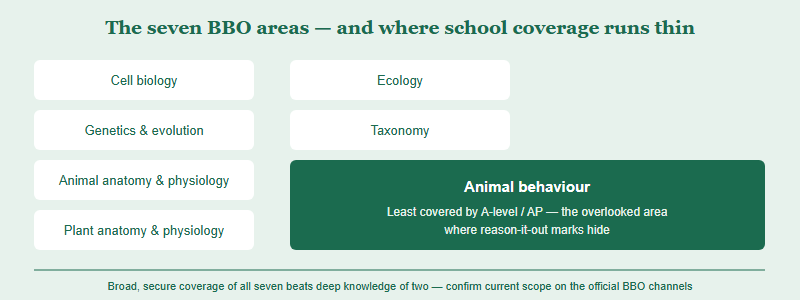
The BBO ranges across seven core areas: cell biology, plant anatomy and physiology, animal anatomy and physiology, animal behaviour, genetics and evolution, ecology, and taxonomy — roughly A-level/AP biology plus some first-year university material. Most school syllabuses put weeks into cells, genetics and physiology, and almost nothing into behavioural ecology. So when a behaviour item appears in a fast online paper, well-drilled candidates who never met the topic lose marks they could have reasoned out.
This matters more than the topic's share of the paper suggests. The BBO is a short, timed online exam with no practical component, and its formats — multiple-choice, fill-in and ordering/sequencing — reward candidates who can apply a principle to an unfamiliar animal on the spot. Behaviour is built for that: give a scenario, ask which explanation fits. A candidate who owns five or six core ideas can often answer without ever having seen the species. The exact weighting of behaviour changes year to year, so treat coverage as insurance and confirm the current syllabus scope on the official BBO channels.
The five ideas the BBO tends to test
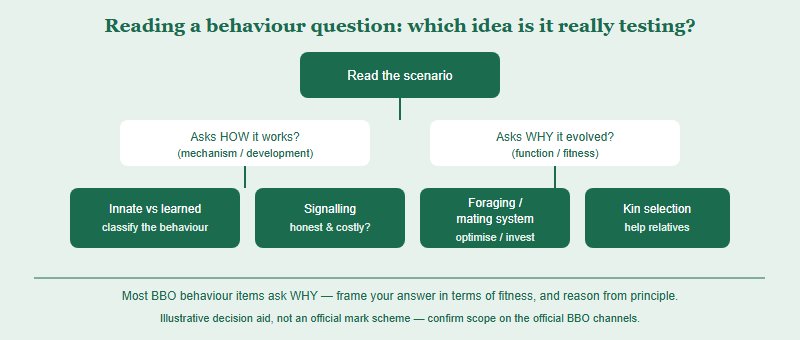
Behaviour on the BBO clusters around a handful of recurring ideas from behavioural ecology. You do not need every case study — you need to recognise which principle a scenario is really asking about. The five below cover most of what comes up:
| Core idea | The question it answers | What a BBO item might ask you to do |
|---|---|---|
| Innate vs learned behaviour | Is this behaviour genetically programmed or acquired through experience? | Classify a described behaviour; distinguish a fixed action pattern, imprinting, habituation or associative learning. |
| Foraging & optimality | How should an animal feed to maximise net energy gain? | Predict a choice from an optimal-foraging model; reason about diet breadth or when to leave a patch. |
| Communication & signalling | How and why do animals send information — and is the signal honest? | Interpret a signal type (visual, chemical, acoustic); reason about why a costly signal stays reliable. |
| Mating systems & sexual selection | Who mates with whom, and why do some traits get exaggerated? | Link a mating system to parental investment; explain a display trait through female choice or male competition. |
| Kin selection & altruism | Why help others at a cost to yourself? | Apply the logic of inclusive fitness; reason about why helping relatives can be favoured. |
Read down the middle column and you will see the pattern: behaviour questions almost always test why a behaviour makes evolutionary sense, framed so you can reason from principle. That is why behaviour overlaps so naturally with the genetics-and-evolution area — both reward thinking in terms of fitness. It is also why a candidate who has drilled cells and physiology but skipped behaviour is leaving reason-it-out marks on the table.
Innate vs learned, and foraging: the two you meet first
If you revise only two behaviour ideas, make them these. Innate versus learned behaviour is the classic entry point. Innate behaviours — reflexes, fixed action patterns, taxes and kineses — appear without prior experience and are highly stereotyped. Learned behaviours change with experience: habituation (fading response to a harmless repeated stimulus), imprinting (a sensitive-period attachment), classical and operant conditioning (associating stimuli or actions with outcomes), and insight learning. A common BBO framing gives you a described behaviour and asks you to place it in the right category, so practise labelling scenarios rather than memorising definitions.
Foraging and optimality is the second gateway idea, and it is where behaviour meets simple quantitative reasoning — a favourite of olympiad papers. Optimal foraging theory treats an animal as if it feeds to maximise net energy gain (energy gained minus energy and time spent getting it). From that one premise you can reason about diet breadth (when a forager should specialise or generalise) and patch use (when it should give up on a depleting patch and move on). You are rarely asked to recall a number; you are asked to predict what a rational forager should do when a variable changes. That style rewards a candidate who understands the model over one who has merely read about voles or crabs.
Signalling, mating systems and altruism: the harder tier
The remaining three ideas carry the tougher marks. Communication and signalling asks how animals transfer information — through visual, acoustic, chemical (pheromone) or tactile channels — and why signals stay honest. The key insight examiners like is that a costly or hard-to-fake signal is hard to cheat, which keeps it reliable; a scenario may ask you to explain why an expensive display persists rather than being replaced by a cheap bluff.
Mating systems and sexual selection link who-mates-with-whom to parental investment. Monogamy, polygyny and polyandry map onto how much each sex invests in offspring, and sexual selection — through male–male competition or female choice — explains why traits like elaborate plumage or antlers get exaggerated even when they look costly for survival. Expect to connect a described mating system to its ecological driver, or to explain an ornament through selection.
Kin selection and altruism is the idea students find most counter-intuitive, so it discriminates well. The puzzle is why an animal would help another at a cost to itself. The resolution is inclusive fitness: genes for helping can spread when the help goes to relatives who share those genes, so an animal can pass on its genes indirectly by aiding kin. The classic shorthand — that altruism is favoured when the benefit to the recipient, weighted by relatedness, exceeds the cost to the actor — is worth understanding as logic, not just as a formula, because BBO items tend to test the reasoning through a scenario.
How to prepare behaviour efficiently
Because behaviour is reasoning-heavy and recall-light, it is one of the highest-return areas per hour you invest. A focused approach:
- Learn the five core ideas as principles, not case studies. Aim to state each in a sentence and recognise it in a scenario — that is what the exam tests.
- Read the behaviour chapters of a college text. Campbell Biology — the backbone of most BBO and USABO preparation — has a strong behavioural-ecology chapter that covers all five ideas at the right level.
- Drill with scenarios. Practise classifying behaviours and predicting what an animal should do, rather than re-reading definitions. Our BBO past-papers pack lets you see how behaviour is framed under time.
- Do not over-invest. Behaviour is one area of seven; secure the five ideas, then return to your weaker core areas. Breadth wins the BBO.
A first-party note from our coaching: behaviour is consistently the area our stronger students under-prepare, and closing that gap is often what nudges a Silver into a Gold — the marks were reasoning marks all along. In our 2026 BBO cohort, 26 students reached Gold (per Hanlin); reviewing exactly which core areas a student is leaking marks in is where structured coaching adds most over self-study, though the plan above works for a disciplined self-studier too. For the bigger picture on how behaviour fits the whole syllabus, see our guide on how to prepare for the BBO.
Frequently asked questions
Is animal behaviour really on the BBO?
Yes — animal behaviour is one of the seven core areas the BBO draws on. Its weighting varies each year, so confirm the current scope on the official BBO channels.
Why do students miss behaviour marks?
Most A-level and AP courses cover behavioural ecology lightly, so candidates meet it cold in the exam — even though the questions reward reasoning, not heavy recall.
What behaviour topics should I prioritise?
Innate vs learned behaviour, foraging and optimality, communication and signalling, mating systems and sexual selection, and kin selection and altruism.
Which book covers BBO behaviour well?
Campbell Biology has a solid behavioural-ecology chapter at the right level; it is the standard text for BBO and USABO preparation.
This is an independent English-language guide to the British Biology Olympiad for international and China-region students, operated by Hanlin Education. It is not affiliated with, endorsed by, or sponsored by UK Biology Competitions (UKBC) or the Royal Society of Biology. The syllabus scope and score boundaries change each year — confirm current details through the official BBO channels. Any error will be corrected within 7 working days.