
UKBC lists two eligible year groups for the British Biology Olympiad, which means most students can sit it twice. Almost everyone uses only the second chance, and that is usually the wrong one. On the dates that have applied recently, a January sitting in your final year lands at or after the UK application deadline. The earlier sitting is the one that can appear on the form.
Two eligible years, and most students notice only one
UKBC states that the British Biology Olympiad is open to “Y12/Y13 in England and Wales, Y13/Y14 in Northern Ireland, S5/S6 in Scotland”, along with equivalent year groups in other countries. Read that carefully: it is not one year group with a fallback. It is a two-year eligibility window, and both years are equally legitimate.
That matters more for a China-based international-school student than for a UK one, because your year label may not map cleanly. An IB Diploma student in DP1, an A-Level student in AS year, and a US-curriculum student in Grade 11 are all in the position UKBC calls Y12. The word on your report card is not the word on the UKBC page, so the mapping is worth confirming explicitly with your school before you build a plan on it — UKBC uses the “equivalent year groups” formulation rather than listing every national system.
UKBC's page does not state a limit on how many times a student may enter across different years, and we are not going to invent one. Confirm repeat entry with your school and on the UKBC official pages. What we can say is that the eligibility window is two years wide, and that almost every student we meet in August has quietly decided to use only the later one.
The timing trap: what a January result can and cannot reach
Here is the structural problem, and it has nothing to do with biology.
The BBO is sat in January. The 2026 competition window ran 19 to 28 January; the dates for the next season are not confirmed on this page, so confirm them on the UKBC official pages. UK undergraduate applications, meanwhile, are submitted in the autumn and early January of your final year. For the 2027-entry cycle, UCAS lists a deadline of 18:00 UK time on 13 January 2027 for most courses, and 18:00 on 15 October 2026 for Oxford, Cambridge, medicine, dentistry and veterinary science. Confirm the exact dates for your own cycle on UCAS, because they move.
Put those two calendars side by side and the arithmetic does itself. A sitting in the January of your final year falls after the October deadline outright, and at or after the main January deadline — and the result arrives later still. A sitting in the January of the year before falls a full twelve months earlier, comfortably inside the window where you are still writing the application.
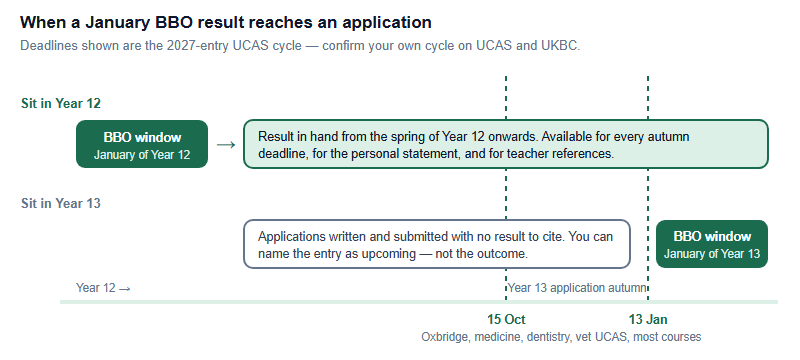
US-bound students face a milder version of the same squeeze. Early deadlines cluster in early November and regular deadlines around the turn of the year, so a final-year January sitting is again too late for most of the file — check each university's own dates rather than assuming.
In our own coaching records, the single most common planning error we correct in August is a Year 12 student who has decided to wait until next year, when I'll know more biology. It sounds like patience. On recent dates it quietly removes the result from the application altogether.
| If you sit in… | Result available for the personal statement? | Available for a 15 October course? | What the sitting is really for |
|---|---|---|---|
| January of Year 12 | Yes — you write the statement months later | Yes | Evidence on the application, plus a diagnostic you still have a year to act on |
| January of Year 13 | No, on recent dates — it falls at or after the deadline | No | A second, better attempt; a stronger record for post-application use and for interviews |
| Both | Yes, from the first | Yes, from the first | The first sits on the form; the second is where the improvement actually shows |
“I haven't covered enough yet” — and why the format weakens that objection
The objection is reasonable on its face. In Year 12 you are perhaps four months into a two-year course. Half the syllabus is unlearned. Why walk into an olympiad paper carrying that?
Because of what UKBC says the paper is testing. The organiser describes the BBO as “not primarily a test of knowledge”, states that “students will be presented with topics and ideas which they are not familiar with”, and asks them to apply basic principles to that unfamiliar material — using, in UKBC's own phrasing, their biological intuition, logic and imagination.
Sit with that for a moment. A paper explicitly designed around unfamiliar material penalises the half-taught student far less than a syllabus test would, because everybody in the room is meeting some of it cold. The Year 13 student has more content, but content is not the axis the paper is built on. The gap between a Year 12 and a Year 13 sitting is real; it is smaller than the calendar makes it feel.
Three further structural points cut the same way:
- The format is short. Two 45-minute multiple-choice papers, sat online while on-site at your registered school or college, with no practical component. Ninety minutes of multiple choice does not have room to punish a missing final-year topic the way a long written paper would.
- You must complete both papers to be considered for an award category, and UKBC allows them to be taken together or on separate occasions. That is a scheduling question for your school, not a readiness question for you.
- There is no transcript risk. A BBO result is not a school grade. A quiet Participation or Commended in Year 12 costs you nothing except the afternoon; there is no line on any record that says you tried and did not medal.
The asymmetry is the whole argument. The downside of sitting early is a modest score you never have to mention. The downside of waiting is a result that arrives after the deadline it was meant to support.
What a Year 12 sitting actually buys you
Four things, in descending order of value.
A real score against a real paper. Everything you plan afterwards — target band, topic priorities, pacing work — rests on a number you generated under exam conditions. Until then you are planning against a guess. Our guide to preparing for the BBO is built around that diagnostic-first sequence for exactly this reason.
An error log with eleven months of runway. This is the part students undervalue. A sitting in the final January produces a diagnosis with nothing left to fix. A sitting a year earlier produces the same diagnosis with a whole year to act on it. In our own records, the students whose second sitting improves most are consistently those who classified every wrong item from the first — content gap, vocabulary gap, misread qualifier, or pace — rather than those who simply revised harder.
Something concrete to write about. A statement that says I sat the BBO, found I could recall enzyme kinetics but could not read an unfamiliar pedigree at speed, and spent the spring fixing that is doing work. A statement that says I am entered for the BBO in January is doing very little. We go into what that paragraph should contain in our piece on the China-region exam and what it means for international applicants.
A position for the two-competition route. If you are considering the BBO-then-USABO sequence, an early BBO gives you a full extra cycle to decide whether that sequence is realistic before you commit spring revision to it. Our BBO-then-USABO plan sets out what the sequence demands.
If you are already in Year 13
None of the above says do not sit. It says sit with the right expectation.
A final-year sitting is still worth doing, for three reasons that survive the deadline problem. First, an interview is not a form: if you are called for an Oxbridge or medicine interview in December or later, or asked about your subject interest at any point, a competition you are actively preparing for is a live conversation, not a dead one. Second, some post-application processes and scholarship routes run later in the year and are not bound by the January date. Third — and this is the honest one — the work you do for a January olympiad in your final year is largely the same work that makes you better at your own examinations in May and June.
What a final-year sitting cannot do is retroactively appear on a form that has already gone. So write the autumn application on what you have actually done: the preparation, the reading, the topic you went after because it interested you. Name the entry as upcoming if it is true. Do not describe an outcome you do not yet hold.
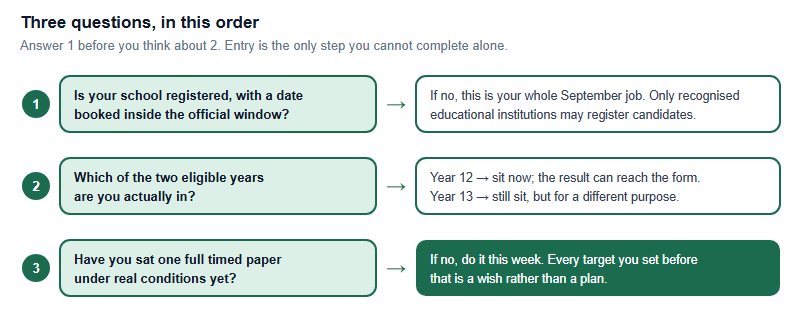
One caution before you commit either way. Entry is not yours to arrange. UKBC states that only recognised educational institutions may register candidates — state-funded or independent schools, further education colleges, and international schools recognised by their national education authority — and that private tutoring companies and individuals cannot. The cost outside the UK is modest, and schools can register at any time until the end of the competition, but “can” is not “has”. Confirm current fees, dates and registration rules on the UKBC official pages, and start the conversation with your biology department in September rather than December.
For the practice half of the plan, we keep our own gathered pack of past papers, with worked solutions for some of the years, alongside our own topic notes and vocabulary lists. Whichever January you choose, the first useful thing you can do is sit one of them properly timed and find out where you actually stand.
Frequently asked questions
Which year groups can enter the BBO?
UKBC lists Y12/Y13 in England and Wales, Y13/Y14 in Northern Ireland, S5/S6 in Scotland, and equivalent year groups in other countries.
Can I sit the BBO twice?
Two year groups are eligible, but UKBC's page states no limit either way. Confirm repeat entry with your school and on the UKBC official pages.
Will a Year 13 January result appear on my UCAS form?
On recent dates, no — the sitting falls at or after the deadline. Confirm both your UCAS cycle dates and the UKBC window.
Is Year 12 too early, given how much biology I have not covered?
UKBC says the BBO is “not primarily a test of knowledge” and uses unfamiliar material, which narrows the gap between the two years.
This is an independent guide operated by Hanlin Education for China-based international-school students. We are not affiliated with, endorsed by, or sponsored by UK Biology Competitions (UKBC) or the Royal Society of Biology, and official competition administration rests with the organiser. Eligibility, dates, fees, registration rules and award boundaries change between seasons, and university application deadlines change between cycles — confirm current details on the UKBC official pages and with UCAS or the relevant university before acting on anything here. Cohort observations are our own de-identified records, per Hanlin; results vary and no award, place or admission outcome is guaranteed. Errors reported to us are corrected within 7 working days.