
UKBC states plainly that the British Biology Olympiad is “not primarily a test of knowledge” and that students will meet topics they are not familiar with. That is not a warning — it is the design. This article gives you the six principles that transfer to unseen biology, a four-move procedure for using them under time, and a way to practise both.
What UKBC says the paper is actually doing
Read the organiser's own description of the BBO and one sentence reframes the whole exam. UKBC says “students will be presented with topics and ideas which they are not familiar with” and are expected to apply basic principles to that material, using their biological intuition, logic and imagination. It states that the competition is “not primarily a test of knowledge”.
Take that at face value and a lot of standard advice collapses. If some proportion of the paper is deliberately built on material nobody in the room has been taught, then the plan “learn more biology until nothing is unfamiliar” cannot work, because the unfamiliarity is manufactured. What separates candidates on those items is not who read further. It is who has a procedure for reasoning when reading runs out.
The format sharpens the point. Two 45-minute multiple-choice papers, sat online while on-site at your registered school or college, both required for an award category, with no practical component. Multiple choice is unusually forgiving of not knowing the name of something and unusually unforgiving of hesitation. You do not have to produce the answer; you have to recognise it, quickly, from a list designed to include the answer you would give if you reasoned badly.
One thing this article is not. Reading a graph — axes, units, controls, trends — is a separate skill with its own drills, and we treat it separately. This is about the layer underneath: what to do when the biology is new, whether or not there is a figure attached.
Six principles that transfer to biology you have not met
Biology has a small number of ideas that hold across every one of the seven BBO content areas — cell biology, plant anatomy and physiology, animal anatomy and physiology, animal behaviour, genetics and evolution, ecology, taxonomy. If you can state them and, more importantly, use them to make a prediction before you read the options, you can answer a great many questions about organisms you have never heard of.
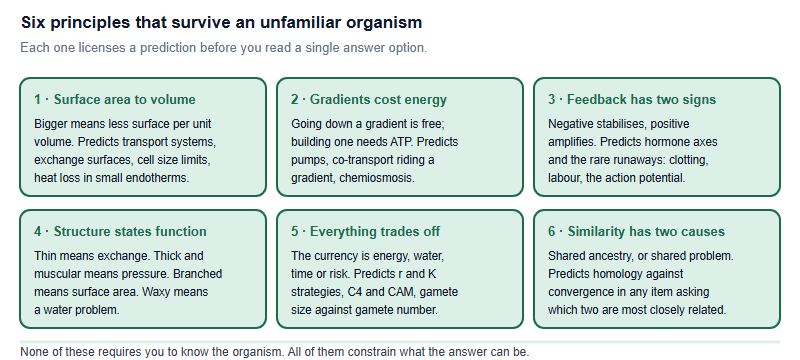
The practical move is to attach each principle to a trigger — a phrase in the question stem that should make you reach for it automatically.
| What the stem gives you | Reach for | The prediction it licenses |
|---|---|---|
| An organism much larger or smaller than its relatives | Surface area to volume | Expect a transport or exchange adaptation, or a difference in metabolic rate per unit mass |
| A protein moving something “against” a concentration or charge difference | Gradients cost energy | Expect ATP, either directly or borrowed from a gradient something else built |
| A dose-response or concentration-response curve | Saturation, plus feedback | Expect a plateau. A rise-then-fall implies a second, opposing effect at high dose |
| A tissue described as thin-walled, folded, or highly branched | Structure states function | Expect exchange or absorption, not support or protection |
| A similar structure in two distantly related lineages | Similarity has two causes | Expect convergence. Do not infer a close relationship from the structure alone |
| An organism producing very many small offspring | Trade-offs | Expect low parental investment, high juvenile mortality, an unstable or unpredictable habitat |
The four moves, worked on a question you have never seen
Here is an illustrative item — ours, not a reproduction of any past paper. A plant hormone you have never heard of is applied to shoot segments at a range of concentrations. Shoot elongation rises with concentration, peaks, then falls at the highest concentrations. You have not been taught this hormone. You can still constrain the answer heavily.
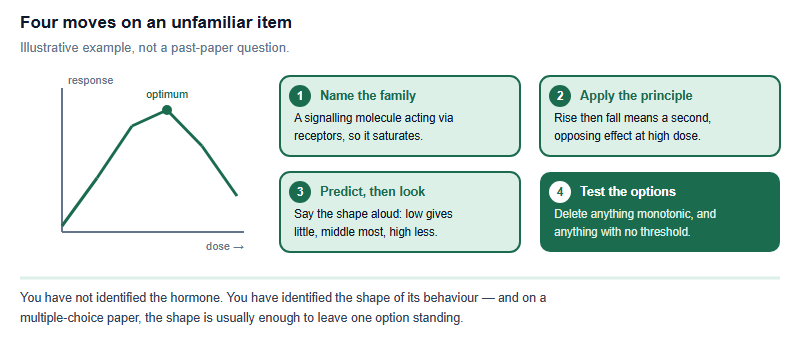
Notice what never happened in that sequence: you never needed the hormone's name, its biosynthesis, or which textbook chapter it lives in. You needed to recognise a category of behaviour and to know that receptor-mediated responses saturate. That is a knowledge claim, but a very cheap one — it generalises across every hormone, every enzyme and every transporter you will ever meet.
Three ways students lose these marks
Searching memory instead of reasoning. The item arrives, the student does not recognise the organism, and spends twenty seconds confirming that they have not been taught it. That search returns nothing every time, and on a 45-minute paper twenty seconds is expensive. The habit to build is a hard stop: if two seconds of recall produces nothing, switch modes and start with move 1. In our own coaching records, the most common sentence after a mock is “we hadn't done that topic” — and when we re-ask the same item with the options covered and a sixty-second budget, a good share of the same students reach a defensible prediction anyway. They could do it. They did not try, because the question felt closed.
Answering the topic instead of the stem. The student recognises the general area, retrieves the standard fact about it, and picks the option that states that fact — which is present, correct in isolation, and not what was asked. This is the distractor writer's favourite trap and the reason move 3 matters: a prediction made before reading the options is a prediction about this question.
Accepting an option that violates a principle. Options are written to sound like biology. Some of them are impossible, and the six principles are how you see it: something moving against a gradient with no energy source named anywhere; a positive feedback loop presented as maintaining a steady state; an adaptation described as free of any cost. Learning to hear those as wrong notes is a large, cheap gain.
Drilling it this autumn — including if you are on AP Biology
Reasoning on unseen material is trainable, but not by ordinary revision, because ordinary revision removes the unfamiliarity that is the whole point. Four drills, in rough order of return:
- Practise deliberately off-syllabus. Pick a topic your course has not covered and will not cover, and answer questions on it. Uncomfortable by design; that is the training stimulus.
- Cover the options. Read the stem, write one sentence of prediction, and only then reveal the answer list. This single change forces move 3 and exposes how often you were option-shopping rather than reasoning.
- Keep a principle log, not just an error log. For every item you missed, write which of the six would have got you there. After thirty items you will see that your misses cluster on one or two principles, which is a far more actionable finding than a list of topics.
- Drill for speed, not just accuracy. Ninety minutes across two papers is short, so the four moves have to run in well under a minute. Practise them slowly first, then against a clock. Our guide to preparing for the BBO sets out how to interleave this with content work rather than choosing between them.
One timely note if you are on AP Biology. The course moved to a digital hybrid format in 2026, with a stimulus-based multiple-choice section — confirm the current arrangements with the College Board, since exam formats change. That change is genuinely relevant here, but narrowly: a stimulus-led multiple-choice section trains exactly the reflex in moves 3 and 4, reading a novel prompt and predicting before committing. What it does not do is close the breadth gap. AP Biology is not built to cover taxonomy, plant anatomy and physiology, or animal behaviour at the range the BBO's seven content areas span. So treat it as free practice on the procedure and plan your content work separately.
A closing caution on how far this gets you. Reasoning does not replace content; it multiplies it. A student with no grounding in cell biology or genetics cannot reason their way to a strong score, because the principles need something to act on. What the procedure changes is the return on the content you do have — and it converts the paper from a memory test you will inevitably lose into a thinking test you can train for. If you are also planning a spring olympiad, the same reasoning habit carries over almost intact; our BBO-then-USABO plan covers where the two papers demand different things. If you are sitting the international route, our China-region exam guide covers the logistics that surround all of this.
For practice material we keep our own gathered pack of past papers, with worked solutions for some of the years, plus our own topic notes and vocabulary lists. Whatever you practise on, do it with the options covered at least half the time. That one constraint is what turns a question bank into training.
Frequently asked questions
Is the BBO really not a knowledge test?
UKBC states it is “not primarily a test of knowledge” and uses unfamiliar topics. Content still matters, but reasoning separates candidates there.
How do I practise on material I have not been taught?
Choose a topic your course will never cover, cover the answer options, and write a one-sentence prediction from the stem before you look.
Does AP Biology's 2026 digital format help?
It builds the stimulus-reading reflex the BBO rewards, but not breadth across the seven content areas. Confirm the AP format with the College Board.
How long should one unfamiliar question take?
Two 45-minute papers leave little room, so drill the four moves to well under a minute. Practise them slowly first, then against a clock.
This is an independent guide operated by Hanlin Education for China-based international-school students. We are not affiliated with, endorsed by, or sponsored by UK Biology Competitions (UKBC) or the Royal Society of Biology, and official competition administration rests with the organiser. Formats, dates, eligibility and award boundaries change between seasons — confirm current details on the UKBC official pages, and confirm AP arrangements with the College Board, before acting on anything here. Worked examples are illustrative and are not reproductions of past-paper questions; coaching observations are our own de-identified records, per Hanlin, and results vary. Errors reported to us are corrected within 7 working days.