
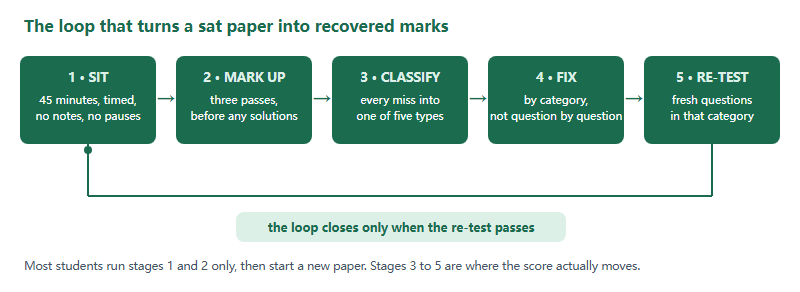
Sitting a BBO past paper earns you nothing. The marks are made afterwards, in how you mark it up, how you classify each miss, and whether you re-test the weakness with fresh questions. One paper reviewed properly is worth more than four papers sat, scored, and filed away — which is what most candidates actually do.
Why the score is the least useful thing a paper gives you
Here is the pattern almost every self-preparing student falls into. Sit a paper. Mark it. Get a number. Feel briefly good or briefly bad about the number. Move to the next paper, hoping the number goes up.
That loop is broken because the number is an aggregate. It tells you that you lost marks; it says nothing about why, and the why is the only part you can act on. Two students can score identically while having completely different problems — one never reached the last six questions, the other reached them all and reasoned four of them wrongly. The same score, two entirely different fixes. Grinding more papers gives both of them another number and no diagnosis.
This matters more in the BBO than in a school exam because of what UKBC says the paper is doing. The questions are framed as testing problem-solving and the application of core principles rather than memorisation, and candidates are expected to meet unfamiliar topics. When a question is unfamiliar by design, “I got it wrong because I did not know it” is almost never the real explanation — the real explanation is usually that you did know the principle and failed to route to it. You cannot see that from a score. You can only see it by interrogating the individual miss.
The three-pass mark-up
Do not look at any solution until you have finished all three passes. This is the whole trick, and it is uncomfortable, because checking answers immediately feels like progress and is genuinely satisfying. It also destroys the information you need.
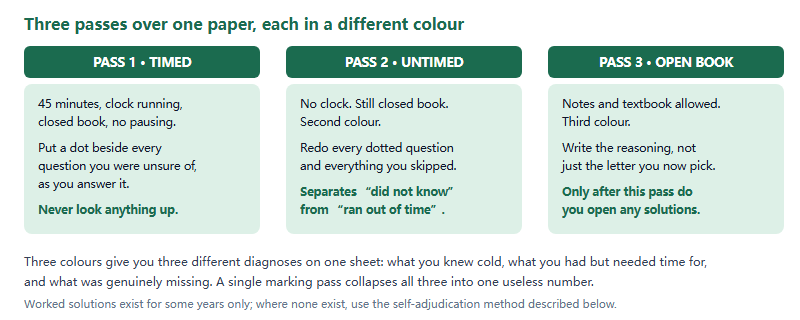
Why it works: a question you answered correctly under time pressure, a question you fixed in pass two with unlimited thinking, and a question you could only resolve in pass three with the textbook open are three completely different states of knowledge. They demand three different responses. After a single conventional marking pass, all three look identical — a tick or a cross.
Pass two is where the largest surprise usually lands. Students routinely recover a meaningful share of their “wrong” answers with nothing but time and no external help. That is not a knowledge problem at all; it is a pacing and confidence problem, and the fix is exam technique, not more content revision. Many students spend a whole autumn revising content to solve a problem that was never about content.
Classify every miss: the five categories
Now open the solutions, and for every question you did not get right in pass one, assign exactly one category. Force yourself to choose one — the discipline of picking is what produces the insight.
| Category | What it looks like | The wrong fix | The right fix |
|---|---|---|---|
| 1. Knowledge gap | You had genuinely never met the concept, and pass three needed the textbook | Re-reading the entire chapter | Learn that concept and its immediate neighbours, then test with fresh questions on the same idea |
| 2. Language / misread | You knew the biology but misread the stem, a term, or which option was asked for | Telling yourself to be more careful | Add the term to a running list; underline the actual question asked before reading options |
| 3. Reasoning slip | Every fact was available to you, but you chained them the wrong way | Memorising more content | Rewrite the chain in full sentences, then do questions with the same reasoning shape |
| 4. Data handling | Misread axes, units or scale — or described a real trend that was not the one asked about | More content revision | Drill graph and table questions specifically; state the trend in words before looking at the options |
| 5. Timing / triage | You never reached it, or you sank several minutes into one question | Sitting more full papers | Set an explicit per-question pace and a hard skip rule, then rehearse both |
Tally the categories after each paper. The distribution is the actual output of the exercise — far more useful than the score. A student whose misses are 70% category 1 has a content problem and should be revising the seven areas. A student whose misses are 70% categories 2, 4 and 5 has a technique problem, and could revise content all autumn without moving their score by much.
Keep the log brutally short: paper, question number, category, one line on the fix. If your error log takes longer than the paper did, you have built a diary rather than a diagnostic and you will stop maintaining it by week three.
The re-test rule: fresh questions, never the same paper
This is the stage almost everyone skips, and it is the one that closes the loop.
After you have fixed a category, you must verify the fix — and you cannot verify it on the paper you just reviewed. You now know those answers. Re-sitting it measures your memory of the review, not your biology, and it will hand you a flattering score that means nothing.
So re-test with fresh questions of the same type. If pass three exposed a gap in water movement through plants, do five unseen questions on plant transport, from a different year, and check whether the category holds. If your problem was category 4, take five data-interpretation questions from any content area — the skill is transferable and you are testing the skill, not the topic. Only when the re-test passes does that entry come off the log.
Where no worked solution exists for a paper — and coverage is genuinely uneven; solutions accompany some years and not others in the pack our teachers have gathered, so check what you actually receive — self-adjudicate with a rule: write your reasoning in full before you decide you were right. If you cannot produce a chain of reasoning that survives your own reading, you did not know it, regardless of whether the letter matched. Students mark themselves generously by default, and a written chain is the cheapest available defence against that.
How many papers, and when
Fewer than you think, reviewed harder than you think.
- Early in the runway (autumn), use papers as a diagnostic, not a rehearsal. One paper, fully reviewed, will tell you which of the seven content areas to prioritise for the next six weeks. Sitting five at this stage mostly produces five similar low scores and some discouragement.
- Mid-runway, alternate: one paper, then a fortnight of category-driven fixing, then the re-test. The paper is punctuation between blocks of work, not the work itself.
- Final weeks, shift towards format rehearsal — full timed conditions matching how your school will actually schedule the two papers, which is worth confirming in advance rather than assuming.
- Always leave unseen papers in reserve. Burning every available year by November means you have no clean instrument left when you most need a reading. Ration them.
How this sits inside the wider plan — content sequencing, the seven areas, the calendar — is covered in our guide to preparing for the BBO. If you are sitting in the China region, replicate the local conditions described in our China exam guide when you run timed papers, since rehearsing the wrong format is a category 5 error waiting to happen. And if you are continuing into an American paper later in the season, your logged categories transfer directly — the content overlap is high, and our BBO-then-USABO plan explains how to carry the diagnosis forward rather than starting a fresh log from scratch.
Four things that quietly waste the papers
Checking answers question by question as you go. It feels efficient and it destroys pass one. You can never again know what you would have done unaided.
Reading papers instead of sitting them. A past paper read like a textbook produces recognition, not retrieval. You will feel you know the material and score as though you do not.
Memorising specific answers. Do not count on questions repeating, and the paper is built to put unfamiliar contexts in front of you. Memorising outputs is preparation for an exam that does not exist.
Reviewing only what you got wrong. The correct-but-guessed question is the most dangerous item on the paper: it scored, so it looks fine, and it will not score next time. That is exactly what the pass-one dots are for.
None of this is complicated. It is just slower and less pleasant than collecting scores, which is precisely why so few candidates do it — and why the ones who do tend to move faster from the same number of papers.
Frequently asked questions
How many BBO past papers should I do?
Fewer, reviewed harder. One paper fully classified and re-tested beats four sat and scored. Keep unseen papers in reserve for later readings.
Should I re-sit a paper I have already reviewed?
No. You know the answers, so it measures memory of the review. Re-test the weak category with fresh questions instead.
What if there is no worked solution for that year?
Self-adjudicate by writing your full reasoning before deciding you were right. Solutions accompany some years only.
My score is not improving across papers. Why?
Usually because you are collecting scores, not classifying misses. Tally your error categories — the pattern shows whether the problem is content or technique.
This is an independent guide operated by Hanlin Education for China-based international-school students. We are NOT affiliated with, endorsed by, or sponsored by UKBC or the Royal Society of Biology, and we do not administer the competition or publish its papers. Formats, dates and materials change between seasons — confirm current details on the UKBC official pages. Errors reported to our editorial desk are corrected within 7 working days.