
You marked a British Biology Olympiad past paper, scored 96, and want to know whether that is a bronze. The honest answer is that it depends entirely on which season's paper you marked. Award boundaries from the 2022 to 2024 seasons sit above 80 marks. Boundaries from 2020 and 2021 sit between the low 30s and the low 60s. Same competition, two different mark scales.
Five seasons of boundaries, and the break in the middle
The table below is drawn from our own operations records rather than from a live UKBC page, so treat it as an archive, not as a forecast. It sets out the mark needed for each award category in five past seasons. Read the shaded rule in the middle of it as a wall, not as a gradient.
| Season | Gold | Silver | Bronze | Highly Commended | Commended |
|---|---|---|---|---|---|
| 2024 | 113.20 | 103.30 | 96.05 | 90.68 | 86.09 |
| 2023 | 106.64 | 98.43 | 91.72 | 86.69 | 81.96 |
| 2022 | 118.35 | 105.15 | 94.62 | 87.98 | 82.34 |
| Mark scale changes below this line — do not compare across it | |||||
| 2021 | 63 | 57 | 53 | 47 | 44 |
| 2020 | 51 | 46 | 43 | 37 | 33 |
Two things follow immediately. First, anybody quoting you a single number as the gold boundary is quoting one season and calling it a rule. Second, any revision plan built on a 2020 or 2021 paper combined with a 2024 boundary is arithmetic nonsense. These are not small differences of a few marks. They are different measuring sticks.
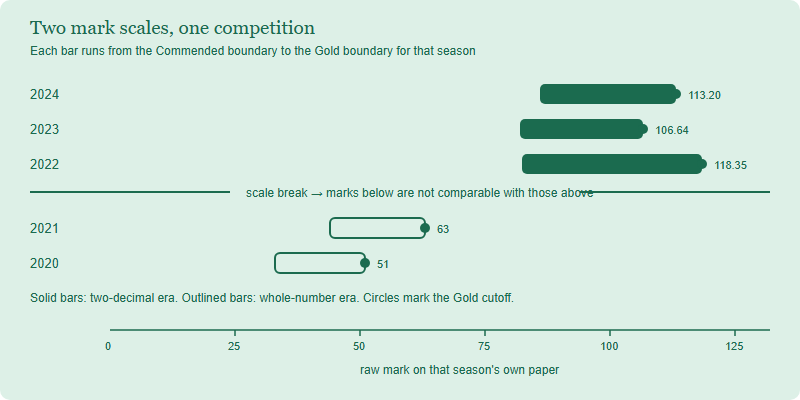
Read the decimals: a boundary is not a question count
Notice that the recent boundaries carry two decimal places. A cutoff of 96.05 cannot come from a paper where every item is worth one mark and every correct answer adds a whole number. Decimals imply weighting of some kind, whether across items, across sections, or between the two papers.
That detail kills the most common question students ask us, which is some version of: how many questions do I need right for bronze? A boundary alone cannot answer it. UKBC describes the olympiad as two forty-five minute online multiple-choice papers, sat under supervision at your registered school and completed either together or on separate occasions. In the papers we work through with students the number and mix of items has varied between seasons, which is exactly why we do not publish a fixed question count. Plan in marks and bands. Never plan in questions.
The higher the band, the less stable the cutoff
Stay inside the 2022 to 2024 era, where the marks are comparable, and something genuinely useful appears. Compare how far each boundary travelled across those three seasons.
| Award | Lowest of the three | Highest of the three | Swing | What that means for a target |
|---|---|---|---|---|
| Gold | 106.64 | 118.35 | 11.71 marks | Heavily season-dependent. A gold target is a moving target. |
| Silver | 98.43 | 105.15 | 6.72 marks | Still moves noticeably between seasons. |
| Bronze | 91.72 | 96.05 | 4.33 marks | Comparatively steady. A sensible first target. |
| Highly Commended | 86.69 | 90.68 | 3.99 marks | The most stable band in the archive. |
| Commended | 81.96 | 86.09 | 4.13 marks | Stable. |
That asymmetry across the three comparable seasons in our records is worth noting, though three seasons is a small sample. Boundaries are set against a distribution of scores, and the top of any distribution is thin. A paper that turns out slightly harder or slightly kinder moves the top few per cent of a cohort much further than it moves the middle. The practical consequence is blunt: the higher you aim, the more of your outcome is decided by which paper you happen to sit.
A student planning around bronze is planning around something reasonably solid, roughly a four-mark band of uncertainty. A student who has decided that anything short of gold is failure has attached their entire self-assessment to the least predictable number in the whole scheme, one that moved nearly twelve marks in three years. That is not a reason to lower ambition. It is a reason to keep the ambition and stop treating one January morning as a verdict. If your spring already contains a second olympiad paper, a hard January stops being the whole story, which is most of the logic behind our BBO then USABO double plan.
The mechanism almost nobody explains: you are placed, not ranked
Here is the part that changes how an entrant outside the UK should read every number above. UKBC sets the award boundaries using the scores of students at UK schools, and those boundaries are then applied to all participating students. Entrants elsewhere are not ranked alongside the UK field. They are measured against the cutoffs that field produced.
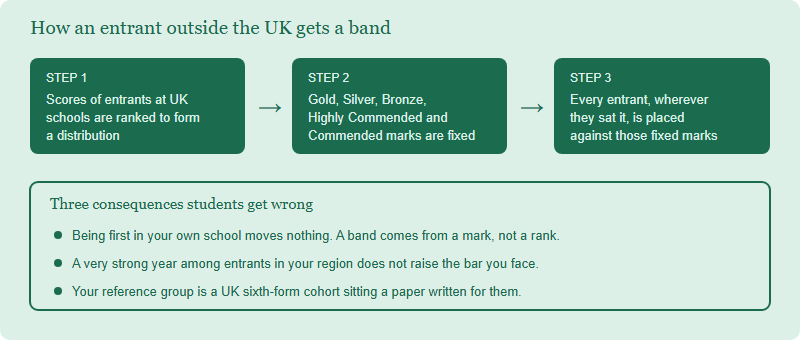
Read the good news in that as well as the bad. Because you are placed rather than ranked against your neighbours, nothing your classmates do can push you out of a band. There is no quota for entrants at your school, and no competition with the person sitting beside you. The only variable in the system that you control is your own mark, which is precisely the kind of target a revision plan can act on.
Marking your own mock without fooling yourself
Put the archive to work with a five-step protocol. It adds about ten minutes to each mock and removes most of the self-deception that mock marking otherwise invites.
- Identify the era before you identify the band. Look at the paper's total mark. If it belongs to the two-decimal era, use the 2022 to 2024 rows. If it belongs to the earlier whole-number scale, use only the 2020 and 2021 rows and expect much smaller numbers.
- Never cross the wall. Applying a 2024 cutoff to a 2021 paper will tell a capable student they have failed and tell a weaker student they are close to gold. Both readings are false, and both change behaviour for months.
- Report yourself a range, not a point. Say “in the bronze region in two of the three comparable seasons” rather than “I got bronze.” The range is the honest unit, because the boundary itself moves.
- Mark three papers from the same era before you believe anything. One paper measures how well that particular paper suited you. Three start to measure you. Where those mocks sit inside a term is set out in our preparation guide.
- Treat every number here as history. The organiser sets boundaries season by season against that season's paper and field. Confirm current categories and cutoffs on the UKBC official pages before planning around them.
A worked example makes the third rule concrete. Suppose you score 96 on a paper from the two-decimal era. Against the 2024 boundaries you are 0.05 of a mark below bronze. Against 2023 you clear bronze by more than four marks. Against 2022 you clear it by nearly one and a half. The same performance is a bronze in two seasons out of three and a near miss in the other. Nothing about you changed between those three readings. If you take a single one of them as your verdict, you have learned nothing except which row you happened to look at.
What a boundary archive cannot do for you
It cannot predict next season. Boundaries follow the paper and the field, and neither is knowable in August. It cannot be converted into a number of correct answers, because we cannot source how marks are allocated to items and the number and mix of items has varied between seasons. It cannot substitute for current official information either: dates, registration arrangements, eligible year groups and the award scheme itself are the organiser's to publish, and for a new season you should confirm them on the UKBC official pages rather than trusting anything written months earlier, including this page.
What it does do is make your own mock results legible. Most students preparing from outside the UK are marking papers in a vacuum, converting a raw number into a mood rather than into information. A season-aware boundary table converts the same number into a band range, a swing estimate and a next action. If you are sitting the paper through a school in China, the arrangements around the real sitting are set out in our China-region exam guide; our own experience is that registration closes in early January and the paper is sat in mid-January, but the organiser publishes the definitive dates each season.
Frequently asked questions
Can I use a 2024 boundary to grade a 2021 past paper?
No. The two seasons use different mark totals, so a 2024 cutoff applied to a 2021 script produces a meaningless result.
Why do the recent boundaries have decimal places?
The recent boundaries are quoted to two decimal places in our records, which is one reason we do not convert a cutoff into a number of correct answers; confirm how marks are awarded on the UKBC official pages.
Does a strong cohort at my school make gold harder for me?
No. Boundaries are built from the UK-school field and then applied to everyone, so your classmates cannot affect your band.
Which award band is the sensible first target?
Bronze or Highly Commended. Across the three comparable seasons those cutoffs moved about four marks, against nearly twelve for gold.
This is an independent guide operated by Hanlin Education for China-based international-school students. We are not affiliated with, endorsed by, or sponsored by UKBC or the Royal Society of Biology, and official administration of the competition rests with the organiser. The boundary figures above come from our own records and are historical; confirm current dates, categories and cutoffs on the UKBC official pages. Errors reported to us are corrected within 7 working days.