
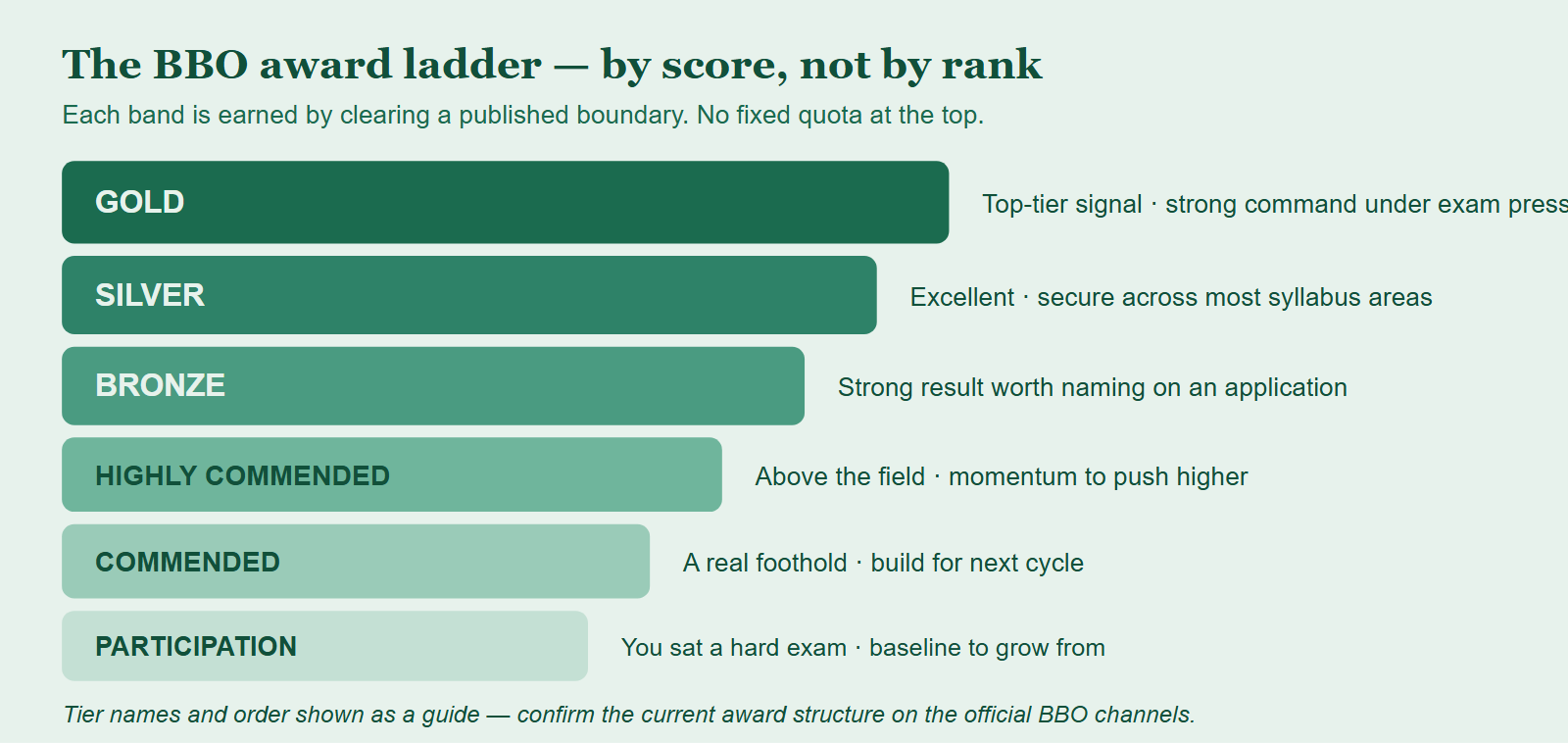
The British Biology Olympiad (BBO) awards by score, not by rank. Everyone who beats a published boundary earns the same medal, so there is no fixed quota at the top. The ladder runs Gold, Silver, Bronze, and lower commendation tiers (such as Highly Commended and Commended) down to Participation. The exact tier names and cut-offs are set yearly — confirm current boundaries on the official BBO channels.
Why BBO awards are score-based, not rank-based
This is the single most important thing to understand about your result, and it is also where students from a competition-heavy background most often guess wrong. The BBO does not say “top 50 students get Gold.” Instead, UK Biology Competitions (UKBC) publishes a set of score boundaries after marking, and your award depends only on whether your raw score crosses those lines. If three thousand students all clear the Gold boundary, three thousand students get Gold. If only a handful do, only a handful do.
That design has a real consequence for how you should read your own performance. A Gold one year is not “harder” or “easier” than a Gold the next year in the sense of beating more rivals — it is calibrated against the paper’s difficulty through the boundary. The organiser moves the boundaries up or down each cycle precisely because papers vary. So when you compare your mark to a friend’s from a previous year, you are comparing two different boundary tables, not two places on one leaderboard.
What each tier actually signals
Reading an award is not just “higher medal = better.” Each tier carries a slightly different message to a reader — an admissions tutor, a teacher writing a reference, or you planning next year.
- Gold — the top recognised tier. It signals that you applied biology confidently to unfamiliar problems under timed conditions, not that you memorised a textbook. For a strong biology applicant, this is the headline result.
- Silver — an excellent outcome that shows secure handling across most of the syllabus, usually with a clear, reachable path to Gold the following year if you tighten a few areas.
- Bronze — a strong result that is genuinely worth naming on a personal statement or supplemental application. It marks you out from the broad field.
- Highly Commended / Commended — the lower commendation tiers. These are easy to underrate. They place you above a large cohort of capable students and, more usefully, give you a precise diagnostic of where the marks were left on the table.
- Participation — you took on a hard, university-flavoured exam early. That is a credible starting baseline, and many of our students who finished here moved up a tier or two the next year.
Two honest caveats. First, the medal is one signal, not the whole story — what you do with biology (projects, reading, follow-on competitions) matters as much as the colour of the award. Second, the precise list of tiers and any tier above or between these can change; the structure above is a working guide, and the authoritative version lives with the organiser. See the live competition results page for the current framing.
How boundaries work (and why last year’s numbers are only a guide)
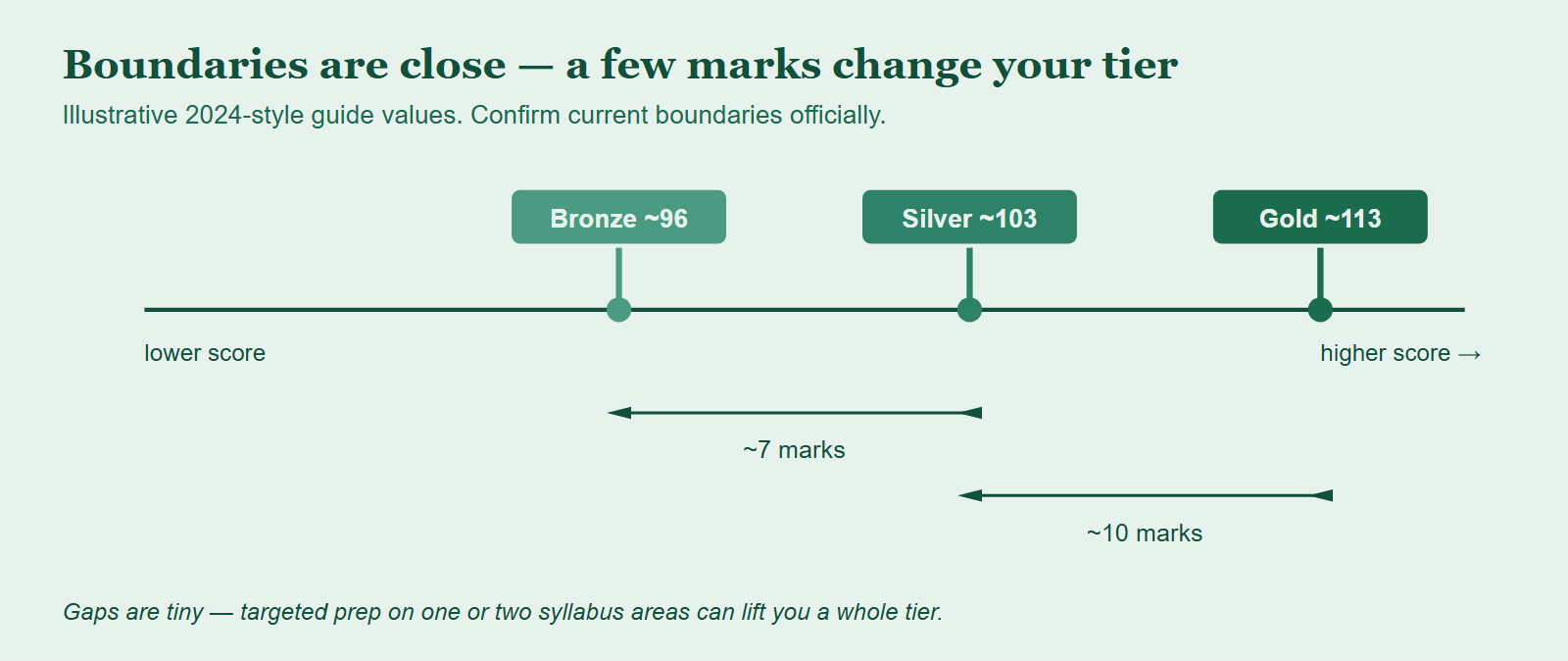
Because awards hinge on boundaries, it pays to understand them concretely. As a guide only, the 2024 cycle landed in the region of ~113 for Gold, ~103 for Silver, and ~96 for Bronze. Treat those as a feel for the gaps between tiers, not as targets — boundaries are re-published every year and you should confirm the current ones on the official channels.
The practical takeaway from those numbers is the spacing. The jump from Bronze to Silver and from Silver to Gold is often only a handful of marks. That is a coaching gift: it means small, targeted gains — one cleaner genetics section, two fewer careless ordering-question errors — can move you a full tier. It also means a result a few marks below a boundary is not a different kind of student; it is the same student a couple of questions away.
Turning your tier into a next step
Whatever band you land in, the useful question is “which marks were within reach?” The BBO is a short online exam with multiple-choice, fill-in, and ordering questions, drawn from seven core areas: cell biology; plant anatomy and physiology; animal anatomy and physiology; animal behaviour; genetics and evolution; ecology; and taxonomy. That content maps onto strong A-level/AP biology plus some first-year university material, with Campbell Biology (alongside your AP/A-level resources) as the standard text.
From our own coaching records, the leverage is real: in the 2026 season our biology cohort earned 26 BBO Golds, 21 Silvers, and 5 Bronzes, and 5 students went on to reach the USABO US-region Semifinal (figures per Hanlin Education’s own records). The pattern behind those results is unglamorous — identify the two weakest syllabus areas, drill unfamiliar-problem questions rather than recall, and rehearse pacing on the ordering and fill-in items where careless marks leak away.
There is also a strategic reason the medal matters beyond the certificate. BBO shares roughly 90% of its content with the USA Biology Olympiad (USABO), which sits in late March, so a strong BBO result is a launchpad into a second, complementary competition. If you are mapping that route, our note on sitting BBO then USABO walks through the timing. International and China-region students should note an eligibility nuance: you take part for BBO recognition, not for the UK’s International Biology Olympiad (IBO) team, which is selected through a separate UK-based path — our China-region exam guide covers how that works in practice.
To prepare, start with the official format on the competition rules page, then build a study plan from our BBO preparation guide. For drilling, we maintain a collected free pack of BBO past papers — scan the QR code on this site or message us to get it (worked-solution coverage varies by year, and our teachers add more over time). We are an independent guide, so for registration, official dates, and your verified result, always confirm on the official BBO channels.
Frequently asked questions
Is BBO Gold capped at a fixed number of students?
No. Awards are decided by score against published boundaries, so any student who clears the Gold boundary earns Gold — there is no fixed quota at the top. Confirm the current award structure on the official BBO channels.
What were the 2024 award boundaries?
As a guide only, 2024 sat around 113 for Gold, 103 for Silver, and 96 for Bronze. Boundaries are re-published every year, so treat these as a feel for the gaps and confirm current boundaries officially.
Does a Commended or Highly Commended award still count?
Yes. The lower commendation tiers place you above a large field of capable students and give you a precise diagnostic for next year. Many students move up one or two tiers in a following cycle with targeted preparation.
Do international and China-region students get the same award tiers?
International students take part for BBO recognition against the same score-based ladder; the UK’s IBO team is selected through a separate UK-based path. For exact eligibility and how your result is reported, confirm on the official BBO channels.
This is an independent English-language guide to the British Biology Olympiad for international and China-region students, operated by Hanlin Education. It is not affiliated with, endorsed by, or sponsored by UK Biology Competitions (UKBC) or the Royal Society of Biology. Rules, dates, eligibility and results are set by the organiser — always confirm current details through the official BBO channels.