
Two facts about BBO entry point in the same direction. Only your school can register you, and the fee for schools outside the UK has been charged per school rather than per candidate. So a teacher entering five students does roughly the same administrative work as a teacher entering one. That turns a solo request into a proposal — and hands you a ready-made study set.
The entry rules make a group the natural unit
UKBC states that only recognised educational institutions may register students for the British Biology Olympiad — state-funded and independent schools, further education colleges and international schools among them — and that individuals and private tutoring companies cannot register. Teachers complete registration through the login portal. The paper is then taken entirely online, on-site at the registered school or college.
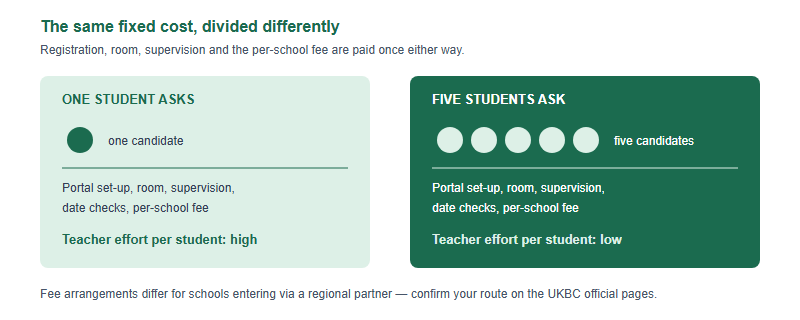
Read those constraints as an economist would. The unit of entry is not the student. It is the school. Everything that makes entry troublesome for a teacher — finding the portal, reading the instructions, booking a room, arranging supervision, checking the dates — is a fixed cost paid once, whether one student sits the paper or fifteen do. On the fee side, the last published cycle charged UK schools nothing and schools outside the UK a per-school fee of £30, again not per candidate; schools entering through a regional partner rather than directly may be charged on a different basis, so confirm which route applies to yours on the UKBC official pages.
The consequence is the whole argument of this article. A lone student asking to be entered is asking a teacher to absorb a fixed cost for one person. A set of five students asking to be entered is asking for the same cost, spread. Nothing about your individual case improved; the proposal did.
Who to recruit, and who not to
Four to six students is the workable range. Below four and the seven content areas cannot be shared without someone carrying two heavy areas alone. Above about six and sessions turn into lectures, attendance decays, and the quiet members stop preparing because nobody will notice.
Recruit for coverage rather than for ability. A group of five students who are all strong on cell biology and all thin on plants has not solved anything; it has merely made the same gap sociable. The most useful groups we see are deliberately mixed: someone who reads widely, someone who is quick with data and graphs, someone strong on genetics problems, someone who has actually studied ecology, and frequently one student on a lighter biology course who is entering on reasoning strength. That last person is not a passenger. They ask the questions that expose where everyone else is running on half-remembered assumptions.
Two people to leave out, kindly. The student who wants the certificate but will not do the reading, because a group tolerates one free rider and then dissolves. And the student who cannot commit to a fixed weekly slot — an irregular attender forces you to re-cover material and quietly converts your sessions into remedial teaching for one person.
Dividing the seven areas without dividing the learning
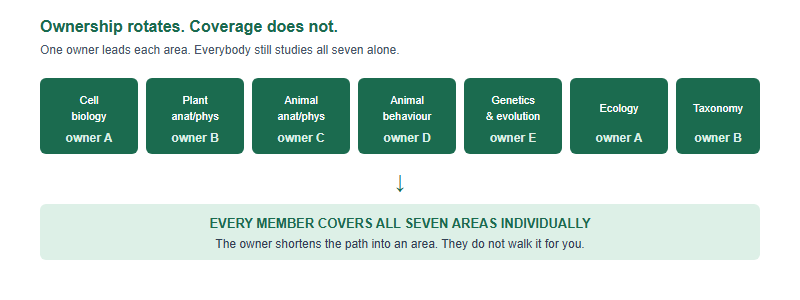
The obvious move is to split the seven content areas — cell biology, plant anatomy and physiology, animal anatomy and physiology, animal behaviour, genetics and evolution, ecology and taxonomy — one per person, and let each become the resident expert. It is also the mistake that ruins most study groups, because the paper is sat alone. If you own taxonomy and merely attend the plants session, you will have taxonomy at depth and plants at the level of a person who once watched a presentation about them.
Separate the two roles instead. Ownership is a preparation job: the owner of an area reads ahead, prepares the session and builds practice items for everyone. Coverage is non-negotiable and individual: every member studies every area, on their own, regardless of who owns it. The owner shortens everyone else's path into an area. They do not walk it for them.
An eight-week cycle that produces something
A group session that consists of talking about biology feels productive and leaves nothing behind. Give every meeting an output that outlives it. The cycle below assumes one ninety-minute meeting a week and independent work in between; it maps onto the wider season plan in our BBO preparation guide.
| Week | Owner leads | Session shape | Everyone does before the session | Output kept |
|---|---|---|---|---|
| 1 | Plant anatomy and physiology | Owner teaches the map of the area, then the group works items together | Read the area to recognition level; list three things you do not understand | Ten practice items, filed in a shared bank |
| 2 | Taxonomy | Rapid recognition drilling in pairs, then a group key-reading exercise | Recognition pass over the major groups | A shared recognition list the group actually agreed on |
| 3 | Animal behaviour | Owner presents mechanisms; group predicts outcomes before being told | Read the area; bring one behaviour you cannot explain | Ten items plus a list of unresolved questions for a teacher |
| 4 | — none — | Timed paper, sat individually and in silence | Nothing new; sleep | Five marked scripts and a group weakness table |
| 5 | Ecology | Graph and data work; every member interprets before discussion | Read the area; revisit the week 4 items you lost | Ten data-handling items |
| 6 | Genetics and evolution | Problem clinic — no presenting, only working problems | Attempt the owner's problem set cold | Worked solutions the group argued to consensus |
| 7 | Animal and cell biology | Two short owner sessions, then mixed-area rapid items | Close the two weakest rows of your own week 4 table | Twenty mixed items across both areas |
| 8 | — none — | Second timed paper, then a group review | Nothing new | Compare with week 4; each member leaves with three named targets |
Weeks 4 and 8 carry the whole cycle. A group weakness table — which areas the group as a whole lost marks in, and which failure types recurred — is information no solo candidate can generate, because one script cannot distinguish “I found this hard” from “this was hard.” If four of five members missed the same kind of item, that is a content gap to fix together. If one member missed it alone, that is individual homework.
Sit those timed papers under conditions close to the real thing. UKBC describes two forty-five-minute multiple-choice papers taken entirely online, on-site at the registered school, so silence, screens and a clock matter more than the room. The China-region arrangements are covered in our BBO China exam guide.
The three ways a group quietly fails
Groups do not usually collapse. They degrade, and always in one of three directions.
- The strongest member becomes a lecturer. One person knows the most, so they talk the most, and everyone else stops preparing because listening is easier than reading. Countermeasure: the owner may present for no more than twenty minutes; the rest of the session is everyone working items. A session where one person speaks for an hour is a lesson, and you can get those from a teacher.
- Marking drifts to consensus. Because official worked answers do not accompany the past papers, a group has to resolve disputed items itself — and five people agreeing is not evidence. The rule that fixes it: any disputed item is settled against a written source or it goes on a list for a teacher. Never settle a biology question by vote.
- The calendar eats it. Groups formed in September routinely die in late November when coursework deadlines land. Countermeasure: fix the slot before the term fills up, keep the meeting even when only three people can come, and shorten rather than cancel. A forty-minute session with three people preserves the habit; a cancellation starts a chain.
What the group cannot do for you
Be precise about the boundary. The paper is sat individually, the marks are individual, and the awards — Gold, Silver, Bronze, Highly Commended, Commended and Participation — are given to individuals. There is no team element and no shared score. Nothing about a group changes what you personally have to know on the day, and results vary between members of every group we have taught.
What a group actually buys is narrower and still worth having: it makes your school's decision to register easier, it gets the thin content areas covered faster than any of you would cover them alone, it produces a bank of practice items no individual would have built, and it makes a January sitting a normal thing at your school rather than an eccentric one. That last effect compounds. A school that entered five students this year usually enters more the next, and the students who sit it in Year 12 come back in Year 13 with a season of experience behind them.
One last piece of leverage. The content built by a group in the autumn does not expire in January — the overlap with the spring biology olympiad season is heavy, which is the basis of the BBO-then-USABO sequence. A group that keeps meeting past the January sitting is already halfway prepared for the next paper, using a bank it wrote itself.
Frequently asked questions
Can a group of students register themselves for the BBO?
No. UKBC states only recognised educational institutions may register students; individuals and tutoring companies cannot. Ask your school.
Does entering more students cost the school more?
The last published cycle charged non-UK schools a per-school fee, not per candidate. Partner routes differ, so confirm officially.
How many students make a workable study group?
Four to six. Fewer cannot cover the seven content areas fairly; more turns sessions into lectures and attendance decays.
Should we include someone on a lighter biology course?
Yes. Mixed groups expose lazy assumptions faster, and the paper is sat individually anyway, so nobody is held back.
This is an independent English-language guide to the British Biology Olympiad, operated by Hanlin Education for China-based international-school students. We are not affiliated with, endorsed by, or sponsored by UK Biology Competitions (UKBC) or the Royal Society of Biology, and official competition administration rests with the organiser. Registration rules, fees, dates and award boundaries are set by the organiser and can change between seasons — confirm current details on the UKBC official pages. Errors brought to our attention are corrected within 7 working days.