
You do not need to be a biology specialist to enter the British Biology Olympiad. UKBC states eligibility in year groups rather than in subjects, so a student on IB Biology SL, on AP Biology alone, or taking no biology at all is not barred by the rules. Whether it is a good use of your autumn is a different question, and it turns on one thing: the knowledge floor.
What the organiser requires, and what it does not
Start with what is actually written down. UKBC expresses BBO eligibility in British year groups — Y12 and Y13 in England and Wales, Y13 and Y14 in Northern Ireland, S5 and S6 in Scotland — and entry runs through recognised educational institutions, with international schools named among them. Individuals and private tutoring companies cannot register students; your school does it. Confirm the current wording on the UKBC official pages before you build a plan on it, because eligibility statements are the organiser's to change.
Notice what is absent from that. There is no stated requirement to be taking biology, no minimum grade, no course prerequisite. This surprises students who assume an olympiad must be gated behind the hardest available course. It is not.
There is, however, a practical wrinkle that catches non-specialists specifically. Because registration is done by the school, it is usually the biology department that holds the login and decides who is entered. If you are not in anyone's biology class, no teacher is automatically thinking of you when the entry list goes round. That is an administrative problem, not an eligibility problem, and it is solved by asking early — in September, not in December when the teacher is closing the list.
Why the paper's design partly favours you
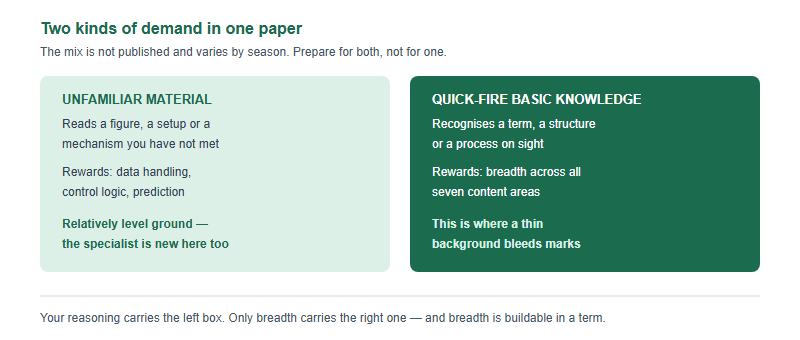
Here is the part that makes this decision genuinely interesting rather than obviously hopeless. UKBC describes the BBO as presenting students with topics and ideas they are not familiar with, and says the paper assesses biological intuition, logic and imagination, alongside some quick-fire questions of basic knowledge.
Read that carefully. The unfamiliarity is deliberate. On the reasoning items, the specialist sitting next to you is also meeting the material for the first time — that is the design. Two years of HL biology does not convert an unfamiliar problem into a familiar one; it converts some of them into slightly-less-unfamiliar ones. What actually decides those items is whether you can read a figure you have never seen, hold a mechanism in your head and predict what happens when one variable moves.
That is why students who are strong in chemistry, physics or mathematics but light on biology often do better than they expect on part of this paper. Data handling, control logic, proportional reasoning and the discipline of not over-reading a trend all transfer directly.
Where a thin background actually costs you
Now the honest half. Reasoning has a precondition: you have to be able to enter the question. If a stem refers to a structure, a process or a group of organisms and the word means nothing at all to you, there is no reasoning move available. You are not solving a hard problem slowly; you are locked out of an easy one.
In the students we coach, that lock-out concentrates in three places rather than being spread evenly. First, taxonomy and the diversity of organisms, which most school courses treat lightly wherever they are in the world. Second, plant anatomy and physiology, routinely the thinnest area for students whose course leaned towards human biology. Third, animal behaviour, which many students have simply never studied as a subject with its own vocabulary and logic.
The useful news is that the floor is much lower than the ceiling. To attempt a question you need to recognise the vocabulary and hold a rough model of how the thing works. To win a gold you need far more. A student with a lighter biology background who spends a term building recognition-level breadth across all seven areas is playing a very different paper from one who arrives with depth in two areas and blanks on the other five.
| Content area | Typical state on a lighter biology course | What the floor requires | Cheapest way to reach it |
|---|---|---|---|
| Cell biology | Usually the strongest area, since almost every course covers it | Organelles, membranes, the main metabolic and division processes in outline | Little work needed — verify, do not re-study |
| Genetics and evolution | Often reasonably covered, but mechanism-light | Inheritance patterns, selection, and reading a pedigree or a cross | Problem practice, not reading — this area is trained by doing |
| Animal anatomy and physiology | Strong on human systems, thin on comparative and non-mammalian material | The main organ systems and how the same problem is solved differently across groups | Read comparatively: one system at a time, across several groups |
| Plant anatomy and physiology | Commonly the thinnest area for human-biology-leaning students | Tissue types, transport, gas exchange, growth responses, reproduction in outline | The highest-return week of the whole plan — do this first |
| Ecology | Concepts often present, quantitative treatment usually absent | Energy flow, cycles, population dynamics, and reading ecological data | Pair concepts with graph work; the maths is not hard |
| Animal behaviour | Frequently never studied as a named subject | Core vocabulary and the logic of why a behaviour is favoured | A short, focused pass — small area, disproportionate return |
| Taxonomy | Thin almost universally, regardless of course | Major groups and their defining features; how a key works | Recognition drilling, not memorising full classifications |
Two lines in that table do most of the work. Plants and taxonomy are where the non-specialist and the HL specialist are often closer than either expects, because school courses under-serve both. A term spent there closes more of the gap than a term spent going deeper into cell biology you already half-know. The full sequencing of that work sits in our BBO preparation guide.
Three profiles, three different answers
“Should I enter without HL biology?” is really three different questions, and they do not share an answer.
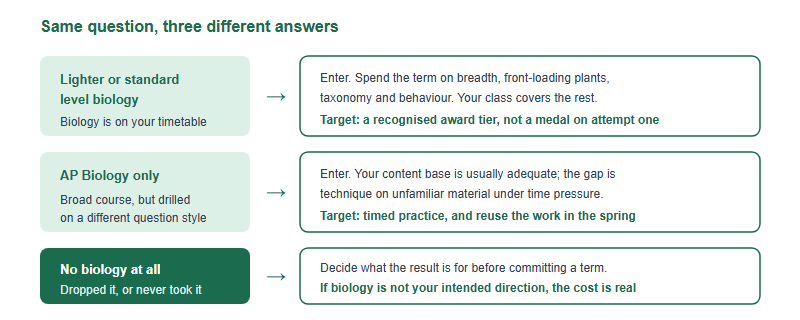
The third row is the one worth dwelling on. If you dropped biology and are applying for a course with no biological content, a BBO award is a pleasant thing that points nowhere in particular, and the term it costs could have gone into something aligned. Nothing about entering is wrong; it simply has to be worth the hours to you. If, on the other hand, you dropped biology but are aiming at medicine, biomedical sciences, psychology with a biological strand or environmental science, the calculation flips completely: the award is evidence of exactly the interest your application otherwise struggles to demonstrate.
What to expect, honestly
Three expectations worth setting before you commit.
- The award ladder has more than three rungs. UKBC lists Gold, Silver, Bronze, Highly Commended, Commended and Participation. A student building breadth from a lighter background in one term should be aiming at a recognised tier, not assuming a medal — and outcomes vary between individuals with no result guaranteed to anyone.
- Format constrains what you can rescue on the day. UKBC describes two forty-five-minute multiple-choice papers taken entirely online, on-site at your registered school. There is no essay in which to display partial understanding, so recognition-level breadth is not optional polish; it is the mechanism by which marks arrive. The China-region arrangements are set out in our BBO China exam guide.
- The work is reusable. The breadth you build for a January paper transfers directly to the spring biology olympiad season, because the content overlap between them is heavy — the logic behind the BBO-then-USABO sequence. A non-specialist who commits a term is buying two seasons of preparation, not one.
The summary is unglamorous and freeing. The rules do not ask what you study. The paper asks whether you can reason on unfamiliar ground, which is a skill you may already have, and whether you recognise enough biology to get into the question, which is a gap you can close in a term if you aim it at the right areas. Decide on those two facts, not on whether your timetable says HL.
Frequently asked questions
Do you need A-level or IB HL Biology to enter the BBO?
UKBC states eligibility in year groups, not subjects. Confirm the current wording officially, but a lighter biology course does not bar you.
Can a student who dropped biology still enter?
Eligibility turns on year group and school registration, not subject choice. The real question is whether a term spent closing the gap is worth it.
Is the BBO easier for strong reasoners from other sciences?
Partly. Unfamiliar material rewards transferable reasoning, but quick-fire knowledge items still punish thin breadth across the seven areas.
Which area should a non-specialist study first?
Plant anatomy and physiology, then taxonomy and animal behaviour. These are thin for most students, so the return per hour is highest there.
This is an independent English-language guide to the British Biology Olympiad, operated by Hanlin Education for China-based international-school students. We are not affiliated with, endorsed by, or sponsored by UK Biology Competitions (UKBC) or the Royal Society of Biology, and official competition administration rests with the organiser. Eligibility, formats, dates and award boundaries are set by the organiser and can change between seasons — confirm current details on the UKBC official pages. Errors brought to our attention are corrected within 7 working days.