
The British Biology Olympiad (BBO) is a short online exam with no laboratory component. You sit it at your registered school on a fixed window, working through timed papers built from three question styles — multiple-choice, fill-in, and ordering (sequencing). It rewards applying biology to unfamiliar problems, not memorising facts, and you are scored against published award boundaries rather than ranked against classmates.
That single paragraph already separates the BBO from most exams international students expect. There is no practical bench, no equipment list, no viva. If you have been picturing a wet-lab olympiad, recalibrate now — the BBO is a reading-and-reasoning paper you take on a screen. This guide stays narrowly on the format: how it is delivered, how long it runs, what the question types feel like, and how the marking works. For the broader “should I do it” and “how do I revise” questions, see our BBO preparation guide.
Online delivery: where and how you sit it
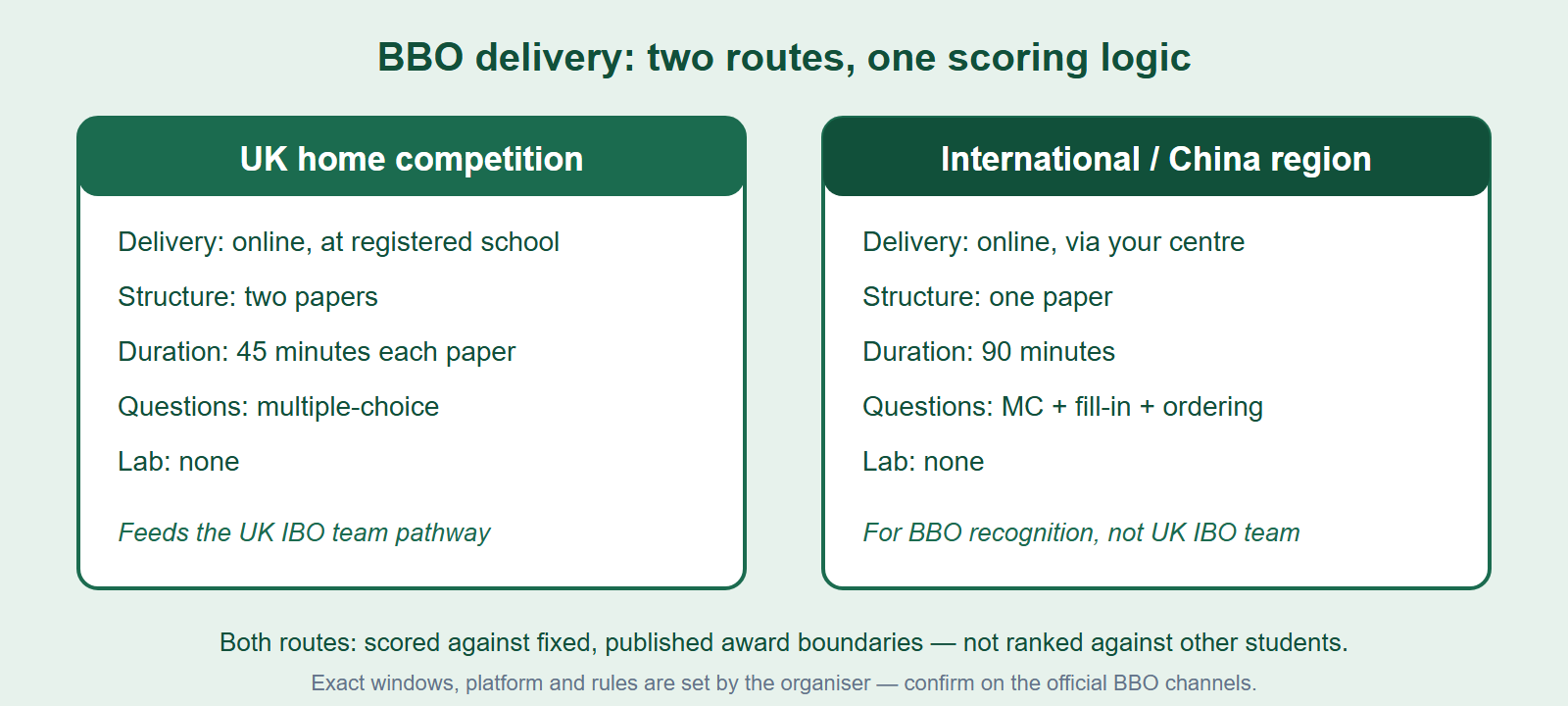
The BBO is administered online. UK home-competition entrants sit it at their registered school inside an official window; international and China-region students take it online as arranged through their centre. The Royal Society of Biology, via UK Biology Competitions (UKBC), sets the platform, the exact timing, and the invigilation rules — those are organiser decisions, so always confirm on the official BBO channels for your cohort.
Two consequences matter for planning. First, because it is online and timed, you cannot pause, research a question mid-paper, or come back tomorrow — treat every practice run as a closed-book sprint. Second, the delivery differs slightly between the UK route and the international route, and so does the paper structure. We break that split down below; the authoritative version always lives on the organiser’s pages and on our BBO competition rules summary.
Timed, not open-ended: length and pacing
The BBO is strictly timed, and the clock is the hard part. On the UK home route the paper is split into two 45-minute papers. On the international/China-region route it is a single 90-minute paper. Either way you are looking at roughly an hour and a half of dense, fast biology with no breaks to think slowly.
The pacing trap is that BBO questions are readable but not quick. A stem may hand you an unfamiliar enzyme pathway, a phylogenetic tree, or an ecology dataset you have never seen, then ask you to reason from it. Strong candidates do not try to answer every question in order — they triage, bank the questions they can resolve fast, and ring-fence the time-sinks. The only reliable way to build that instinct is to practise full papers under the real clock, which is exactly why we treat timed past-paper runs as the core of preparation. Mark each run honestly, log which of the seven syllabus areas keeps costing you minutes, and watch the trend across papers.
The three question types, at a high level
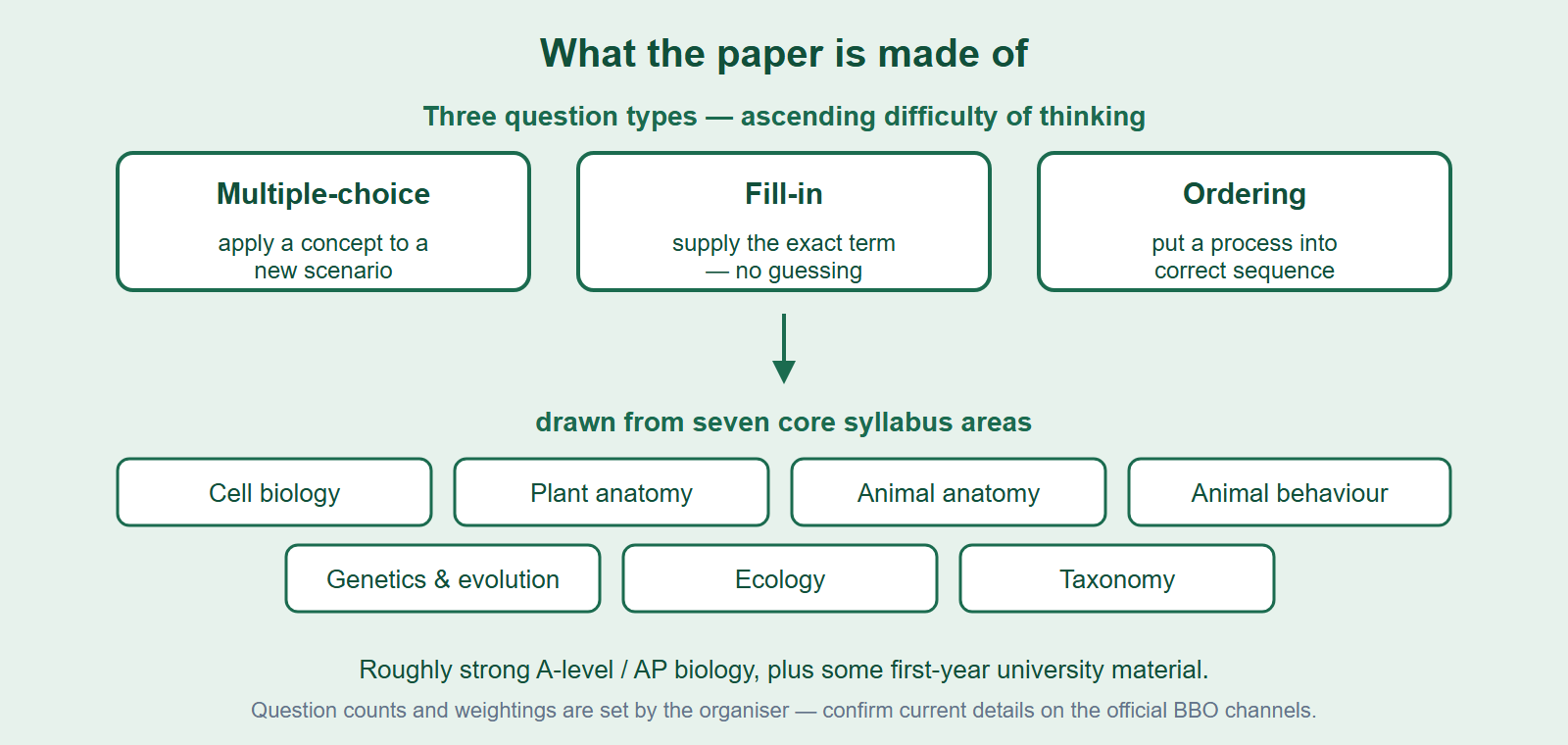
The international paper draws on three formats. You do not need to “study the formats” so much as recognise what each is testing:
- Multiple-choice — the backbone of the paper. These reward precise reasoning under uncertainty: several options will look plausible, and the discriminator is whether you can apply a concept to an unfamiliar scenario, not whether you have memorised a definition.
- Fill-in — you supply a missing term, value, or label rather than picking from options. There is nowhere to hide and no lucky guess; you either know the biology precisely or you do not. These reward exact vocabulary and clean recall of mechanisms.
- Ordering (sequencing) — you arrange steps, structures, or events into the correct sequence: a metabolic pathway, a developmental cascade, a taxonomic hierarchy, an ecological succession. These test whether you understand process and causal order, which is where rote learners tend to slip.
Together the three types push you up the cognitive ladder: recognise, recall, then reconstruct. That is by design — the BBO is built to reward applying biology to unfamiliar problems, and the question mix is the mechanism that makes rote memorisation insufficient on its own.
No lab — and why that changes how you prepare
There is no practical or laboratory section in the BBO. Nothing is weighed, measured, dissected, or pipetted. That makes it unusually accessible for international students — you need a stable internet connection and a quiet room, not a school lab — but it also shifts where your preparation effort goes. Instead of bench technique, you are training breadth across the seven syllabus areas and speed at reasoning from unfamiliar data. Your standard text is Campbell Biology, backed by your AP or A-level resources; past papers convert that knowledge into exam pace.
How marking works: scored against fixed boundaries
The BBO is not a head-to-head ranking. Your raw score is measured against published award boundaries, and everyone who clears a boundary earns that award. The tiers run Gold, Silver, Bronze and further levels such as Highly Commended and Commended. As a rough guide, the 2024 boundaries sat near 113 for Gold, 103 for Silver and 96 for Bronze — but boundaries move every year, so confirm the current boundaries on the official channels rather than aiming at last year’s numbers.
For international and China-region students this is the key fairness point: you are assessed against the same fixed UK cut-offs, not ranked against the other students sitting alongside you. A strong cohort beside you does not raise your bar. Note also the pathway split — the BBO selects the UK’s International Biology Olympiad (IBO) team through a separate UK-based route, so international students compete for BBO recognition (the awards), not for a UK IBO team seat. We unpack that distinction in our guide to the BBO international and China-region exam.
How the BBO format compares to USABO
If you are also eyeing the USA Biology Olympiad (USABO), the format overlap is large: the two share roughly 90% of content, and USABO’s opening round is likewise an online, timed, no-lab paper that sits in late March. Because the BBO falls in January, many of our students use it as a content-and-stamina warm-up before USABO — the same Campbell-based revision serves both. We map that out in BBO then USABO: one prep, two shots at gold.
This double-runway is not theoretical. In the 2026 season, Hanlin’s biology cohort earned 26 BBO Golds, 21 Silvers and 5 Bronzes, and 5 students reached the USABO US-region Semifinal (per Hanlin’s own records). The common thread was timed-paper practice that made the format itself feel routine, so the biology was the only thing left to think about on exam day.
Practising the real format
The fastest way to internalise an online, timed, no-lab paper is to rehearse one. We maintain a collected free pack of BBO past papers — papers, answer keys, topic notes and a vocabulary list — assembled and organised by our teachers for international students. Worked-solution coverage varies by year, and our teachers add more over time. It is not an official download and we do not link the organiser’s files; it is our own collected pack. Scan the QR on our BBO past papers page, or message us, to get it.
FAQ
Is the BBO online or paper-based?
It is delivered online. UK home-competition students sit it at their registered school within an official window; international and China-region students take it online through their centre. The exact platform and timing are set by the organiser — confirm on the official BBO channels.
How long is the BBO and is there a break?
The UK route is two 45-minute papers; the international/China-region route is one 90-minute paper. It is strictly timed with no research breaks — practise under the real clock.
Does the BBO have a lab or practical component?
No. There is no laboratory or practical section. It is a reading-and-reasoning exam built from multiple-choice, fill-in, and ordering questions across seven syllabus areas.
How is the BBO scored — ranking or boundaries?
By score against published award boundaries (Gold, Silver, Bronze and further tiers), not by ranking against other students. Boundaries change yearly, so confirm the current ones officially; international students are assessed against the same fixed UK cut-offs.
This is an independent English-language guide to the British Biology Olympiad for international and China-region students, operated by Hanlin Education. It is not affiliated with, endorsed by, or sponsored by UK Biology Competitions (UKBC) or the Royal Society of Biology. Rules, dates, eligibility and results are set by the organiser — always confirm current details through the official BBO channels.