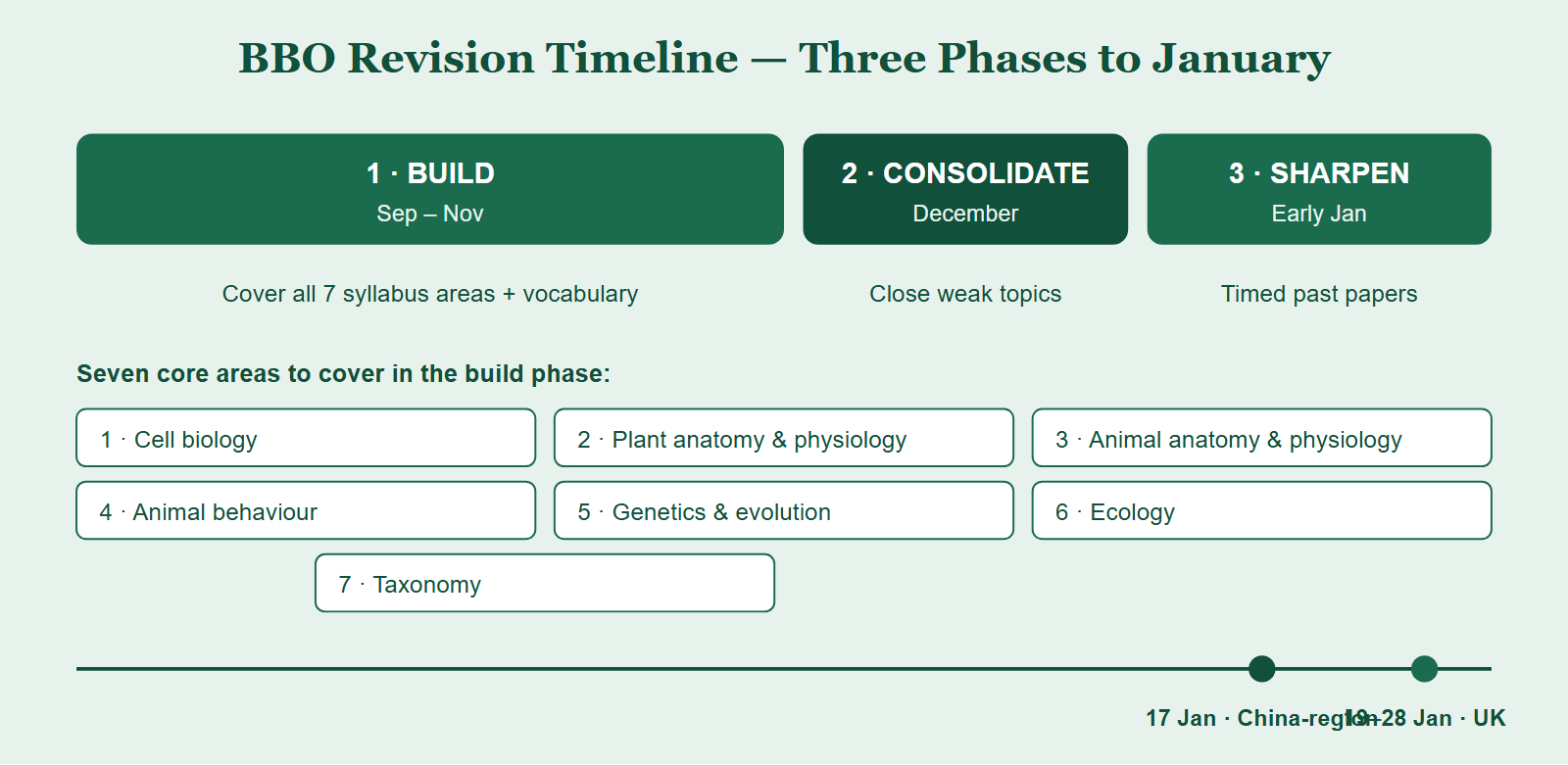
A solid British Biology Olympiad (BBO) revision plan works backwards from the exam. With the 2026 China-region paper on 17 January and the UK home window 19–28 January, count back roughly a term: build the seven syllabus areas through autumn, consolidate weak topics in December, then switch to timed past papers in early January. Below is that timeline, month by month.
This guide is for sixth-form and high-school students — especially international and China-region candidates — who want a calendar, not another “read Campbell and good luck” list. The BBO is a short online exam with no lab component, and it rewards applying biology to unfamiliar problems rather than reciting facts. That single idea shapes everything about how you should spend each month.
The timeline at a glance
Most students who score well do not cram. They run three distinct phases, each with a different job: a long build phase to cover content, a short consolidate phase to close gaps, and a final sharpen phase to train exam reflexes under the clock. Here is how those phases line up against the BBO’s seven core syllabus areas and the January exam dates.
September – November: the build phase
This is the longest stretch and it does the heavy lifting. Your goal is breadth: get a working command of all seven core syllabus areas — cell biology, plant anatomy & physiology, animal anatomy & physiology, animal behaviour, genetics & evolution, ecology, and taxonomy. The BBO maps onto strong A-level/AP biology plus some first-year university material, so most of this is reachable from your school course if you push a little past it.
Work from Campbell Biology as your spine, topped up with your A-level or AP resources. A realistic autumn rhythm is one syllabus area roughly every one-to-two weeks, reading actively rather than passively: after each chapter, close the book and try to redraw the pathway or summarise the mechanism from memory. The areas that catch international candidates out tend to be plant physiology and animal behaviour — they are often thin in school courses, so give them deliberate time now rather than discovering the gap in January.
One habit pays off all term: keep a running vocabulary list. The BBO leans on precise terminology, and the fill-in and ordering question types reward students who know the exact word, not the rough idea. Five minutes of vocabulary review at the end of each session compounds. For the official structure of what you are studying for — question types and how content is grouped — see our BBO competition rules page.
December: consolidate weak topics
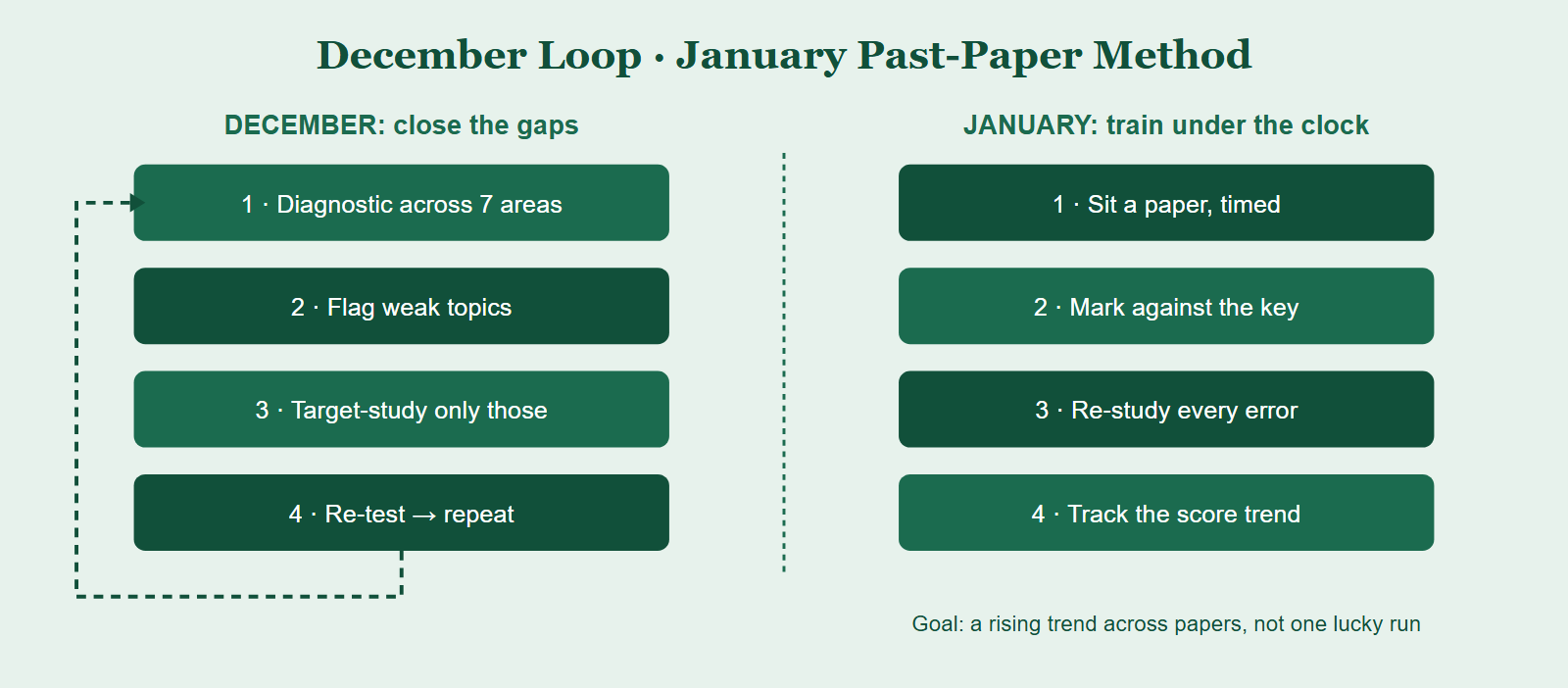
By December you should know where you are shaky. This month is not for new content — it is for closing gaps. The most efficient move is to take a short diagnostic: attempt a mixed set of questions across all seven areas and log which topics cost you marks. Then spend December’s limited time disproportionately on those weak areas instead of re-reading what you already know.
December is also when the “apply, don’t recall” nature of the BBO starts to matter. The exam rewards reasoning through unfamiliar scenarios, so practise pulling a principle — osmosis, natural selection, enzyme kinetics — and applying it to a context you have never seen. If you are also aiming at the USA Biology Olympiad (USABO), this is the moment that double-prep starts to pay: BBO and USABO share roughly 90% of content, and USABO sits in late March, so a strong BBO December feeds directly into a USABO run. Our BBO past papers hub and the related write-up under News & insights walk through how to sequence the two exams.
Early January: past papers under the clock
In the final stretch your content is mostly set — now you train exam reflexes. The single most effective activity is timed past papers. Sit a full paper under realistic conditions, mark it honestly against the answer key, and then re-study every question you got wrong until you could re-derive the answer. Across several papers you are looking for a rising score trend, not a single good run. This is also where you calibrate pace: the China-region paper is a single 90-minute sitting, while the UK home competition uses two papers of 45 minutes each, so practise to the format you will actually face (confirm your exact format on the official channels).
A note on benchmarking: awards are decided by score against published boundaries — Gold, Silver, Bronze, and further tiers such as Highly Commended and Commended. As a rough historical guide, 2024 cut-offs sat near 113 (Gold), 103 (Silver) and 96 (Bronze), but boundaries change every year, so confirm current boundaries officially. Use them only to sanity-check your trajectory, not as a fixed target. You can see how recognition is reported on our competition results page.
On past papers themselves: we maintain a collected free pack — papers, answer keys, topic notes and vocabulary lists that our teachers have gathered for international students. Scan the QR code or message us to get it. Worked-solution coverage varies by year, and our teachers add more over time, so it is worth asking for the latest set rather than assuming a specific year is fully solved.
How the calendar shifts if you are also doing USABO
For students stacking both olympiads, the timeline extends rather than changes. Keep the BBO phases as above through January, then carry the same content forward: USABO’s roughly 90% overlap means your January sharpening doubles as a USABO foundation, and the late-March USABO date gives you a clean second half-term to add the US-specific edges. One honest caveat on pathways: international and China-region students take part in the BBO for recognition; the BBO selects the UK’s International Biology Olympiad (IBO) team through a separate UK-based route, so the UK IBO team is not a route open to international entrants. For who can enter and how, defer to the official BBO channels.
What does this look like when a cohort actually runs the plan? Per Hanlin’s own records, our 2026-season biology cohort earned 26 BBO golds, 21 silvers and 5 bronzes, and 5 students reached the USABO US-region Semifinal — built on exactly this build → consolidate → sharpen rhythm rather than last-minute cramming.
Frequently asked questions
When should I start revising for the BBO?
Working back from a mid-to-late January exam, a full term is ideal: begin the build phase around September so you can cover all seven syllabus areas before consolidating in December. If you start later, prioritise a diagnostic first and spend your shorter runway on weak topics and timed past papers. Confirm your exact exam date on the official channels.
How many past papers should I do, and when?
Quality beats quantity. Aim to sit several papers under timed conditions in early January, marking each against the key and re-studying every error. You are tracking a rising score trend across papers, not chasing a number of attempts. Our collected free past-paper pack is available by QR or message.
Do I need a lab component or experiments to prepare?
No. The BBO is a short online exam with no lab component. Question types are multiple-choice, fill-in and ordering, so your time is best spent on content mastery, terminology and timed problem-solving rather than practical work.
Can the same timeline prepare me for USABO too?
Largely, yes. BBO and USABO share roughly 90% of content, and USABO sits in late March, so your BBO January sharpening feeds straight into a USABO run with a few weeks added for US-specific material. Note that international students take part in the BBO for recognition, not for the UK IBO team.
This is an independent English-language guide to the British Biology Olympiad for international and China-region students, operated by Hanlin Education. It is not affiliated with, endorsed by, or sponsored by UK Biology Competitions (UKBC) or the Royal Society of Biology. Rules, dates, eligibility and results are set by the organiser — always confirm current details through the official BBO channels.