
BBO award boundaries — the marks for Gold, Silver and Bronze — change every year because they are set after the exam to reflect how hard that year’s paper turned out to be. A harder paper pulls the cut-offs down; an easier one pushes them up. So a raw score means little on its own: what matters is where it falls against that year’s published boundaries, which you should always confirm on the official channels.
What a “boundary” actually is
The British Biology Olympiad (BBO), organised by UK Biology Competitions (UKBC) under the Royal Society of Biology, gives awards by score against published boundaries, not by a fixed pass mark. After the cohort has sat the paper, the organiser looks at how the whole field performed and draws the lines for Gold, Silver, Bronze and the further tiers (such as Highly Commended and Commended). The award you earn is simply a function of which band your mark lands in.
Because those lines are drawn fresh each year, the same raw number can mean different things in different seasons. As a published guide only, the 2024 boundaries sat at roughly 113 for Gold, 103 for Silver and 96 for Bronze — useful for a rough sense of scale, but not a target to bank on. Boundaries change yearly; always confirm the current ones officially.
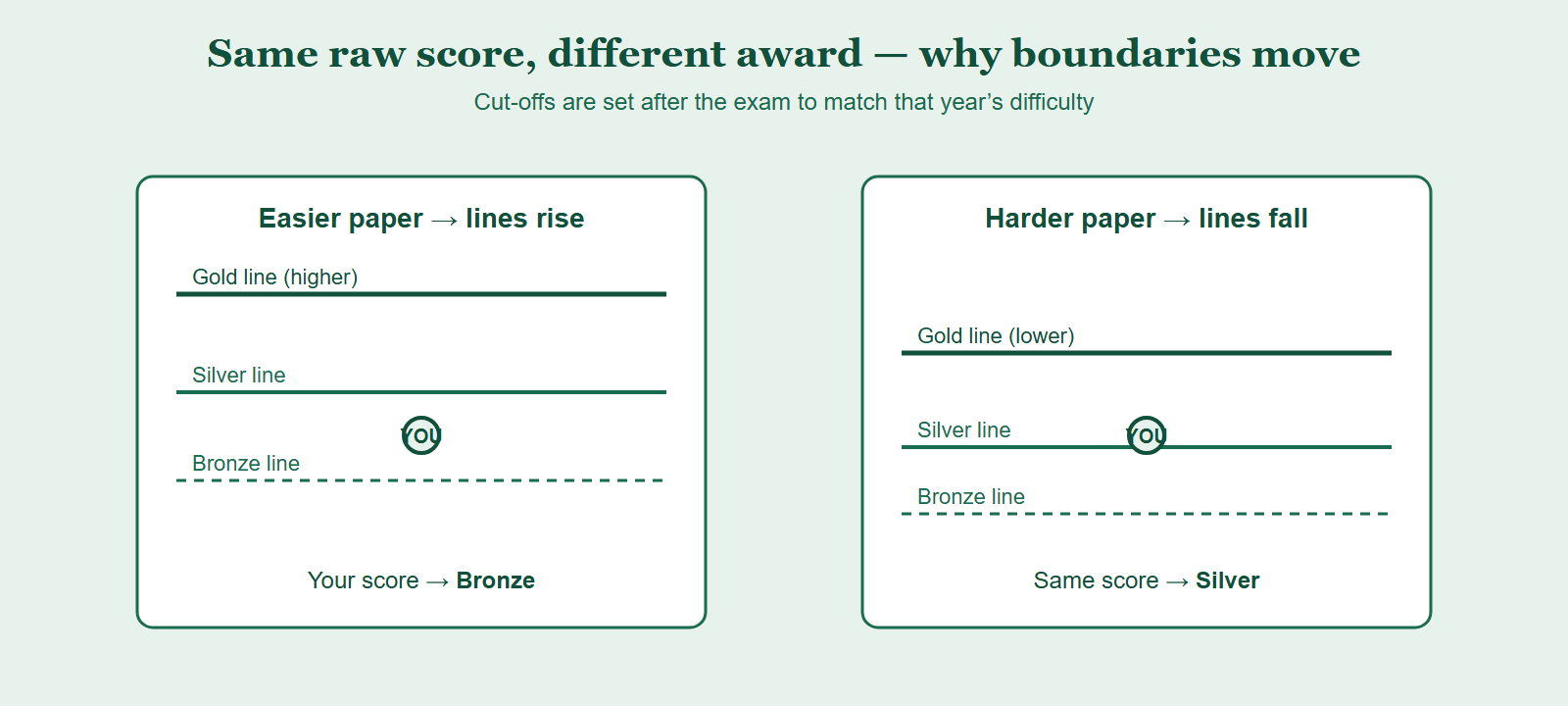
Why the lines move: it is about the paper, not you
The BBO is deliberately a paper that rewards applying biology to unfamiliar problems rather than reciting facts. That design means difficulty genuinely varies from year to year — one season’s questions might lean harder on novel data interpretation, another’s on synthesis across topics. Holding the award marks fixed would be unfair: a brutal paper would hand out fewer Golds simply because it was harder, and an easy paper would inflate them.
Moving the boundaries each year keeps an award meaning roughly the same thing across seasons. In effect, the organiser is normalising for difficulty so that a Gold this year reflects a comparable level of performance to a Gold last year, even though the raw mark behind it differs. Several forces feed into where the lines land: the overall difficulty of the questions, how the whole field of students performed, and the spread of marks across the cohort. None of these is something an individual candidate can predict in advance.
How to read your raw score the right way
If boundaries shift, then chasing a magic number is the wrong mental model. Here is how we coach students to interpret a BBO result honestly:
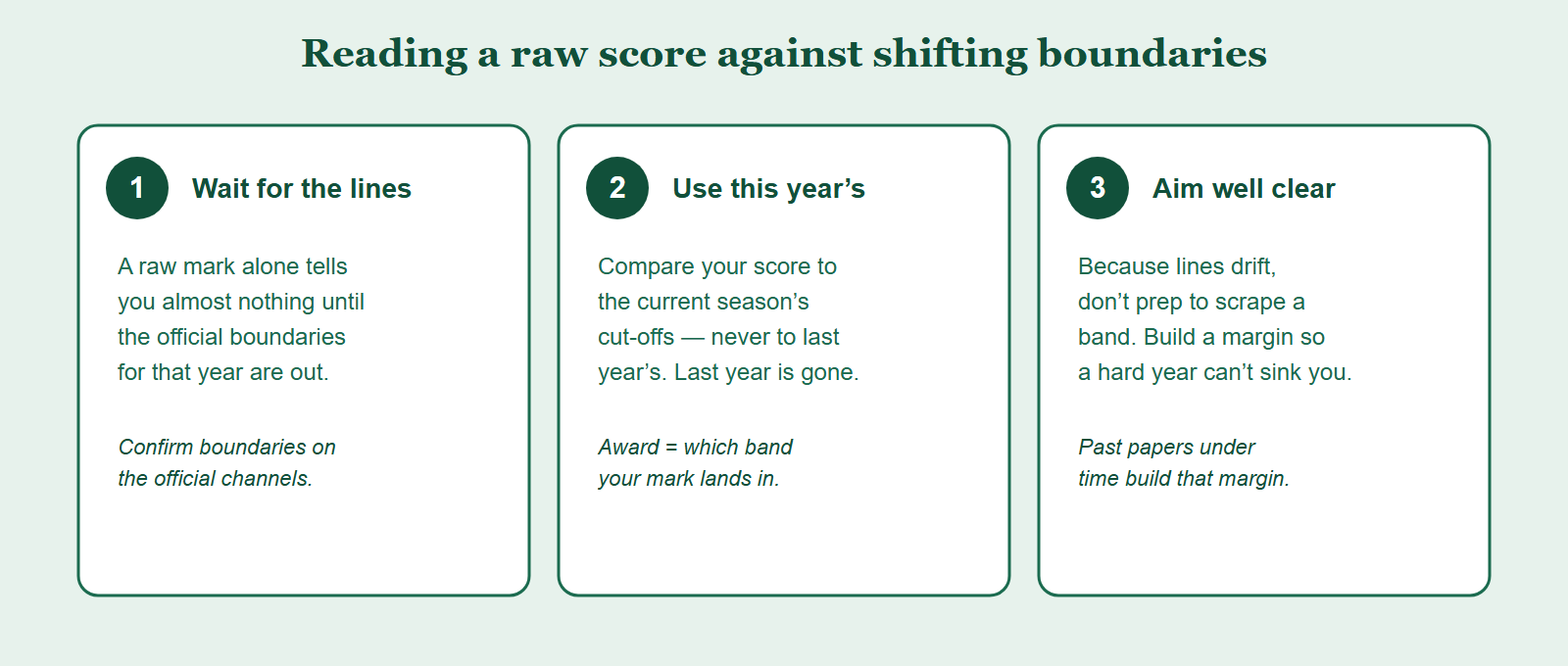
A practical consequence: do not prepare to land exactly on a boundary. If last year’s Gold line was around 113, aiming for 113 is risky, because a harder paper could move Gold higher this year. Build a comfortable margin instead. The students in our cohort who clear Gold reliably are not the ones who scrape it — they are the ones whose command of the syllabus puts them clearly above wherever the line happens to fall.
This is also why year-on-year comparisons of raw marks are misleading. “I got 105 and missed Silver, but my friend got 102 last year and made Silver” is not a contradiction; it just means the two papers were calibrated differently. The fair comparison is always score-versus-its-own-year’s-boundary.
What this means for how you prepare
If the target line is a moving object, the only thing fully in your control is depth of preparation. The BBO covers seven core syllabus areas — cell biology; plant anatomy and physiology; animal anatomy and physiology; animal behaviour; genetics and evolution; ecology; and taxonomy — mapping to a strong A-level or AP biology foundation plus some first-year university material. Working a college-level text such as Campbell Biology (alongside your AP or A-level resources) across all seven areas is how you build a score that comfortably clears whatever boundary lands.
Equally important is exam-style practice, because the BBO is a short online exam with multiple-choice, fill-in and ordering questions and no lab. Drilling those question types under time turns syllabus knowledge into marks. Our students do this with our collected free BBO past-papers pack — a set of papers we have gathered to practise from; scan the QR code on the site or message us to get it. Worked-solution coverage varies by year, and our teachers add more over time. For the wider prep plan, see how to prepare for the BBO, and for the papers themselves, our BBO past-papers pack.
One note for international and China-region students: roughly 15,000+ students from 900+ schools took part last year, and the BBO shares about 90% of its content with the USA Biology Olympiad (USABO), which sits in late March. International students take part in the BBO for the award and recognition — selection for the UK’s International Biology Olympiad team runs through a separate UK-based path. If you intend to sit both, the same depth that clears a shifting BBO boundary carries straight over; see our BBO-then-USABO double-gold plan. In Hanlin’s own 2026 season, our biology cohort earned 26 BBO golds, 21 silvers and 5 bronzes, and five students reached the USABO US-region Semifinal (per Hanlin’s records) — results that came from clearing the lines with room to spare, not from guessing where they would fall.
Frequently asked questions
Why do BBO score boundaries change every year?
Because they are set after the exam to reflect that year’s difficulty. A harder paper lowers the cut-offs for Gold, Silver and Bronze; an easier paper raises them. This keeps each award meaning a comparable level of performance across years. Confirm the current boundaries on the official channels.
What were the 2024 BBO boundaries?
As a rough guide only, the 2024 cut-offs were around 113 for Gold, 103 for Silver and 96 for Bronze. Treat these as a sense of scale, not a target — boundaries change yearly, so always confirm the figures for your own year officially.
How should I interpret my raw BBO score?
Wait for the published boundaries for your year, then compare your mark to those lines — never to a previous year’s. Your award is simply the band your score falls into. Comparing raw marks across years is misleading because each paper is calibrated differently.
What score should I aim for?
Aim well above last year’s line rather than exactly on it, since the boundary can rise in a harder year. Building a margin across the seven syllabus areas — with timed past-paper practice — is the reliable way to clear whatever cut-off lands.
This is an independent English-language guide to the British Biology Olympiad for international and China-region students, operated by Hanlin Education. It is not affiliated with, endorsed by, or sponsored by UK Biology Competitions (UKBC) or the Royal Society of Biology. Rules, dates, eligibility and results are set by the organiser — always confirm current details through the official BBO channels.