
The difference between a BBO Silver and a Gold is usually narrow — a handful of marks separated the published 2024 boundaries (a guide; confirm current boundaries on the official channels). Most students who land just under Gold did not lack knowledge. They lost marks to timing, misread questions, and shaky decisions on ordering items. Close that margin and the medal changes.
Gold is a few marks away, not a different syllabus
It is tempting to assume Gold students simply know more biology. In our experience coaching China-region cohorts, that is rarely the real story. The British Biology Olympiad — organised by UK Biology Competitions (UKBC) / the Royal Society of Biology — rewards applying biology to unfamiliar problems, not rote recall. A Silver candidate and a Gold candidate usually sit on the same seven core areas: cell biology; plant anatomy & physiology; animal anatomy & physiology; animal behaviour; genetics & evolution; ecology; and taxonomy. Both have covered strong A-level/AP material plus some first-year university content.
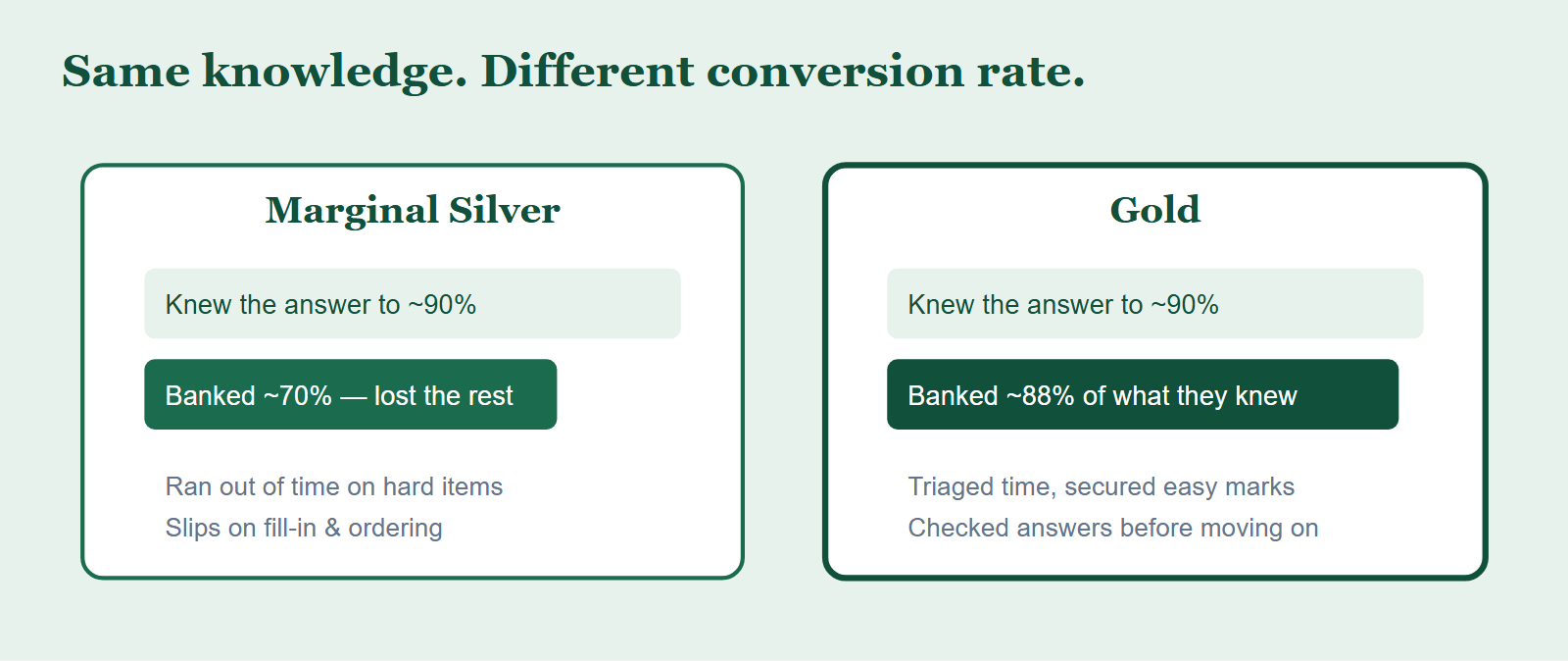
What changes the score is the conversion rate: how many questions you actually bank out of the ones you could, in principle, answer. The BBO is a short online exam with no lab component, and its three question types — multiple-choice, fill-in, and ordering — each reward a slightly different discipline under time pressure. The marginal Silver loses points it had the knowledge to win.
Where the marginal marks actually leak
When we review a near-miss script, the lost points cluster in four predictable places. Fixing these is faster than learning new topics, which is why the Silver-to-Gold jump often happens in weeks, not months.
- Pacing collapse. Spending five minutes wrestling one hard item means three easy items at the end go unanswered or rushed. The discipline is to move on and return — protect the marks you are certain of first.
- Fill-in precision. Multiple-choice forgives a fuzzy memory; fill-in does not. A term half-remembered, a misspelled enzyme, or an imprecise unit loses a mark that recognition would have saved.
- Ordering logic. Sequencing questions (e.g. ordering steps of a process) are all-or-much-or-nothing. One transposed pair can cost the item. Gold candidates reason the sequence from first principles, then sanity-check the ends.
- Careless misreads. “Which is not true,” “all except,” and double-negative stems catch tired readers. A few of these per paper is the entire Silver–Gold margin.
Note the BBO China-region exam (17 January 2026) and the UK home competition (19–28 January 2026) differ in format — international students take part for BBO recognition rather than for the UK International Biology Olympiad (IBO) team, which is selected via a separate UK-based path. For exact paper structure, timing and eligibility nuances in your sitting, confirm on the official BBO channels and see our competition rules overview.
The four habits that move Silver to Gold
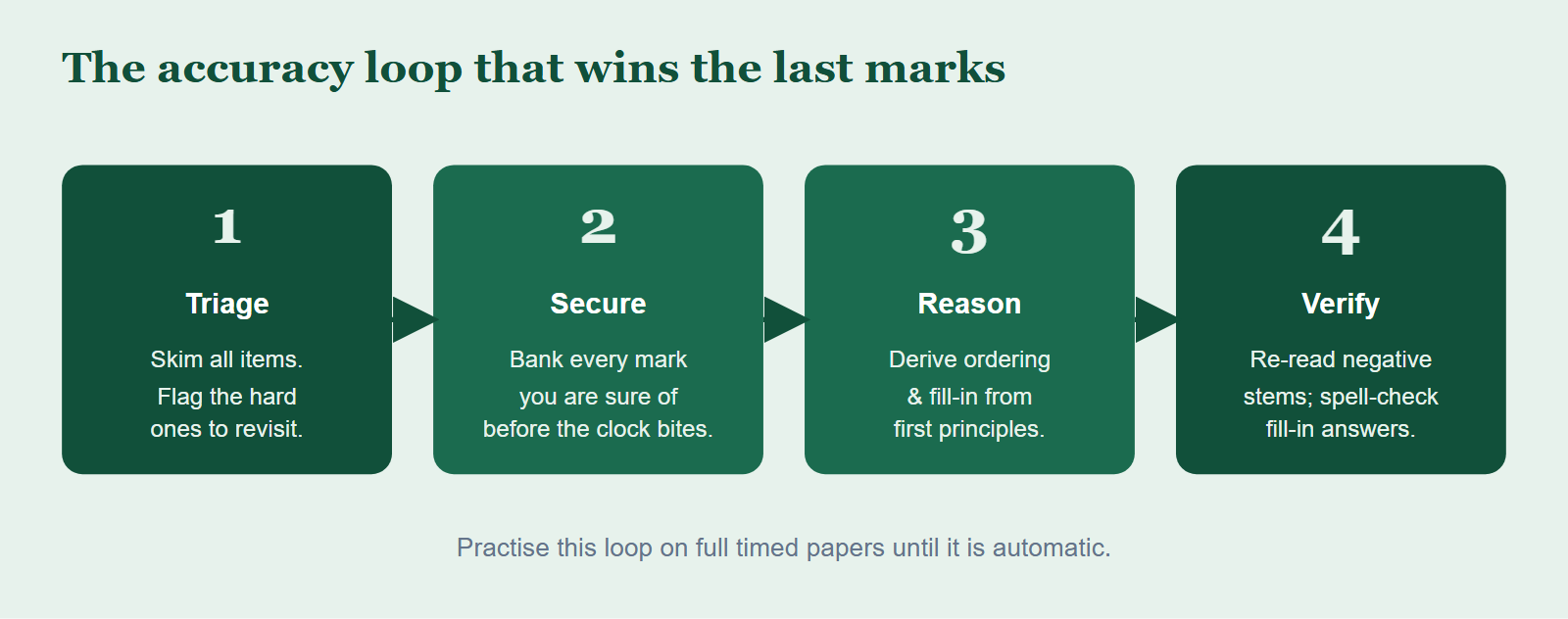
To build these habits, the highest-yield tool is full timed papers under exam conditions — sit the paper, mark it against the key, and track which of the four leak-points keeps recurring for you. Then drill that one. If you are still building base knowledge, Campbell Biology (plus your AP/A-level resources) remains the standard text; the seven syllabus areas map onto strong A-level/AP biology with a layer of first-year university material on top.
Because the BBO and the USA Biology Olympiad (USABO) share roughly 90% of content — with USABO sitting late March — many strong candidates run a double-medal plan, using one to sharpen the other. We cover how to sequence them in BBO then USABO: the double-gold plan, and the China-region specifics in the international & China-region exam guide. For a full study arc, see how to prepare for the BBO.
What the first-party results say about the margin
The pattern holds in our own cohort. Per Hanlin’s records, our 2026-season biology cohort earned 26 BBO Golds, 21 Silvers and 5 Bronzes, and 5 students reached the USABO US-region Semifinal. Read across those numbers and the takeaway is consistent: the students clustered at Silver were not weaker biologists than the Gold group — they were typically one accuracy habit away. The ones who tightened pacing and verification crossed the line.
That is the encouraging part. If you are a Silver candidate, you have already done the hard work of building the knowledge. The remaining gap is a trainable skill — and it is the cheapest medal upgrade in the whole olympiad.
Past papers: the fastest way to find your leak
The single most diagnostic exercise is sitting real papers under time pressure and reviewing exactly where marks fell. We maintain a collected free pack — past papers, answer keys, topic notes and vocabulary lists. It is our own compiled pack, not an official download: scan the QR on our past papers page, or message us, to get it. Worked-solution coverage varies by year — our teachers add more over time.
FAQ
Is a BBO Gold harder than a Silver because it tests more advanced biology?
Not usually. Both medals draw on the same seven syllabus areas. Gold candidates generally win on conversion — banking more of the questions they already had the knowledge to answer — rather than on knowing rarer content. Awards are set by score against published boundaries; confirm the current boundaries on the official channels.
How big is the gap between the Silver and Gold boundary?
As a guide, the published 2024 boundaries sat only a handful of marks apart (around Gold ~113, Silver ~103, Bronze ~96). Boundaries change every year, so treat these as illustrative and confirm current boundaries officially.
I keep landing just under Gold. What should I fix first?
Start with pacing and verification. Sit full timed papers, mark them, and identify whether you lose most marks to running out of time, fill-in slips, ordering errors, or misread negative stems — then drill that one habit. It is faster than learning new topics.
Do international students compete for the same Gold as UK students?
International and China-region students take part for BBO recognition (medals against the boundaries), while the UK International Biology Olympiad team is selected through a separate UK-based path. For the exact rules and eligibility for your sitting, confirm on the official BBO channels.
This is an independent English-language guide to the British Biology Olympiad for international and China-region students, operated by Hanlin Education. It is not affiliated with, endorsed by, or sponsored by UK Biology Competitions (UKBC) or the Royal Society of Biology. Rules, dates, eligibility and results are set by the organiser — always confirm current details through the official BBO channels.