
On British Biology Olympiad (BBO) exam day you sit a short online exam with no lab component — multiple-choice, fill-in and ordering questions that test how you apply biology to unfamiliar problems, not rote recall. The China-region exam is 17 January 2026; the UK home competition runs 19–28 January. This guide walks through how the sitting runs and what to expect; for the exact timing, login and rules that apply to you, always confirm on the official BBO channels.
First, know which sitting you are in
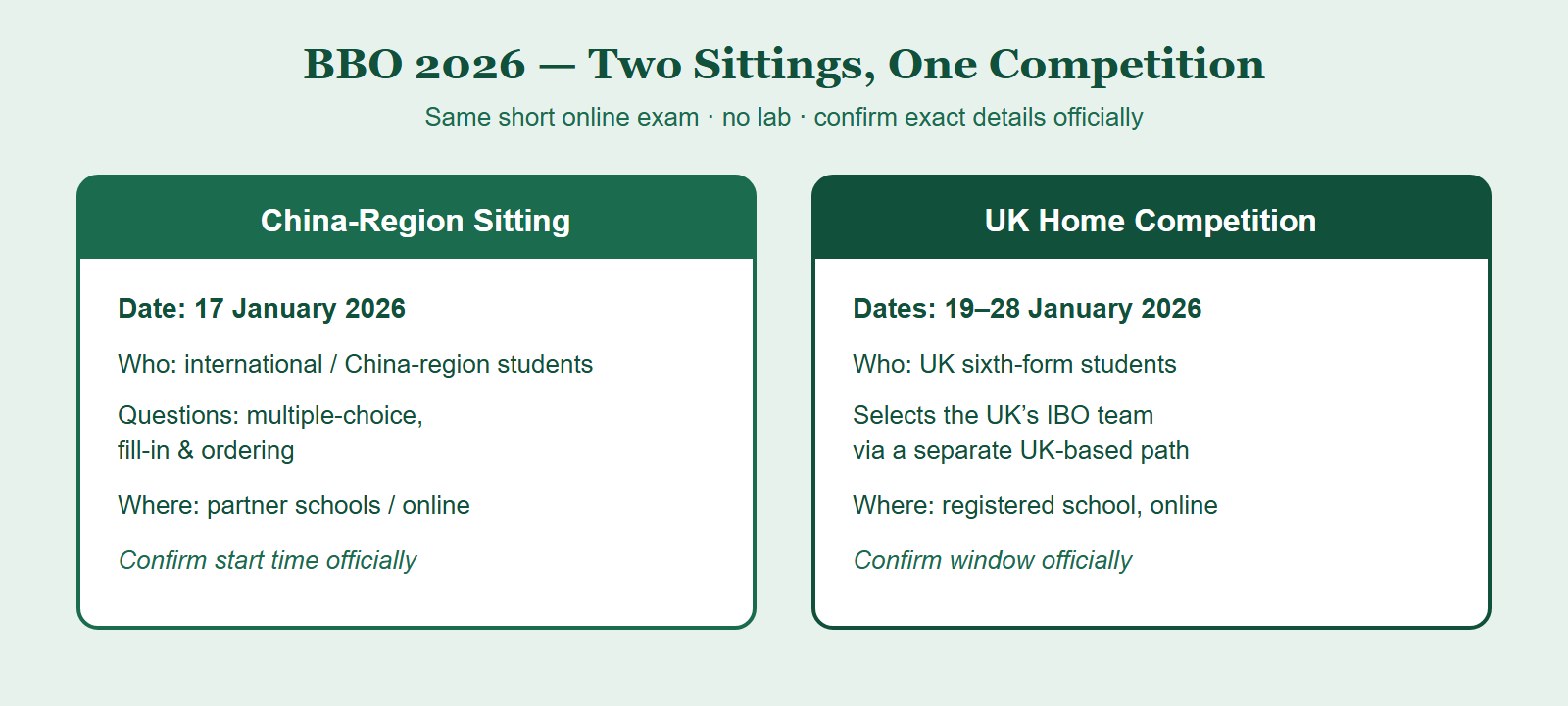
The BBO is one competition that runs on two calendars, and the exam-day logistics differ between them. International and China-region students take the China-region sitting; UK schools sit the home competition. Before exam day, the single most important thing is to confirm which sitting applies to you and its exact start time — because they are not the same.
What the exam itself looks like
Whichever sitting you take, the paper is built to reward reasoning, not memory. You will meet three question types — multiple-choice, fill-in, and ordering (sequencing) — and there is no practical / lab component, so nothing depends on equipment or a wet-lab setup. The content is drawn from seven core syllabus areas: cell biology; plant anatomy & physiology; animal anatomy & physiology; animal behaviour; genetics & evolution; ecology; and taxonomy. That maps onto strong A-level / AP biology with some first-year university material layered on top.
The practical upshot for exam day: most questions hand you an unfamiliar scenario — a graph, an experimental result, an unusual organism — and ask you to apply a principle you already know. Knowing the seven areas cold is necessary but not sufficient; the marks come from working the problem in front of you. Last year more than 15,000 students from over 900 schools took part, so a strong score is an externally-verified signal, not a participation badge.
How the online sitting runs
Because the BBO is delivered online, exam-day logistics are mostly about your device, your connection and the clock rather than a physical exam hall. The exact platform, login steps, permitted materials and on-screen rules are set by the organiser and can differ between the China-region and UK sittings, so treat the sequence below as a general shape and confirm every specific on the official channels.
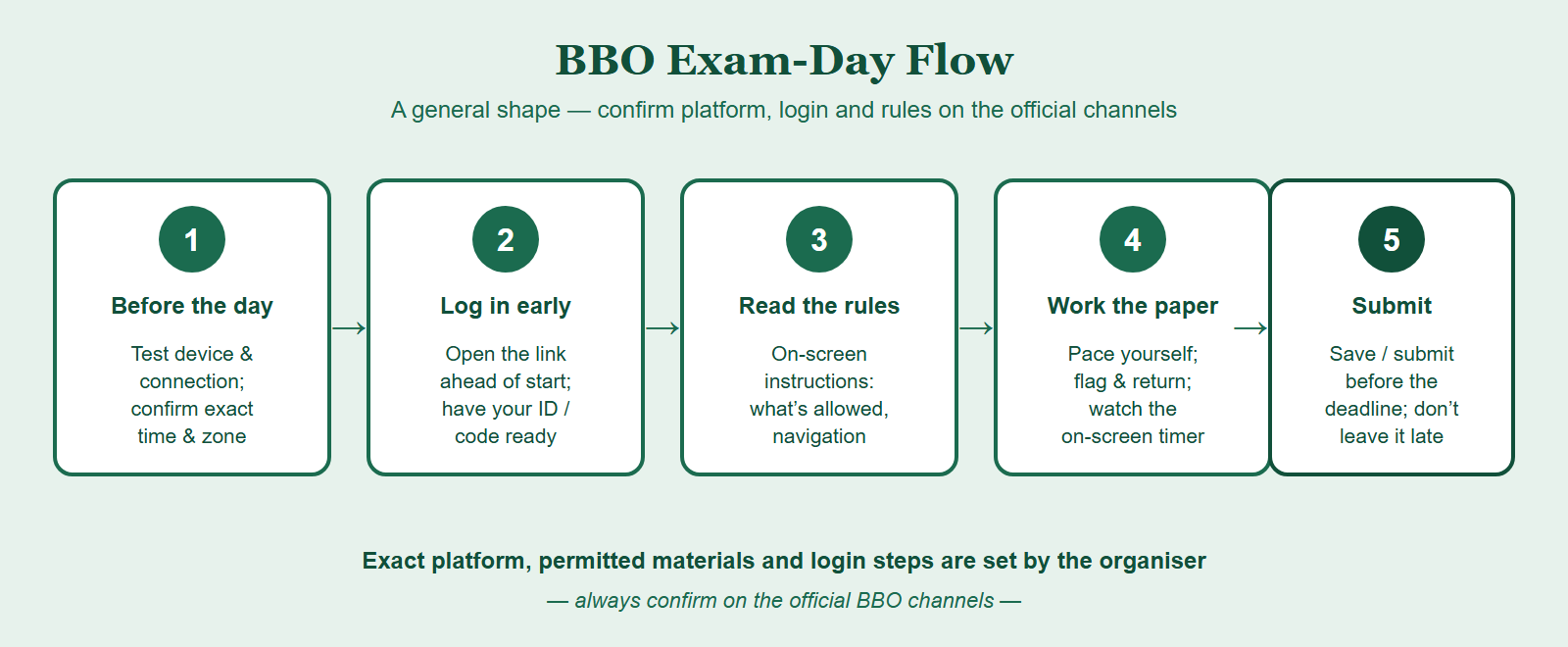
A few practical habits help on the day, regardless of the platform. Log in well before the start so a slow connection or a password problem does not eat into your time. Read the on-screen instructions in full before you answer — that is where any rules about permitted materials, calculators, navigation between questions and timing live, and those rules are the organiser’s, not ours. Keep an eye on the timer and use a flag-and-return approach so a single hard question does not strand you. And submit with a margin to spare; never gamble on a last-second save.
What to confirm officially (don’t guess)
There are details students reasonably want pinned down before exam day — and the honest answer for each is the same: check the organiser. We will not invent values for any of these:
- Exact start time and time zone for your sitting — confirm on the official channels.
- Whether calculators or any reference materials are permitted — confirm on the official channels.
- The platform / login procedure and any proctoring or browser requirements — confirm on the official channels.
- How marks are weighted and whether there is any negative marking — confirm on the official channels.
- Registration deadlines, fees and eligibility nuances — confirm on the official channels.
For the official rules, registration and results, the administration sits with UK Biology Competitions (UKBC) / the Royal Society of Biology for the home competition and with the regional partner for the China-region sitting. Our role is to help international students prepare; the binding details are theirs.
The best exam-day prep is real papers
Because the BBO rewards problem-solving under time, the most reliable way to be ready on the day is to rehearse the format — sit full papers to the clock, mark them, and find your weak areas across the seven syllabus topics. Work from Campbell Biology plus your AP / A-level resources for the underlying content, then convert that knowledge into exam speed on past papers. Our walkthrough of that routine is in how to prepare for the BBO, and the registration-and-recognition side is covered in the China-region exam guide.
On materials: we have collected a free pack of BBO past papers (papers, answer keys, topic notes and a vocabulary list). It is our collected free pack — scan the QR code or message us to get it; worked-solution coverage varies by year, and our teachers add more over time. For the full collection and how to use it, see our BBO past-papers pack, and check the competition rules for the official format.
One first-party note on what strong preparation can do: in the 2026 season, our biology cohort earned 26 BBO golds, 21 silvers and 5 bronzes, and 5 students reached the USABO US-region Semifinal (per Hanlin’s own records). The exam-day mechanics above are only the frame — the result comes from the practice you put in before you log in. Because BBO and the USA Biology Olympiad share roughly 90% of content, many students run both in one cycle; see BBO then USABO: the double-gold strategy.
Frequently asked questions
What happens on BBO exam day?
You sit a short online exam with no lab component — multiple-choice, fill-in and ordering questions on the seven core syllabus areas. Log in ahead of the start, read the on-screen rules, work to the timer and submit before the deadline. Confirm the exact timing and login for your sitting on the official channels.
Can I use a calculator or notes in the BBO?
Permitted materials are set by the organiser and may differ between sittings, so we will not state a value — confirm whether a calculator or any reference materials are allowed on the official channels before exam day.
When is the BBO in 2026?
The China-region exam is 17 January 2026; the UK home competition runs 19–28 January. Dates change each year, so confirm officially before you plan.
What question types should I expect, and is there a lab?
Multiple-choice, fill-in and ordering questions — and no, there is no practical or lab component. The exam rewards applying biology to unfamiliar problems rather than recall.
This is an independent English-language guide to the British Biology Olympiad for international and China-region students, operated by Hanlin Education. It is not affiliated with, endorsed by, or sponsored by UK Biology Competitions (UKBC) or the Royal Society of Biology. Rules, dates, eligibility and results are set by the organiser — always confirm current details through the official BBO channels.