
A BBO Gold is won by breadth, speed, and nerve — not by memorising one chapter. The British Biology Olympiad rewards students who can apply biology to unfamiliar problems across seven areas under time pressure. To reach Gold you spread coverage so no topic is a hole, drill timed multiple-choice and fill-in questions, and protect easy marks. Boundaries change yearly — always confirm current ones officially.
First, what “Gold” actually means here
The BBO is organised by UK Biology Competitions (UKBC) and the Royal Society of Biology for sixth-form and high-school students with a strong interest in biology. It is a short online exam with no lab component — question types are multiple-choice, fill-in, and ordering — and it deliberately tests whether you can reason about unfamiliar problems rather than recite facts you revised the night before.
Awards are decided purely by your score against published boundaries: Gold, Silver, Bronze, then further tiers such as Highly Commended and Commended. As a rough guide, the 2024 boundaries sat near 113 for Gold, 103 for Silver and 96 for Bronze — but these move every year, so treat them as a feel for the gap, not a target, and confirm the current boundaries on the official BBO channels. Last year the competition drew roughly 15,000+ students from 900+ schools, so a Gold is a genuine distinction earned by a small slice of a large, capable field.
One honest note for international and China-region students: you take part for BBO recognition. Selection for the UK’s International Biology Olympiad (IBO) team runs through a separate UK-based path — so your goal is the medal boundary, full stop. For exact eligibility nuances, dates and registration, confirm on the official channels. (The 2026 China-region exam is 17 January 2026; the UK home competition runs 19–28 January 2026 — confirm any other year officially.)
Where the marks are: the seven areas
The single biggest predictor of a Gold is even coverage. Because every question is worth marks and the paper ranges across the whole syllabus, a candidate who is excellent at genetics but blank on plant physiology bleeds easy points an all-rounder collects. The seven core areas map onto strong A-level / AP biology plus some first-year university material:
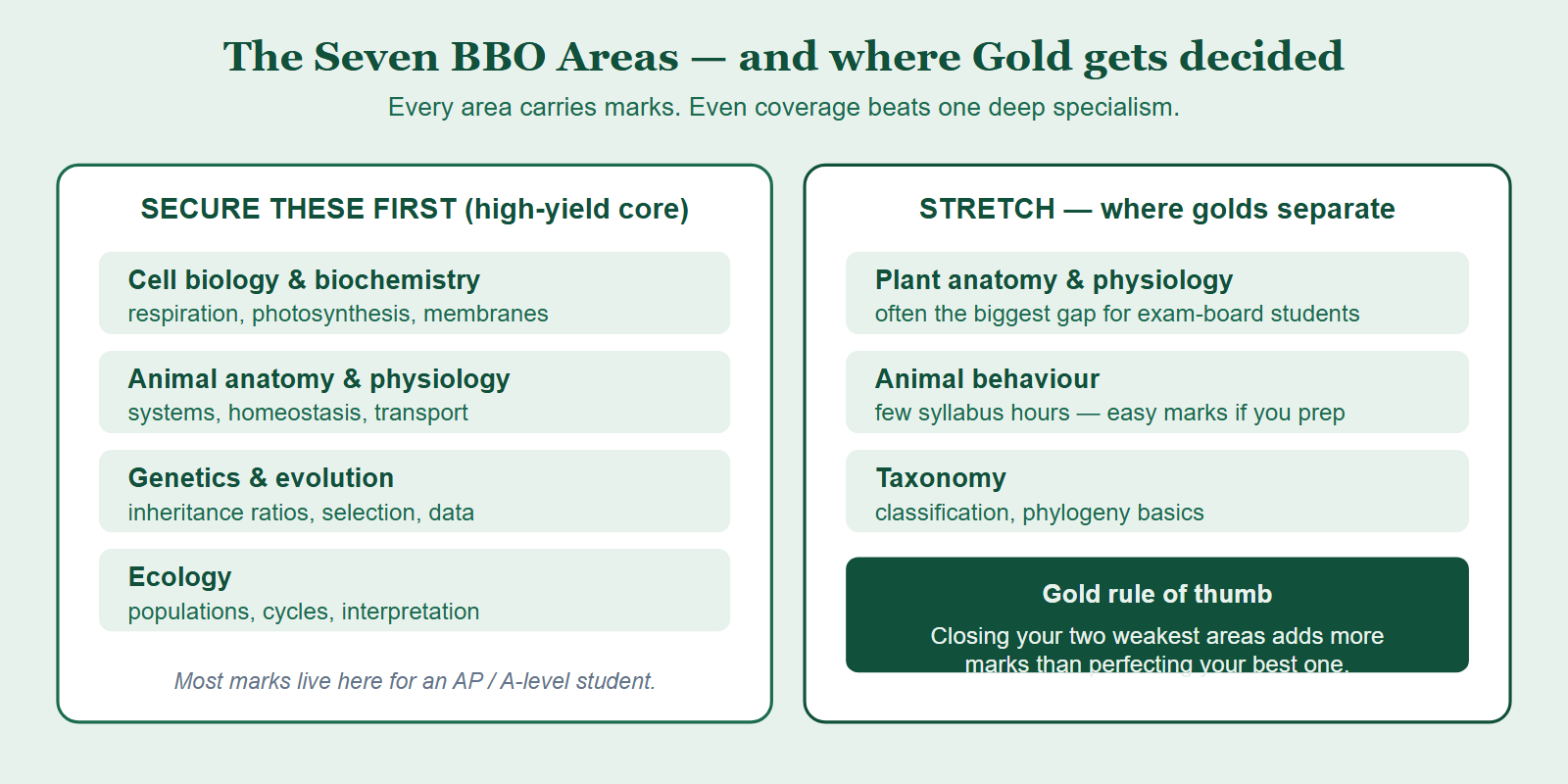
That is the strategist’s insight most students miss. If you already pull A-level / AP A-grades, your core four areas are probably 70% of the way there. The marks that lift Silver to Gold usually hide in plant physiology, behaviour and taxonomy — the topics exam boards under-weight. Audit yourself honestly, then spend disproportionate time on your two weakest areas. You can see exactly how the syllabus is framed on our competition rules and format page.
The timing game: how the paper is actually won
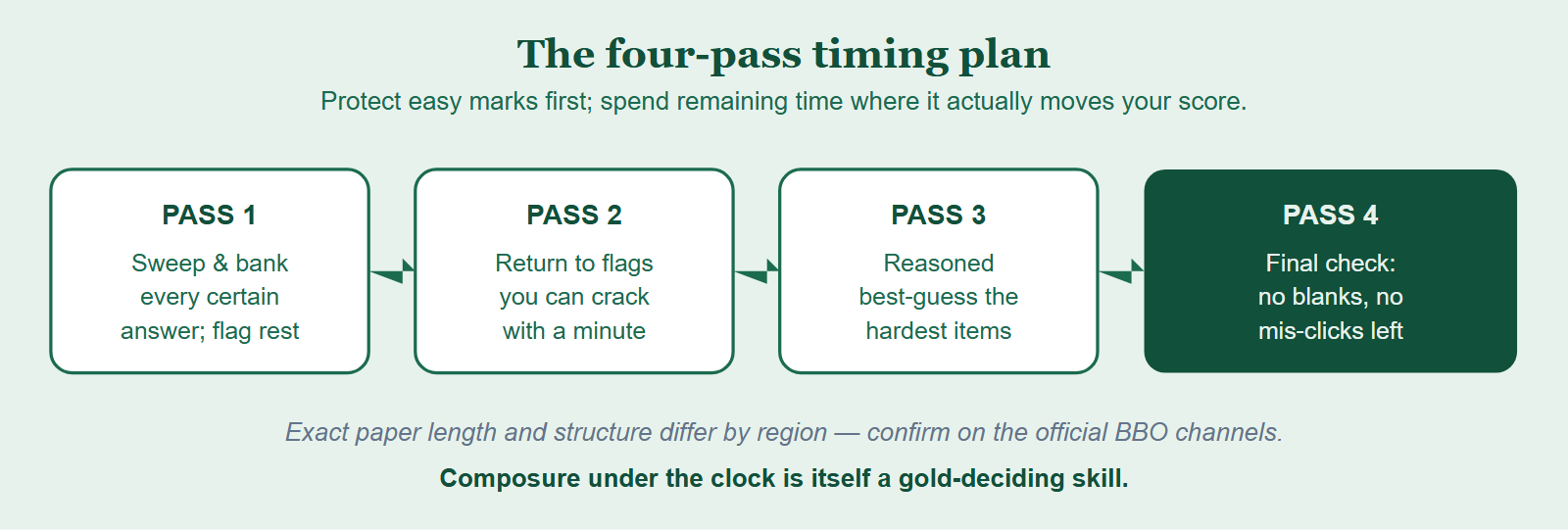
Because the questions are multiple-choice, fill-in and ordering rather than long essays, the BBO is partly a pace-and-composure test. A student who knows the same biology but panics on the clock will score lower. Three habits protect marks under pressure:
- Bank the certainties first. Do a fast sweep, answer everything you know cold, and flag anything that needs thought. You never want an easy mark left blank because you stalled on a hard one early.
- Cap your time per question. If a problem isn’t yielding in your set window, make your best-reasoned choice, flag it, and move on. One stubborn question can cost you three answerable ones.
- Reason, don’t recall. Many BBO items describe an unfamiliar scenario. Read what the data is telling you and apply a principle — the “right” recalled fact is often a trap if the scenario has shifted.
The prep that earns it: timed past papers, the right textbook
There is no shortcut, but there is a most-efficient route. The students who convert to Gold almost all do the same two things.
Build the knowledge base on the standard text. Campbell Biology, supported by your AP / A-level resources, covers the great majority of what the seven areas demand. Read for understanding of mechanisms, not lists — the BBO will ask you to predict what happens when a familiar system is perturbed, which only sticks if you understood why it works.
Then train against the clock with past papers. This is where reading turns into a score. Working real questions under timed conditions teaches the exam’s rhythm, exposes which of your seven areas are genuinely solid, and trains the “flag and move on” discipline above. Sit them as full timed runs, then review every miss until you can explain it — that review loop is where the marks come from. We maintain a collected free pack of BBO past papers for international and China-region students: scan the QR / message us to get it. Worked-solution coverage varies by year, and our teachers add more over time. (We do not host or link any official download — for official materials, see the organiser.)
If you are also eyeing biology olympiads beyond the UK, note that the BBO and the USA Biology Olympiad (USABO) share roughly 90% of their content, and USABO sits in late March. That overlap means one disciplined BBO build can carry into a second medal a couple of months later — a genuinely efficient double. We break down how to sequence the two on our guide to going from BBO to USABO.
What a Gold campaign looks like in practice
Concretely, a Gold-aimed plan over a season looks like: weeks of mechanism-first reading on Campbell to remove knowledge gaps; an honest seven-area audit to find your two weakest topics; a heavy second block closing those gaps (usually plant physiology, behaviour, taxonomy); then a final stretch of full timed past-paper runs with ruthless review. The reading makes the marks possible; the timed papers make them happen.
Does it work? Per Hanlin’s own records, in the 2026 season our biology cohort earned 26 BBO Golds, 21 Silvers and 5 Bronzes, and 5 students reached the USABO US-region Semifinal. We share that as a first-party result, not a guarantee — boundaries shift, fields are strong, and the medal is always earned on the day. You can see how results are reported and confirmed on the official results page.
FAQ
What score do I need for a BBO Gold?
Gold is set by a published boundary each year, not a fixed percentage. As a rough guide the 2024 Gold boundary was around 113, with Silver near 103 and Bronze near 96 — but these change annually, so confirm the current boundaries on the official BBO channels.
Which of the seven areas should I prioritise for Gold?
Secure your high-yield core first — cell biology, animal physiology, genetics and ecology. Then spend disproportionate time on the topics exam boards under-weight: plant anatomy and physiology, animal behaviour and taxonomy. Closing your two weakest areas typically adds more marks than perfecting your strongest.
How important are timed past papers?
Very. The BBO is partly a pace test, so full timed runs build exam rhythm, reveal weak areas, and train the “flag and move on” discipline. We offer a collected free pack of past papers — scan the QR or message us to get it; worked-solution coverage varies by year.
Can international students win a BBO Gold?
Yes — international and China-region students take part for BBO recognition and are scored against the same award boundaries. Selection for the UK’s IBO team runs through a separate UK-based path. For eligibility, dates and registration, confirm on the official BBO channels.
This is an independent English-language guide to the British Biology Olympiad for international and China-region students, operated by Hanlin Education. It is not affiliated with, endorsed by, or sponsored by UK Biology Competitions (UKBC) or the Royal Society of Biology. Rules, dates, eligibility and results are set by the organiser — always confirm current details through the official BBO channels.