Three of the seven British Biology Olympiad (BBO) areas — plant anatomy & physiology, ecology, and taxonomy — are the ones candidates most often under-prepare, because A-level and AP courses cover them lightly. The exam rewards applying biology to unfamiliar problems, and these topics carry real marks. This guide maps what to study in each so you stop leaking points where others do.
Why these three areas decide medals
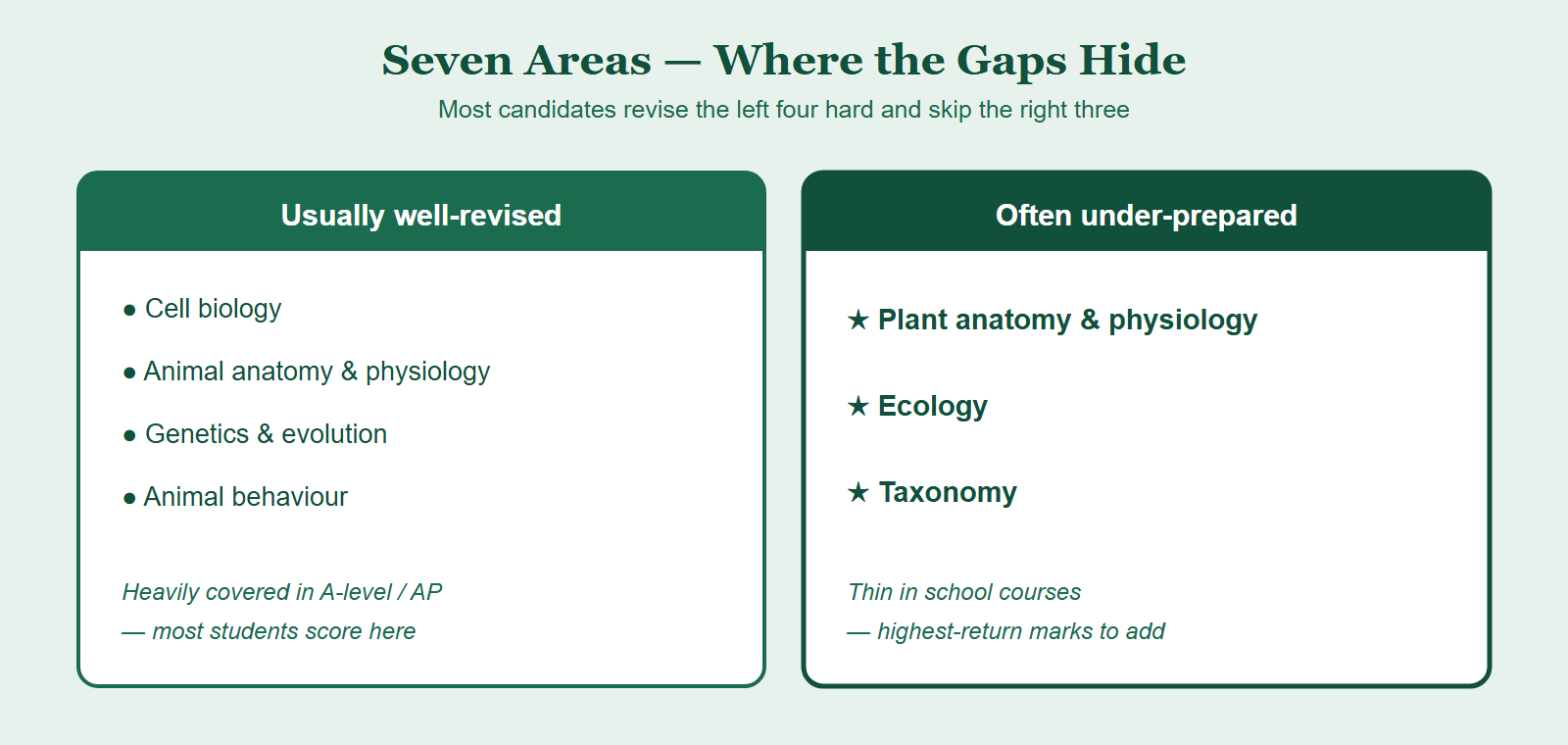
The BBO draws on seven core areas: cell biology; plant anatomy & physiology; animal anatomy & physiology; animal behaviour; genetics & evolution; ecology; and taxonomy. Most students arrive strong on cells, genetics and animal physiology — those dominate school courses — and treat plants, ecology and taxonomy as afterthoughts. That is exactly where the gap opens. Because the paper ranges widely and moves fast (a short online sitting of multiple-choice, fill-in and ordering questions, with no lab component), a candidate who is excellent on four areas and blank on three is leaving easy marks on the table that medal-winners pick up.
Awards are set by score against published boundaries — Gold, Silver, Bronze and further tiers such as Highly Commended and Commended. As a rough guide, 2024 boundaries sat near 113 for Gold, 103 for Silver and 96 for Bronze, but boundaries move every year, so confirm current boundaries on the official channels. The point of the numbers is simple: at the top, medals turn on a handful of marks. Securing the under-prepared areas is one of the highest-return moves available, precisely because so few candidates do it.
Plant anatomy & physiology: the engine schools skip
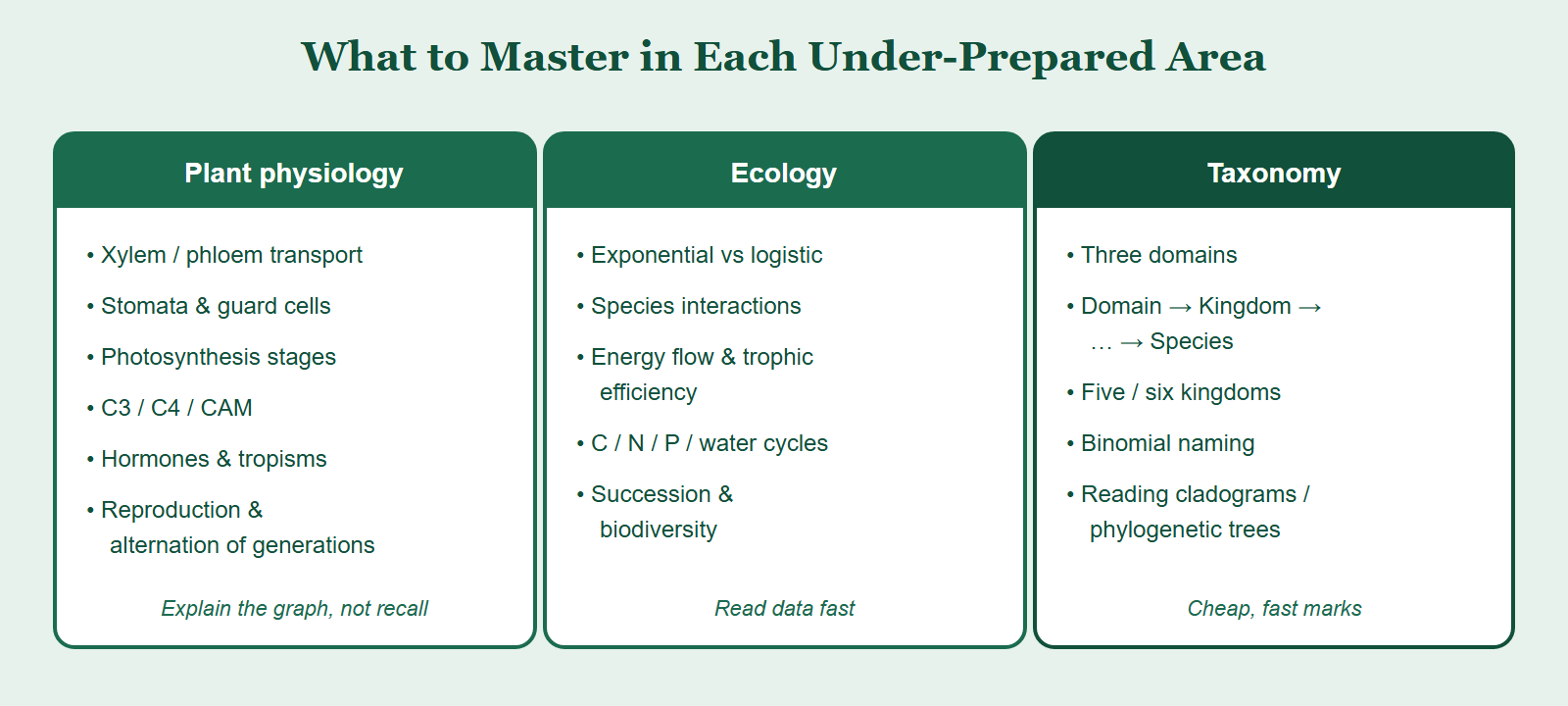
School biology tends to treat plants as a single chapter, yet the BBO can ask detailed questions on plant structure and function. Build security across the core machinery: tissue systems (dermal, ground and vascular), the xylem and phloem and how water and sugars move (transpiration pull and the cohesion–tension idea; pressure-flow in phloem), stomatal control and the role of guard cells, and the light-dependent and light-independent stages of photosynthesis including C3, C4 and CAM differences. Add the plant hormones — auxins, gibberellins, cytokinins, abscisic acid and ethylene — with what each does, plus tropisms (phototropism, gravitropism) and basics of plant reproduction and the alternation of generations.
The marks here are reasoning marks, not recall. A typical item hands you a graph of stomatal aperture against time of day, or transpiration against humidity, and asks you to explain the pattern from first principles. If you know why guard cells lose turgor under water stress, or how a C4 plant concentrates carbon dioxide to suppress photorespiration, you answer an unfamiliar scenario quickly. Campbell Biology covers all of this at the right depth; work the plant unit deliberately rather than skimming it.
Ecology: where data-reading questions live
Ecology is the area most likely to appear as a graph or table you have never seen, which suits the BBO’s problem-solving style perfectly — and rewards anyone who has the framework ready. Cover the levels of organisation (population, community, ecosystem), population growth (exponential vs logistic, carrying capacity, and what limits a population), and species interactions (competition, predation, mutualism, parasitism, the competitive-exclusion idea and niches). Then the systems layer: energy flow through trophic levels and why transfer efficiency caps food-chain length, food webs, and the biogeochemical cycles — carbon, nitrogen, phosphorus and water. Finish with succession (primary and secondary), biodiversity measures, and the broad strokes of conservation and human impact.
Practise reading, not just memorising. Train yourself to take a survival curve, a predator–prey oscillation, or a nutrient-cycle diagram and extract the mechanism in seconds: which population is the limiting one, where the energy is lost, which nutrient is fixed by bacteria. Those habits convert ecology from a guessing area into a reliable scoring one.
Taxonomy: the cheapest marks you can buy
Taxonomy is small, finite and frequently ignored — which makes it the best effort-to-reward trade in the syllabus. The framework you need is compact: the three domains (Bacteria, Archaea, Eukarya), the classification hierarchy (Domain → Kingdom → Phylum → Class → Order → Family → Genus → Species), the major kingdoms in the five- or six-kingdom systems with the defining features of each, and the rules of binomial nomenclature (genus capitalised, species lower-case, both italicised). Add the difference between homologous and analogous structures and how to read a cladogram or phylogenetic tree — nodes as common ancestors, branch order as relatedness.
Most taxonomy questions are quick if you have the framework and slow guesses if you do not. A tree-reading item asks which two organisms share the most recent common ancestor; a classification item asks you to place an unfamiliar organism by a stated feature. None of it requires deep theory — it requires that you actually learned the map. An afternoon spent securing taxonomy can be worth more than another pass over cell biology you already know.
How to fold these into a real revision plan
Order your work by return on effort. Audit your seven areas honestly, then give disproportionate time to the weakest of plant, ecology and taxonomy — that is where your score has the most room to move. Build the underlying content from Campbell Biology plus your AP / A-level resources, then immediately convert it into exam speed by sitting timed past papers and tagging every wrong answer by area. After a few papers a pattern appears, and it is almost always in these three. Our general routine for this is in how to prepare for the BBO; the registration-and-recognition side for international candidates is in the China-region exam guide, and the official format sits in the competition rules.
One first-party note on what this kind of targeted work delivers: in the 2026 season our biology cohort earned 26 BBO golds, 21 silvers and 5 bronzes, and 5 students reached the USABO US-region Semifinal (per Hanlin’s own records). A recurring theme in those results is candidates who stopped neglecting plants, ecology and taxonomy. Because BBO and the USA Biology Olympiad share roughly 90% of content, the same three areas carry over to USABO (late March) — so this revision does double duty; see BBO then USABO: the double-gold strategy.
Practise on real papers
The fastest way to find your gaps in these three areas is to sit full papers to the clock and mark them by topic. On materials: we have collected a free pack of BBO past papers (papers, answer keys and topic notes). It is our collected free pack — scan the QR code or message us to get it; worked-solution coverage varies by year, and our teachers add more over time. For the collection and how to use it, see our BBO past-papers pack. Last year more than 15,000 students from over 900 schools took part, so a strong, well-rounded score is an externally-verified signal — and a well-rounded score is exactly what securing these three areas buys you.
Frequently asked questions
Which BBO topics are most under-prepared?
Plant anatomy & physiology, ecology and taxonomy — because A-level and AP courses cover them lightly, while cells, genetics and animal physiology get most class time. They sit among the seven core areas and carry real marks, so securing them is high-return.
How much plant biology does the BBO test?
Enough that it should not be skimmed. Expect transport (xylem/phloem), stomatal control, photosynthesis including C3/C4/CAM, plant hormones and tropisms — usually as reasoning questions on unfamiliar data rather than recall. Campbell Biology covers it at the right depth.
Do I need to memorise classification for taxonomy questions?
You need a compact framework: the three domains, the Domain-to-Species hierarchy, the five/six kingdoms, binomial naming rules and how to read a phylogenetic tree. It is finite and quick to secure, which makes it some of the cheapest marks in the paper.
How are BBO awards decided?
By score against published boundaries — Gold, Silver, Bronze and further tiers like Highly Commended and Commended. As a rough 2024 guide, Gold was near 113, but boundaries change every year, so confirm current boundaries on the official channels.
This is an independent English-language guide to the British Biology Olympiad for international and China-region students, operated by Hanlin Education. It is not affiliated with, endorsed by, or sponsored by UK Biology Competitions (UKBC) or the Royal Society of Biology. Rules, dates, eligibility and results are set by the organiser — always confirm current details through the official BBO channels.