The most common BBO preparation mistakes are predictable: cramming one favourite topic while neglecting the other six, never sitting a past paper under timed conditions, and treating the exam as a recall test instead of a problem-solving one. The British Biology Olympiad rewards applying biology to unfamiliar problems — so the fixes below are about how you practise, not just how much.
This guide is written for international and China-region students preparing independently. It is based on what we see in our own cohort each season, and it pairs each mistake with a concrete fix you can start this week.
First, know what you are preparing for
The BBO is a short online exam with no lab component, organised by UK Biology Competitions (UKBC) under the Royal Society of Biology. Questions come in three forms — multiple-choice, fill-in, and ordering — and they reward reasoning over rote recall. Awards (Gold, Silver, Bronze, and further tiers such as Highly Commended and Commended) are decided by your score against published boundaries, not by ranking against your school. There is no curve to game; there is only the paper in front of you. Last year, more than 15,000 students from over 900 schools took part.
The seven core syllabus areas are cell biology; plant anatomy & physiology; animal anatomy & physiology; animal behaviour; genetics & evolution; ecology; and taxonomy. That maps to a strong A-level or AP biology base plus some first-year university material. Most preparation mistakes are really a failure to respect one of those facts. For exact dates, eligibility and the rules that apply to you, always confirm on the official BBO channels — see our plain-English summary of the competition format and rules.
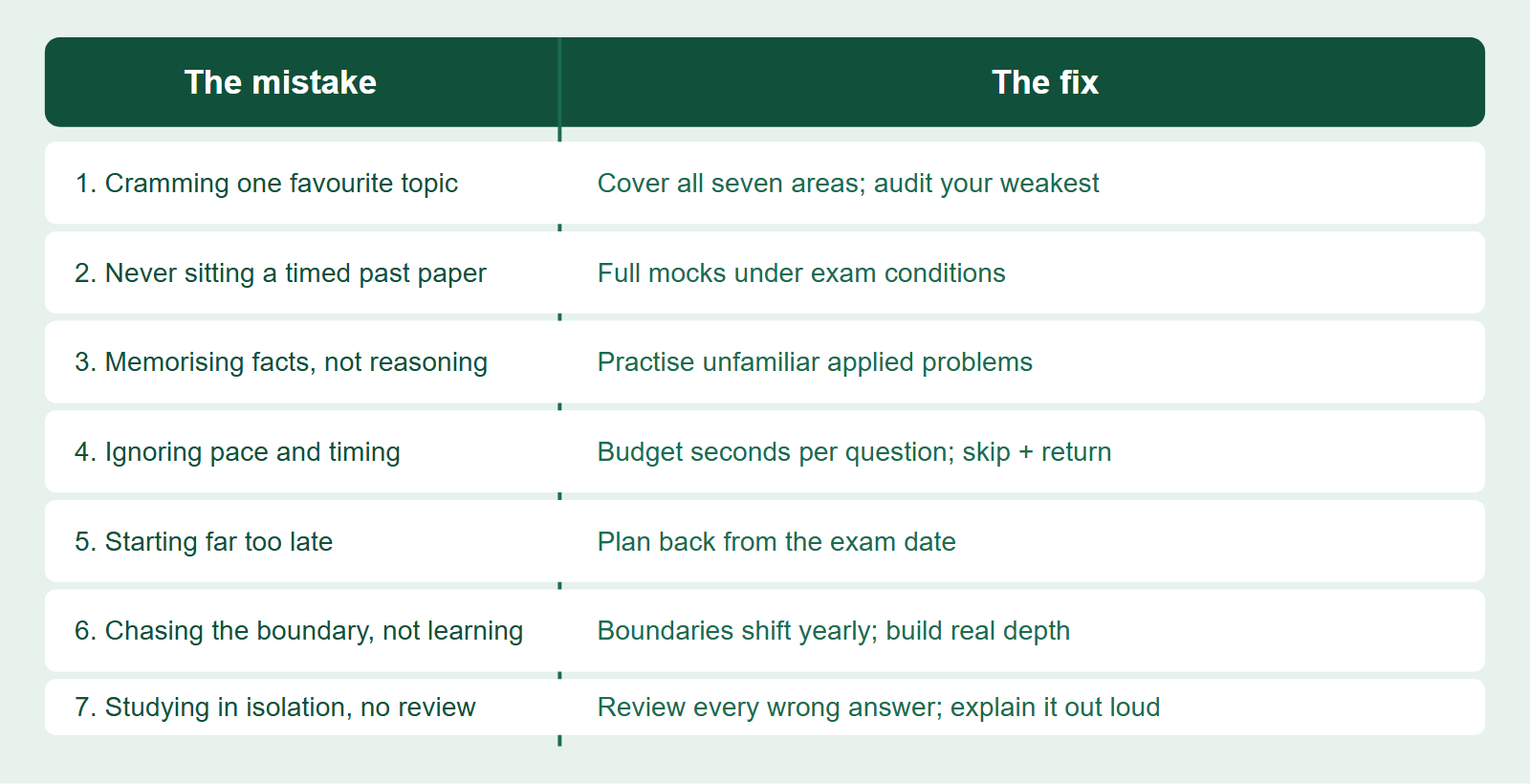
Mistake 1 — Cramming one area and hoping the rest doesn’t show up
Students who love genetics tend to revise genetics. The BBO does not care what you love: it draws across all seven syllabus areas, and a lopsided preparation leaves easy marks on the table in taxonomy, ecology, or plant physiology — areas many students quietly avoid. Because awards are by total score, a weak spot you “hope to skip” simply caps your ceiling.
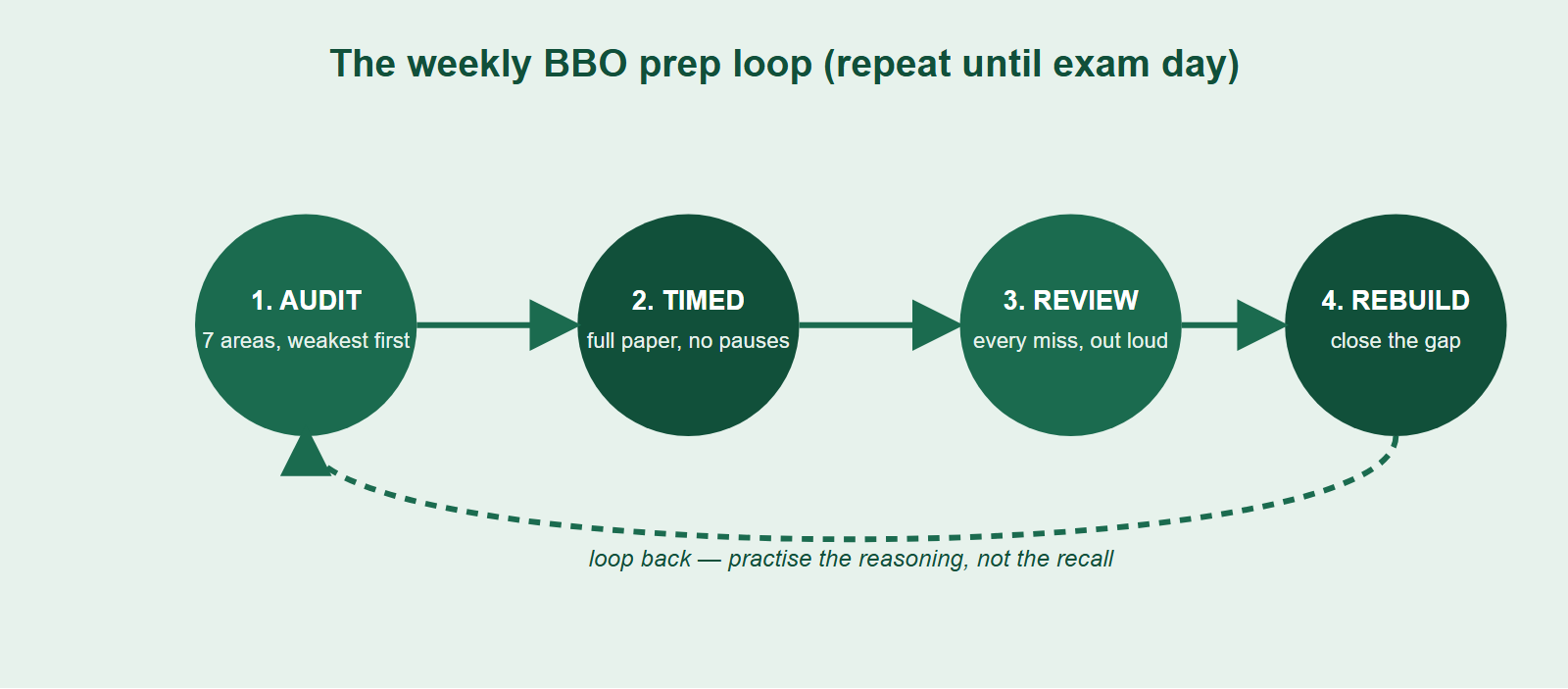
The fix: run a quick self-audit against the seven areas, rate your confidence in each, and spend the most time where you are weakest, not where you are most comfortable. Plant anatomy and taxonomy are the classic blind spots for students coming from a heavily molecular A-level or AP route. Use Campbell Biology as your spine and fill gaps with your AP/A-level resources.
Mistake 2 — Skipping past papers (or only reading them)
Reading a past paper and thinking “I could do that” is not practice. The single biggest predictor of improvement we see is the number of timed, marked papers a student has actually sat. Past papers teach you the BBO’s question styles — the way ordering questions are phrased, how fill-ins are scored, how multiple-choice distractors are built — and that familiarity is worth marks on the day.
The fix: sit complete papers under exam conditions, then mark them honestly and review every miss. Treat your first paper as a diagnostic, not a verdict. We maintain a collected free pack of BBO past papers for our students — scan the QR code or message us to get it. (Worked-solution coverage varies by year; our teachers add more over time.) For how to fold papers into a wider plan, see how to prepare for the BBO.
Mistake 3 — Memorising facts instead of practising reasoning
The BBO explicitly rewards applying biology to unfamiliar problems. A student who has memorised every glycolysis intermediate can still stall when a question hands them an unfamiliar experiment, an odd organism, or a data table and asks them to reason. Pure recall has a low ceiling here.
The fix: practise the skill the exam tests. When you review a question, don’t just check the right letter — articulate why the other options fail and what principle the question is really probing. Work with data: graphs, experimental setups, and “what would happen if” reasoning. This is also the strongest bridge to other olympiads, because the BBO and the USA Biology Olympiad (USABO) share roughly 90% of their content, and USABO sits late March — the same reasoning muscle pays off twice.
Mistake 4 — Ignoring timing and pace
The BBO is a short online exam. Students who are strong on biology still lose marks because they sink ten minutes into one stubborn ordering question and run out of time before reaching questions they would have answered correctly. Untimed practice hides this problem completely.
The fix: always practise to the clock. Build a simple rule — if a question is fighting you, flag it, answer your best guess, and move on, then return if time allows. Knowing the exact format and conditions in advance removes nasty surprises; confirm the current format on the official rules page rather than assuming it matches a paper you saw online.
Mistake 5 — Starting far too late
For the 2026 cycle, the China-region exam is on 17 January 2026 and the UK home competition runs 19–28 January 2026. (For any other year, confirm officially.) Seven syllabus areas plus timed-paper practice does not compress into a frantic final week.
The fix: plan backwards from your exam date. Reserve the last stretch for full timed papers and targeted review — not for first-time learning of taxonomy. If you are an international or China-region student, also be clear on which exam window and recognition path apply to you; we cover that in the BBO international and China-region exam guide. International students take part for BBO recognition rather than for the UK’s International Biology Olympiad (IBO) team, which is selected through a separate UK-based path.
Mistake 6 — Chasing last year’s award boundary instead of learning biology
Award boundaries are published, and they move every year. As a rough guide, the 2024 cycle saw Gold near 113, Silver near 103, and Bronze near 96 — but treat those as illustrative only and confirm current boundaries officially. Students who fixate on “I just need 96” tend to stop learning the moment they think they’ve cleared a number, then get caught out by a slightly harder paper.
The fix: aim for genuine depth and let the score follow. Boundaries are a finish line you don’t control; your understanding is the part you do. You can see how results are reported on the official results page.
Mistake 7 — Studying in isolation with no review or feedback
The quietest mistake is doing lots of practice and never reviewing it. A paper you sit but never mark teaches almost nothing; the learning lives in the review. Self-study works, but it works far better with a feedback loop.
The fix: after every paper, review each wrong answer and explain the correct reasoning aloud — if you can teach it, you know it. For students who want structure, a guided path that pairs BBO practice with the strongly overlapping USABO can compound results. In our 2026 season, the Hanlin biology cohort earned 26 BBO Golds, 21 Silvers, and 5 Bronzes, and 5 students reached the USABO US-region Semifinal (per Hanlin’s own records). If you’re considering both exams, see preparing for BBO then USABO.
Frequently asked questions
What is the most common BBO preparation mistake?
Over-revising one strong topic while neglecting the other syllabus areas, and practising recall instead of applied reasoning. The BBO draws across all seven core areas and rewards solving unfamiliar problems, so balanced, reasoning-led preparation beats deep specialisation in one favourite subject.
How many past papers should I do?
As many full, timed, marked papers as you can fit before the exam — quality of review matters more than raw quantity. Treat your first as a diagnostic. We share a collected free past-paper pack for students; scan the QR or message us to get it, and note that worked-solution coverage varies by year.
When is the BBO held?
For 2026, the China-region exam is on 17 January 2026 and the UK home competition runs 19–28 January 2026. For any other year, and for the registration window and rules that apply to you, confirm on the official BBO channels.
Do I need a lab to prepare for the BBO?
No. The BBO is a short online exam with no lab component, using multiple-choice, fill-in, and ordering questions. Preparation centres on the seven syllabus areas, timed practice, and applied reasoning — a strong A-level/AP base plus Campbell Biology is the standard foundation.
This is an independent English-language guide to the British Biology Olympiad for international and China-region students, operated by Hanlin Education. It is not affiliated with, endorsed by, or sponsored by UK Biology Competitions (UKBC) or the Royal Society of Biology. Rules, dates, eligibility and results are set by the organiser — always confirm current details through the official BBO channels.