The British Biology Olympiad (BBO) is a short, fast online exam that rewards applying biology to unfamiliar problems — not rote recall. Preparing well comes down to three things in order: know the seven areas the syllabus covers, build that knowledge from a college-level text, and convert it into marks with timed past papers. Here is how to put a plan together.
What the BBO syllabus covers
The BBO draws on seven core areas of biology. You do not need graduate depth in all of them, but you do need broad, secure coverage — the exam moves quickly and ranges widely:
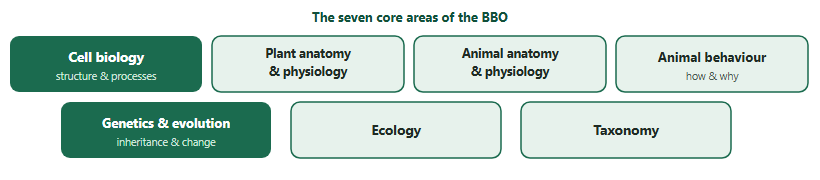
Those seven areas — cell biology, plant anatomy and physiology, animal anatomy and physiology, animal behaviour, genetics and evolution, ecology, and taxonomy — map closely onto a strong A-level or AP biology course plus some first-year university material. That overlap is also why the BBO pairs so well with the USABO, which tests the same core areas.
A four-stage study plan
Knowledge and exam technique are built in different stages. Do not jump to past papers before the foundation is there — and do not keep reading once it is:
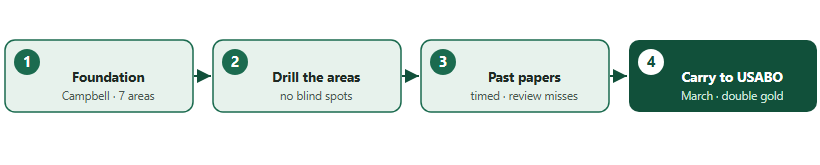
- 1 · Build the foundation. Work a college-level text — Campbell Biology is the standard — across the seven areas, making concise notes. AP and A-level resources are useful companions.
- 2 · Drill the seven areas. Once the foundation is in place, practise topic by topic so no area is a blind spot. The BBO ranges widely, so breadth matters.
- 3 · Work past papers under time. Sit real papers to the clock, then review every miss to name the gap. This is where knowledge becomes a score — our BBO past-papers pack has the papers and a method for using them.
- 4 · Carry it into the USABO. Because the USABO shares about 90% of the content and sits in late March, your BBO preparation sets you up for a second medal — see the double-gold strategy.
Aiming for gold
BBO awards are decided by score against published boundaries, with Gold, Silver and Bronze tiers (as a guide, the 2024 Gold boundary was around 113). At that level, the difference between a Silver and a Gold is usually not a missing topic — it is speed and accuracy under time, which only timed past-paper practice builds. Reading your own past-paper errors and choosing what to drill next is where a tutor adds the most over self-study; the plan above works for a disciplined self-studier too.
Frequently asked questions
What does the BBO syllabus cover?
Seven core areas: cell biology, plant anatomy and physiology, animal anatomy and physiology, animal behaviour, genetics and evolution, ecology, and taxonomy — roughly A-level/AP biology plus some first-year university material.
Which textbook should I use?
Campbell Biology is the standard college text and the backbone of most BBO preparation; AP and A-level materials are helpful companions for exam-style practice.
How do I get BBO past papers?
Our past-papers pack gathers the BBO papers and answer keys; scan the QR code there to receive the set, with worked solutions for many of the years.
What score do I need for Gold?
Awards are score-based against boundaries that shift each year; as a guide the 2024 Gold boundary was around 113. Confirm current boundaries on the official channels.
This is an independent English-language guide to the British Biology Olympiad for international and China-region students, operated by Hanlin Education. It is not affiliated with, endorsed by, or sponsored by UK Biology Competitions (UKBC) or the Royal Society of Biology. The syllabus summary is indicative and score boundaries change each year — confirm the current syllabus and boundaries through the official BBO channels.