
Biochemistry is one of the densest scoring zones on the British Biology Olympiad because a handful of molecular ideas — enzyme behaviour, aerobic respiration, photosynthesis and the structure of biological molecules — recur across many questions. For international-school students, mastering these mechanisms first gives fast, reliable marks. This guide maps the high-yield biochemistry topics and how to revise them efficiently.
Why biochemistry rewards early revision
The BBO draws its content from across A-Level, IB and first-year university biology, and biochemistry sits at the overlap of “cell biology” and the physiology topics. Because molecular concepts are abstract but rule-based, they reward students who learn the mechanism once and then apply it. Unlike a fact you either know or don’t, an enzyme graph or a respiration pathway can be reasoned through under time pressure — which is exactly the kind of transferable skill the exam tests.
A practical way to think about it: content areas such as cell biology, plant and animal physiology all depend on the same underlying chemistry. Learn respiration properly and you simultaneously strengthen your grasp of muscle physiology, plant metabolism and even ecology (energy flow). That is why we place biochemistry near the front of any serious plan — a point we develop in our guide to preparing for the BBO.
Enzymes: the single most tested mechanism
Enzyme questions appear in almost every biology olympiad because they combine chemistry, graph-reading and physiology. You should be fluent in the following, not just able to recite definitions:
- Induced-fit and active-site models — why substrate specificity arises from three-dimensional shape.
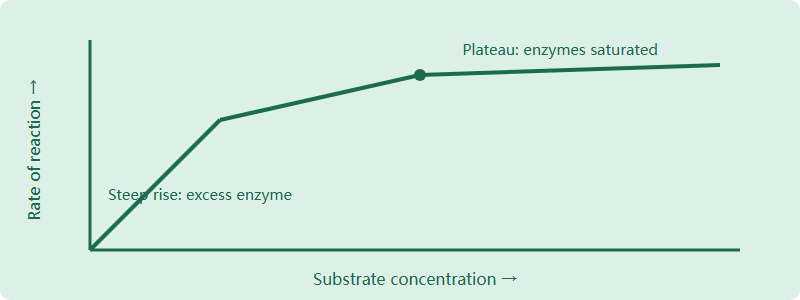
- Effect of temperature, pH and substrate concentration — and crucially, the shape of each curve and why it plateaus or peaks.
- Competitive vs non-competitive inhibition — how each changes the rate, and how they differ on a rate-against-substrate graph.
- Cofactors, coenzymes and activation energy — the vocabulary that questions use to add difficulty.
| Variable changed | Effect on reaction rate | Why it matters in the exam |
|---|---|---|
| Rising temperature (below optimum) | Rate increases — more kinetic energy, more collisions | Tests whether you link kinetics to biology |
| Temperature past optimum | Rate falls sharply — denaturation of tertiary structure | Common distractor: “enzymes are killed” is wrong wording |
| pH away from optimum | Rate falls — altered charges disrupt active site | Different enzymes have different optima (pepsin vs trypsin) |
| Increasing substrate concentration | Rate rises then plateaus — enzymes become saturated | Plateau is the classic “explain this graph” mark |
| Competitive inhibitor | Rate reduced but can be overcome by more substrate | Graph converges on same maximum rate |
Respiration and photosynthesis: learn them as energy accounting
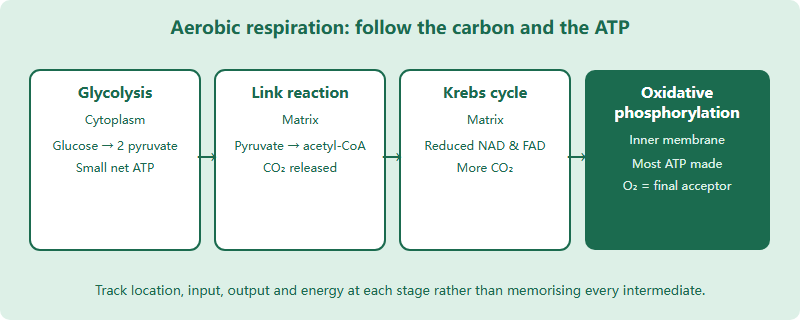
Metabolism questions frequently ask you to track molecules, electrons and ATP across a pathway. Rather than memorising every intermediate, learn each stage as a location, an input, an output and a net energy change. This “accounting” approach survives exam pressure far better than rote lists.
Aerobic respiration breaks into four recognisable stages you should be able to place and summarise:
- Glycolysis (cytoplasm) — glucose to two pyruvate; small net ATP and reduced NAD.
- Link reaction (mitochondrial matrix) — pyruvate to acetyl-CoA, releasing CO₂.
- Krebs cycle (matrix) — acetyl-CoA oxidised; more reduced NAD and FAD, plus CO₂.
- Oxidative phosphorylation (inner membrane) — the electron transport chain and chemiosmosis produce most of the ATP; oxygen is the final electron acceptor.
Photosynthesis mirrors this logic in reverse: light-dependent reactions in the thylakoid membranes generate ATP and reduced NADP, which the light-independent reactions (Calvin cycle) in the stroma use to fix CO₂ into carbohydrate. Questions love to test the difference between the two stages and what happens if light or CO₂ is limited — a natural link to the graph-reading skills we cover in our topic guides.
Biological molecules: the vocabulary that unlocks marks
Many biochemistry marks hinge on precise knowledge of the four families of macromolecules. Build a compact reference in your notes:
- Carbohydrates — monosaccharides, glycosidic bonds, starch/glycogen/cellulose structure-function links.
- Proteins — primary to quaternary structure, peptide bonds, and how structure dictates function (haemoglobin, collagen, enzymes).
- Lipids — triglycerides vs phospholipids, and why the phospholipid bilayer is the basis of every membrane.
- Nucleic acids — DNA/RNA structure, base pairing, and the flow from replication to transcription to translation.
Because roughly 90% of the BBO content overlaps with the USA Biology Olympiad syllabus, this molecular foundation transfers almost directly if you plan to sit both exams — the sequencing logic behind our BBO-then-USABO double-gold plan.
A four-week biochemistry revision block
If you want a concrete schedule, treat biochemistry as a focused block before you broaden into whole-organism physiology:
- Week 1 — Enzymes: mechanisms, all four graph types, inhibition. Practise explaining each curve in one sentence.
- Week 2 — Respiration: the four stages, ATP yields, anaerobic pathways. Sketch the pathway from memory daily.
- Week 3 — Photosynthesis: light-dependent vs Calvin cycle, limiting factors, C3/C4 basics.
- Week 4 — Biological molecules & consolidation: structure-function tables, then mixed past-paper questions.
Our collected pack of past papers — a gathered study set with worked solutions available for some years — is useful in that final consolidation week to see how examiners actually phrase molecular questions. Details are in our China-region exam guide.
Frequently asked questions
Is biochemistry a large part of the BBO?
Molecular biology, enzymes and metabolism recur across many questions, but exact weightings vary by year — confirm current details on the UKBC official pages.
Do I need university-level biochemistry?
The exam can reach beyond A-Level, but strong A-Level or IB command of enzymes, respiration and photosynthesis covers most biochemistry marks.
Should I memorise every respiration intermediate?
No. Learn each stage's location, inputs, outputs and net ATP. Reasoning beats rote recall under time pressure.
Does this overlap with USABO preparation?
Yes — the molecular foundation transfers directly, which is why many students sit BBO first, then USABO.
This is an independent guide operated by Hanlin Education for China-based international-school students. It is NOT affiliated with, endorsed by, or sponsored by the UK Biology Competitions (UKBC) or the Royal Society of Biology. Official competition administration is handled by the organiser; always confirm current dates, format and rules on the UKBC official pages. Any factual error will be corrected within 7 working days.