
Statistics and experimental-design questions on the British Biology Olympiad test how you think like a scientist, not just what you have memorised. They reward students who can identify variables, judge whether a method is valid, and read the logic of a significance test. Because these skills are learnable rules rather than facts, they are among the most efficient marks to secure — and this guide shows how.
Why the BBO tests scientific method, not just recall
A biology olympiad wants to find students who can evaluate evidence. That is why questions ask you to spot a confounding variable, criticise a control, or interpret error bars — tasks that a well-drilled A-Level or IB student can reason through even on unfamiliar biology. Unlike a content topic you either know or don't, experimental-design questions can be decoded on the spot if you carry the right mental checklist into the exam.
This is also why we treat “how to think” skills as a distinct revision strand alongside content. If you have already worked through our BBO preparation guide, treat this article as the analytical layer that sits on top of your topic knowledge.
Variables and controls: the vocabulary examiners expect
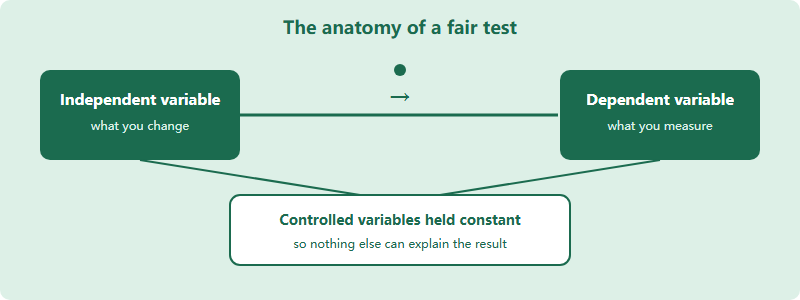
Most experimental-design marks come down to precise use of a small vocabulary. Be able to identify each of these instantly in a described experiment:
- Independent variable — the one factor the experimenter deliberately changes.
- Dependent variable — the outcome that is measured.
- Controlled variables — everything kept constant so the result is fair.
- Confounding variable — an uncontrolled factor that could explain the result instead.
- Control group — the baseline for comparison; a negative control shows the effect is real, a positive control checks the method works.
| Concept | Question stem you might see | What earns the mark |
|---|---|---|
| Identifying variables | “State the independent and dependent variables.” | Name the changed factor and the measured outcome precisely |
| Improving validity | “Suggest one way to improve this method.” | Control a named confounding variable, not a vague “be more careful” |
| Reliability vs validity | “Why repeat the experiment?” | Repeats reduce the effect of random error and let you spot anomalies |
| Sample size | “Comment on the sample used.” | Larger samples make the mean more representative and reduce chance effects |
| Interpreting a control | “Explain the purpose of the control group.” | It isolates the variable being tested from background effects |
Significance tests: what the exam actually wants
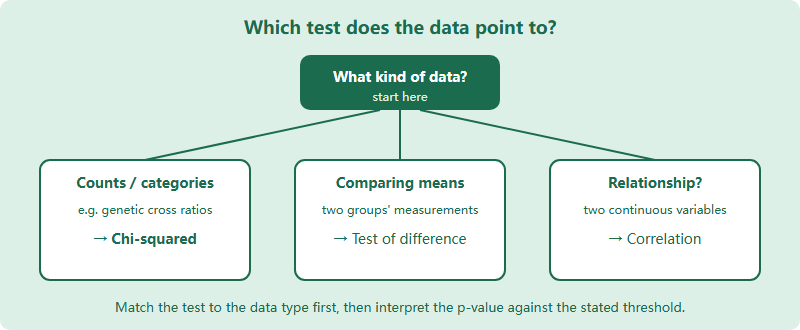
You do not usually need to run a full statistical calculation from scratch, but you should understand the logic of common tests and be able to interpret their output. The key ideas recur:
- The null hypothesis — the assumption that there is no real difference or association.
- Probability and the p-value — how likely the result is if the null hypothesis were true.
- A common significance threshold — biologists often use p = 0.05; if the probability is below the threshold, the null hypothesis is rejected. (Any specific threshold in a given question — confirm it against the question itself.)
- Choosing the right test — chi-squared for categorical/count data and genetic ratios; correlation for associations; a test of difference for comparing means.
The most exam-relevant of these is the chi-squared test, because it links directly to genetics — checking whether observed offspring ratios fit an expected Mendelian ratio. Learn to read a chi-squared statement even if you do not calculate it: a value beyond the critical value means the difference from expectation is unlikely to be due to chance alone.
Reading graphs and error bars critically
Experimental questions often present a chart and ask you to draw a justified conclusion. Strong answers do three things: describe the trend precisely (including any anomaly), quote figures from the data, and comment on how confident the conclusion can be. Error bars matter here — overlapping error bars suggest a difference may not be significant, while clearly separated bars support a real effect. Refusing to over-claim from limited data is itself a mark-worthy scientific instinct.
These are transferable analytical habits. They pair naturally with the pattern-recognition needed for the many topic areas of the exam, and they matter again if you progress to the USA Biology Olympiad, whose data questions demand the same discipline — the sequencing behind our BBO-then-USABO double-gold plan.
A practical way to drill these skills
Statistics and experimental design are best learned actively, not by reading definitions:
- Build a one-page checklist — variables, controls, reliability, sample size, significance logic — and apply it to every practical you meet.
- Rewrite flawed methods — take any described experiment and list three improvements, each naming a specific variable.
- Practise chi-squared with genetics — pair this skill with Mendelian crosses so both reinforce each other.
- Use gathered past papers — our collected pack (with worked solutions for some years) shows how examiners phrase design and stats questions; see the China-region exam guide.
Because the exam is a timed online paper with no practical component, these questions test your understanding of method in the abstract — which means a portable checklist and steady practice beat last-minute cramming.
Frequently asked questions
Do I have to calculate statistics by hand in the BBO?
The emphasis is usually on interpreting and reasoning about tests rather than long calculations, but formats vary — confirm current details on the UKBC official pages.
Which statistical test matters most?
Chi-squared is high-value because it links to genetics and expected ratios. Understand its logic even if you don't compute it fully.
What's the difference between reliability and validity?
Reliability is about consistent, repeatable results; validity is about actually measuring what you intend, free of confounding variables.
Can I improve at these questions quickly?
Yes — they follow learnable rules. A variables-and-controls checklist plus regular practice raises your score efficiently.
This is an independent guide operated by Hanlin Education for China-based international-school students. It is NOT affiliated with, endorsed by, or sponsored by the UK Biology Competitions (UKBC) or the Royal Society of Biology. Official competition administration is handled by the organiser; always confirm current dates, format and rules on the UKBC official pages. Any factual error will be corrected within 7 working days.