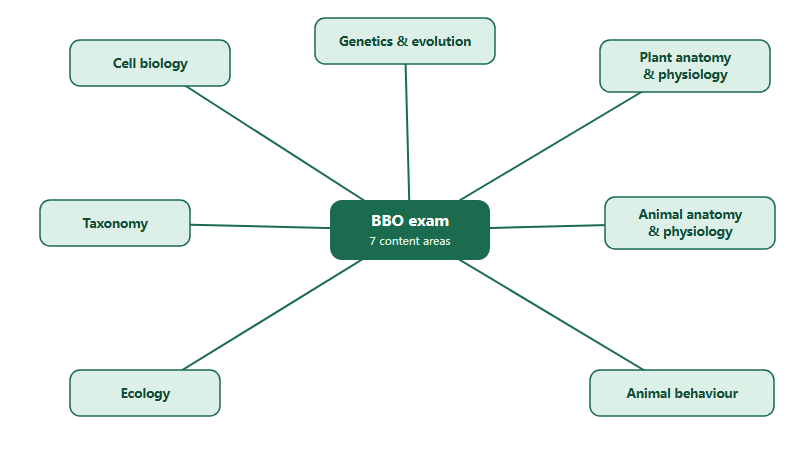
The British Biology Olympiad (BBO) tests seven content areas: cell biology, plant anatomy and physiology, animal anatomy and physiology, animal behaviour, genetics and evolution, ecology, and taxonomy. This checklist maps all seven so you can rate yourself honestly on each, find the gaps your school course leaves behind, and prioritise them before the exam. Treat it as a diagnosis you run before building any study plan.
The seven content areas at a glance
The BBO is a short online exam for sixth-form students, administered by UK Biology Competitions (UKBC) under the Royal Society of Biology. It has no practical or laboratory round — every mark comes from objective, exam-style questions sat at your school or centre. Its defining feature is breadth: rather than drilling one narrow topic, the paper samples across all seven content areas, so a candidate who is strong in genetics but blank on plant physiology quietly gives away accessible marks.
Because the questions spread across the whole map, no single area is safe to skip, and the areas reward different skills. Some lean on structured recall (taxonomy), some on reasoning and calculation (genetics and evolution), and some on integrating several systems at once (physiology). Knowing which is which lets you prepare each area in the right way instead of re-reading everything at the same shallow depth.
There is a strategic bonus to learning this map well: the BBO shares around 90% of its content with the USA Biology Olympiad (USABO). Master the seven areas here and you have effectively built most of your USABO base too — the logic behind the BBO-then-USABO double-gold plan.
The reasoning core: cell biology, genetics and evolution
Two areas reward thinking over memorising, and they are where careful candidates separate themselves from well-drilled ones.
Cell biology spans membrane structure and transport, organelles and their functions, cellular respiration and photosynthesis, the cell cycle and division, and the molecular basics of DNA, RNA and proteins. Expect questions that ask you to interpret a diagram or predict what happens when one step in a pathway is blocked, not just to name a part.
Genetics and evolution covers Mendelian inheritance, linkage and recombination, allele-frequency and population-genetics reasoning, mutation, natural selection and the mechanisms of evolution, plus the basics of how phylogenies are built. This area often carries data and calculation questions, so practising numerical genetics problems under time pressure pays off directly. Self-check: can you set up and solve an allele-frequency problem without a worked example in front of you?
Systems thinking: anatomy and physiology, plant and animal
Two more areas test whether you can hold a whole organism in your head. Marks here go to candidates who see how systems connect rather than treating each organ in isolation.
- Animal anatomy and physiology: circulatory, respiratory, nervous, endocrine, digestive, excretory and immune systems, plus how they are regulated through homeostasis and feedback.
- Plant anatomy and physiology: water and mineral transport in the xylem, sugar transport in the phloem, transpiration, gas exchange, photosynthesis at the organ level, plant structure and plant hormones.
Plant physiology is the classic weak spot for students coming from courses that spend most of their time on human biology. If your A-Level or IB has under-served plants, this is where targeted work moves your score the most for the least effort.
The breadth band: behaviour, ecology and taxonomy
The final three areas are wider and often lighter in the school syllabus, which makes them low-effort, high-return once you give them deliberate attention.
- Animal behaviour: innate versus learned behaviour, communication and signalling, and behaviour viewed through an evolutionary lens.
- Ecology: energy flow, nutrient cycles, population dynamics, and interactions within and between species and communities.
- Taxonomy: the principles of classification and the distinguishing features of the major groups of living things.
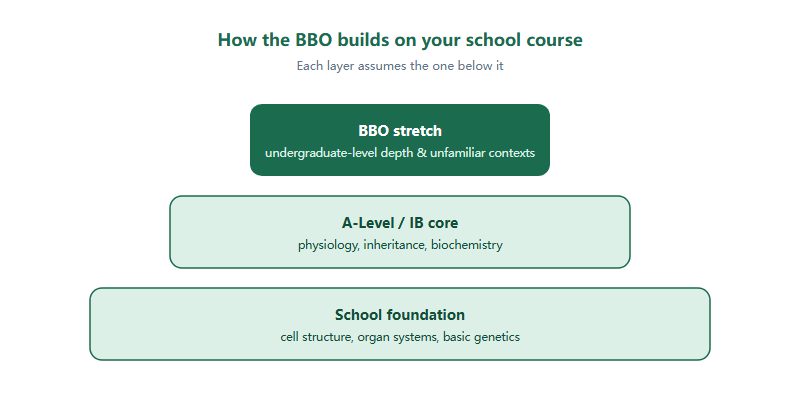
Taxonomy in particular rewards structured recall — a well-made summary sheet banks marks that reasoning alone will not. The diagram below shows how each area builds from your school foundation up to the undergraduate depth the BBO reaches into.
Your self-audit table: rate yourself on all seven
Work down the table and give each area an honest label — solid, shaky, or blank — using the self-check question in the last column. Spend your first study sessions on the blanks, then convert shaky areas into solid ones with past-paper questions. A curated past-paper pack (gathered by Hanlin, with worked solutions for some years) helps you see how the same sub-topics recur, but even a handful of papers will expose your true gaps quickly.
| Content area | Typical A-Level / IB coverage | Where the BBO stretches | Self-check question |
|---|---|---|---|
| Cell biology | Membranes, organelles, respiration and photosynthesis basics | Molecular detail and integration across pathways in new contexts | Can you explain respiration and photosynthesis end to end? |
| Genetics and evolution | Mendelian genetics, natural selection | Population genetics, linkage, quantitative problems | Can you solve an allele-frequency problem under time pressure? |
| Animal anatomy and physiology | Human systems in depth | Comparative systems and finer regulation and feedback | Can you trace a feedback loop across two systems? |
| Plant anatomy and physiology | Transport and photosynthesis (often lighter) | Organ-level physiology, hormones, structure | Can you explain transpiration and phloem transport? |
| Animal behaviour | Often minimal | Innate versus learned behaviour, evolutionary framing | Can you separate innate from learned behaviour with examples? |
| Ecology | Energy flow and nutrient cycles | Population dynamics and community interactions | Can you apply a population model, not just define it? |
| Taxonomy | Classification basics | Distinguishing features of the major groups | Can you list the defining features of each major group? |
Once you have your labels, the audit turns into an action list. Convert it into a week-by-week routine using our guide on how to prepare for the BBO, check the sitting logistics in the BBO China exam guide, and remember to confirm the current exam format and date on the official pages, since details can shift between seasons.
Frequently asked questions
What topics are on the BBO syllabus?
Seven content areas: cell biology, plant and animal anatomy and physiology, animal behaviour, genetics and evolution, ecology, and taxonomy.
How deep does the BBO go compared with A-Level or IB?
It builds on school biology and stretches into first-year-undergraduate depth in several areas. Confirm the current scope on the official pages.
Which BBO area do students most often neglect?
Plant physiology, animal behaviour and taxonomy are common blind spots for students trained mainly on human biology.
Is any content area safe to skip?
No. The paper samples across all seven areas, so leaving one blank means giving away marks you could have earned.
This is an independent guide operated by Hanlin Education for China-based international-school students. It is not affiliated with, endorsed by, or sponsored by UK Biology Competitions (UKBC) or the Royal Society of Biology, which handle official competition administration. Syllabus scope, eligibility, exam format and dates are set by the organiser and can change between seasons — always confirm current details on the official UKBC pages. Any error will be corrected within 7 working days.