
The BBO sorts entrants into award tiers — commonly Gold, Silver and Bronze, plus commendation and participation levels — based on how your mark compares with the whole cohort that year. The exact score boundaries are not fixed: they are set after marking and published by the organiser, so a “Gold” mark differs from year to year. Here is how the system works and how to read your result. Confirm the current ladder and boundaries on the official pages.
How BBO awards are structured
The British Biology Olympiad is a short online exam for sixth-form students, run by UK Biology Competitions (UKBC) under the Royal Society of Biology, with no practical round. After marking, entrants are placed into a ladder of award tiers. The best-known are the medal tiers — Gold, Silver and Bronze — with commendation and participation levels beneath them. The precise set of tiers and their names are defined by the organiser and can be refined between seasons, so treat any ladder (including the one below) as representative and confirm the current version on the official pages.
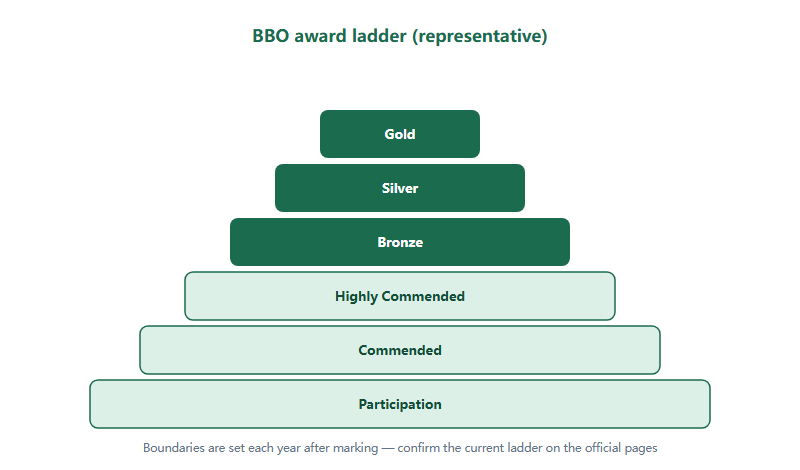
Above the ladder, the very top scorers may additionally be invited to the next stage of selection that leads toward the UK team for the International Biology Olympiad (IBO). That onward pathway has its own rules, and it does not apply the same way to every entrant — confirm the current structure, and what it means for your route, on the official pages.
Why the score boundaries change every year
The single most misunderstood thing about the BBO is that the boundaries are not fixed pass marks. A paper’s difficulty varies from year to year, and the awards are set relative to how the whole cohort performs, with boundaries decided after all papers are marked and then published. So “the Gold boundary” is a moving number: last year’s cutoff does not reliably predict this year’s.
The practical takeaway is simple — chase rank, not a magic number. Do not anchor your preparation to a specific score you saw quoted online, because that figure belonged to one particular cohort and paper. Aim to be well inside the top band of your year, build a margin, and let the boundary fall where it falls. If you want a structured way to build that margin across all seven content areas, our BBO preparation guide breaks the work into weekly steps.
The award ladder, tier by tier
Here is what each tier broadly represents and how to read it. Every boundary is set each year, so the descriptions below are about relative standing, not fixed marks.
| Award tier | What it broadly represents | How to read it |
|---|---|---|
| Gold | The top band of scorers nationally in that year | Strongest signal; boundary set each year after marking |
| Silver | A high band immediately below Gold | Strong, competitive performance |
| Bronze | A solid band above the commendation levels | A credible, positive result worth reporting |
| Highly Commended | Above the middle of the cohort, below the medal bands | Shows real engagement and progress |
| Commended | A recognised band below Highly Commended | Worth noting, especially alongside improvement |
| Participation | Entered and completed the exam | A baseline and a starting point to build on |
From paper to result: how a mark becomes an award
Understanding the pipeline removes a lot of anxiety about “what score do I need.” Nothing is decided in advance; the boundaries emerge from the cohort itself.
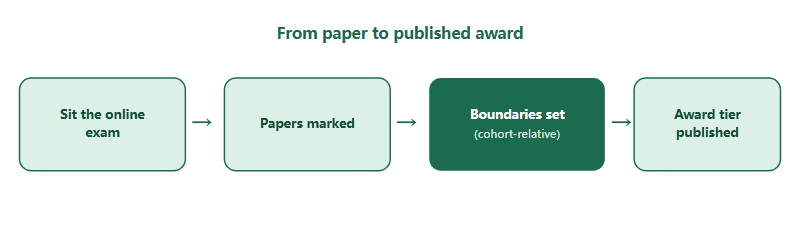
This is also why comparing your raw mark against a friend from a different year tells you very little. The only fair comparison is award tier within the same cohort, which is exactly what universities and admissions readers see.
Reading a BBO award — including for China-region entrants
An award is a signal of relative performance in a national-standard biology exam. Gold reads strongest, but Bronze and the commendation levels still show genuine engagement well beyond the school syllabus, especially when paired with an upward trend across years. A single result is a data point; a story of improvement is more persuasive. It is a positive signal, never a guarantee of anything.
For students sitting the China-region exam (typically held in January), the awards, recognition and boundaries used for your cohort may differ from the UK arrangement, so confirm exactly which ladder applies to you before quoting a tier. The logistics of that sitting are covered in the BBO China exam guide. And because the content overlaps heavily with USABO, a strong BBO result is a natural springboard into the BBO-then-USABO plan for a second, complementary award.
Frequently asked questions
What score do I need for a BBO Gold?
There is no fixed score. Boundaries are set each year after marking, relative to the cohort, and published by the organiser. Confirm on the official pages.
What are the BBO award tiers?
Commonly Gold, Silver and Bronze plus commendation and participation levels. Confirm the current ladder on the official UKBC pages.
Why do BBO boundaries change every year?
Because paper difficulty varies, awards are set relative to how the whole cohort performs that year rather than against a fixed pass mark.
Does a BBO award guarantee a university place?
No. It is a positive signal of biology aptitude and commitment, never a guarantee of admission anywhere.
This is an independent guide operated by Hanlin Education for China-based international-school students. It is not affiliated with, endorsed by, or sponsored by UK Biology Competitions (UKBC) or the Royal Society of Biology, which handle official competition administration. Award tiers, score boundaries, eligibility, format and dates are set by the organiser and can change between seasons — always confirm current details on the official UKBC pages. Any error will be corrected within 7 working days.