
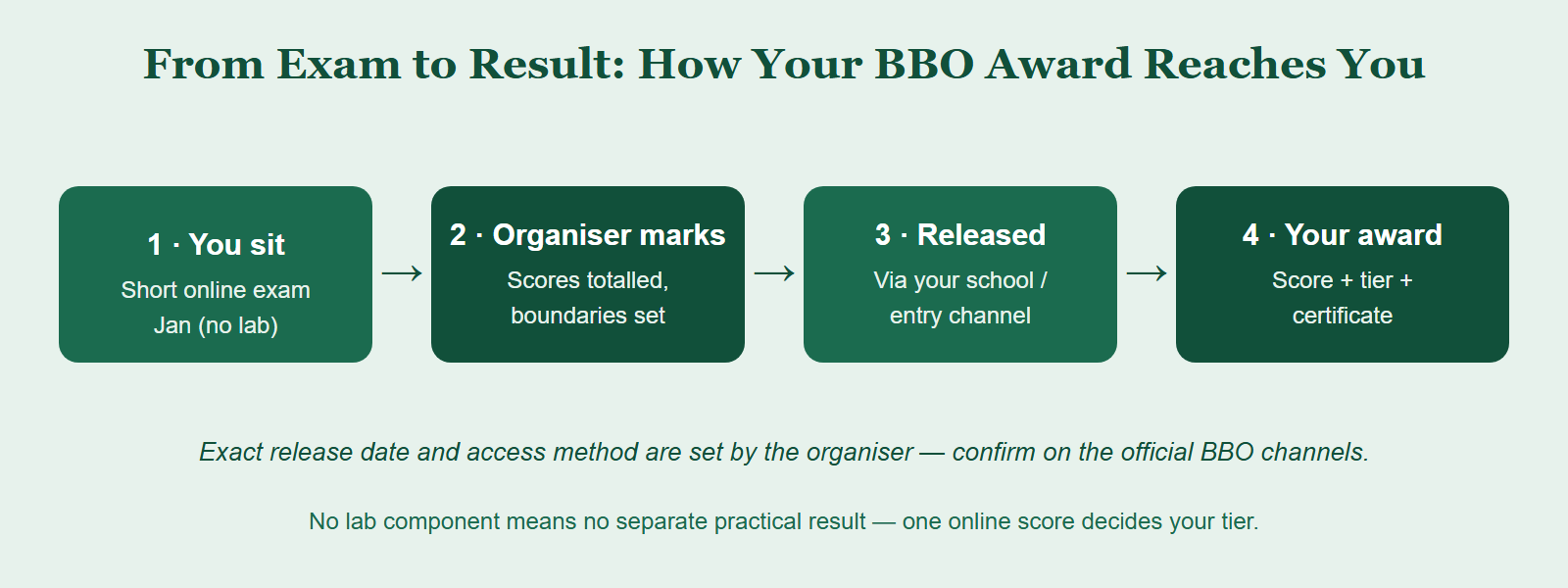
Your British Biology Olympiad (BBO) result reaches you through your school or the channel you sat under, usually some weeks after the January exam. Your award — Gold, Silver, Bronze or a further tier such as Highly Commended — is decided by your raw score against that year’s published boundaries, not a fixed percentage. For the exact release date and how to access your score, always confirm on the official BBO channels.
Below is the practical “results day” guide: what arrives, how to read it, and — the part most students get wrong — what a given award actually signals and what to do next. The BBO is run by UK Biology Competitions (UKBC) under the Royal Society of Biology; administration, timing and results are set by the organiser, so we point you back to them for anything date- or login-specific.
When and how your result arrives
The BBO is a short online exam with no lab component, so there is no manual marking delay of the kind a written-script olympiad has — but results are still released on the organiser’s schedule, typically weeks after the sitting, once boundaries are set across all entries. The 2026 China-region exam is 17 January 2026 and the UK home competition runs 19–28 January 2026; the results-release date for either is something to confirm on the official channels rather than assume from last year.
How the result actually reaches you depends on the route you entered through. Most candidates sit through a school or registered centre, and the result — a score plus an award certificate or label — is distributed back via that same coordinator. If you registered through a different channel, your result returns through that channel. We do not publish a single “log in here to see your score” link, because the access mechanism is the organiser’s to define and it can change year to year — confirm on the official BBO channels.
How to read your award: it is scored, not ranked
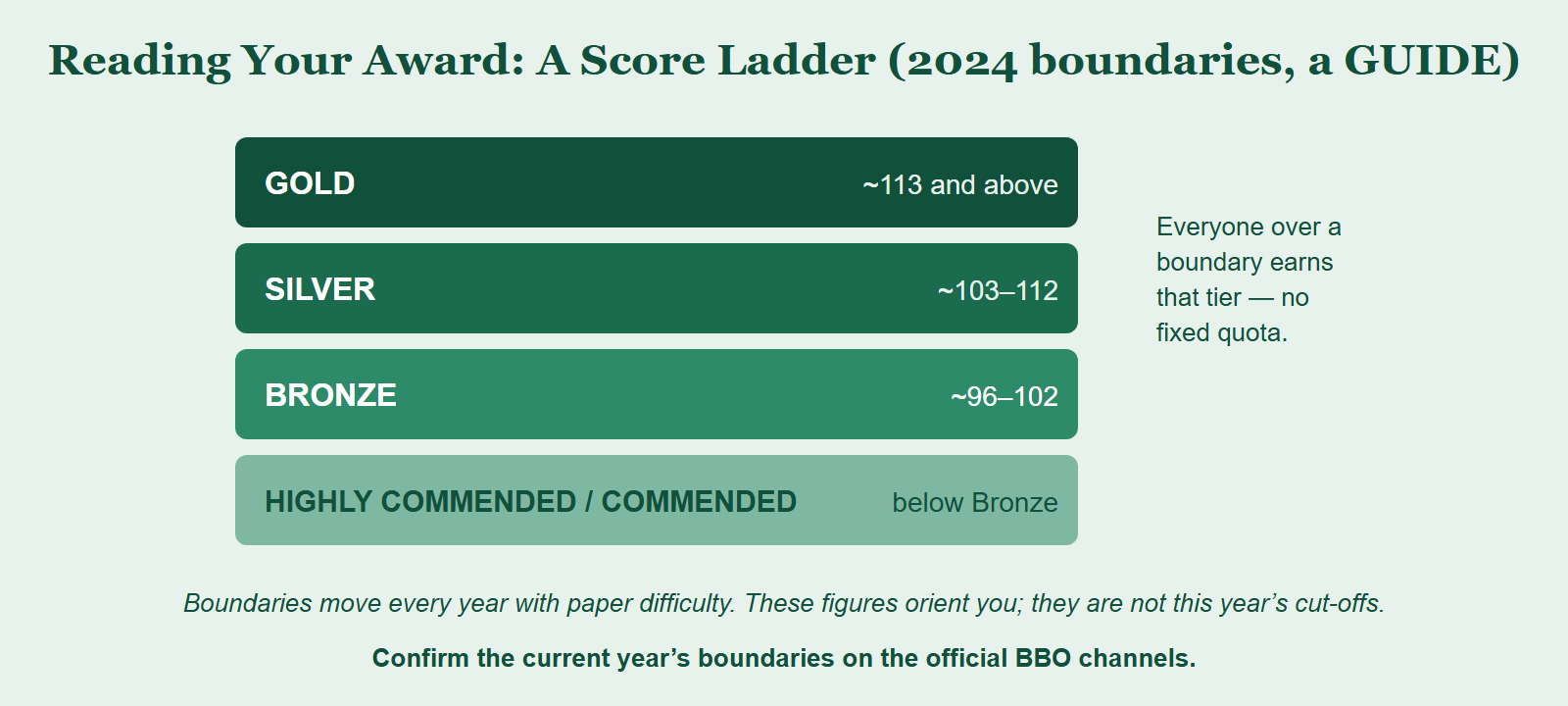
This is the single most important thing to understand. A BBO award is criterion-based: you are measured against a published score boundary, not against the person sitting next to you. Everyone who clears the Gold boundary gets Gold — there is no fixed quota of one award per N students. So your result is best read as “how much of the paper I converted into marks,” not “where I ranked.”
Boundaries are set each year and move with the difficulty of that paper. As a guide only, the 2024 boundaries sat around 113 for Gold, 103 for Silver and 96 for Bronze, with further recognition tiers (such as Highly Commended and Commended) below those. Treat those numbers as orientation, not a target you can bank on — confirm the current year’s boundaries on the official channels, because a harder paper lowers them and an easier one raises them. If your score lands just under a boundary, that is the paper’s calibration, not a verdict on your ability.
Two practical reading tips. First, look at your score relative to the boundary gap, not just the label: a Silver three marks off Gold tells you something very different from a Silver thirty marks off. Second, remember the scale of the field — last year 15,000+ students from 900+ schools took part, so a Bronze or higher already places you meaningfully within a large, self-selected, biology-keen cohort.
What your result means for international and China-region students
If you sat the China-region exam, an important point of honesty: your award is BBO recognition — a Gold, Silver or Bronze certificate that documents your performance — and it is a genuine, internationally legible biology credential. What it does not do is place you onto the UK team for the International Biology Olympiad (IBO); the BBO selects the UK’s IBO team through a separate UK-based pathway. International students take part for the recognition, not for UK team selection. Read your certificate for what it is and use it accordingly on applications.
The more useful way to frame a result is forward-looking. Because the BBO and the USA Biology Olympiad (USABO) share roughly 90% of their content, a strong BBO showing is direct evidence you are ready to convert that same biology into a second credential a few weeks later — USABO sits in late March. A January Gold or Silver, in particular, is a signal to push straight on rather than stop. We map that handoff in detail in BBO then USABO: the double-gold path, and the route specifics for overseas candidates in the international / China-region exam guide.
What to do next, by result band
Gold or Silver. Do not coast on it. You have proven applied command of the syllabus; the highest-value move is to ride that momentum into USABO in late March while the same 90%-overlapping material is fresh, and to deepen the two or three areas where you dropped marks. Pull your paper apart question by question and note exactly where the lost marks came from.
Bronze, Highly Commended or Commended. This is a solid platform in a 15,000-strong field, and the gap to the next tier is almost always a few specific, fixable areas — not a ceiling. The fastest gains usually come from the topics A-level and AP courses under-cover: plant physiology, ecology and taxonomy. Diagnose, target, and resit next cycle with a plan.
Just under a recognition tier. Remember the boundaries are calibrated to the paper. A near-miss often means your biology is close and your exam execution — pace across multiple-choice, fill-in and ordering questions — cost you. That is the most improvable thing of all.
Whatever the band, the next step is the same shape: turn the result into a study plan. Our structured route is in how to prepare for the BBO, which builds from Campbell Biology plus AP/A-level resources toward a January sitting. To rehearse under real conditions, work through full papers: BBO past papers are available as our collected free pack — scan the QR on that page or message us to get it (worked-solution coverage varies by year, and our teachers add more over time). For exactly what is and isn’t allowed on the day, see the competition rules.
A note on first-party results
To make “what a result can lead to” concrete: in the 2026 season, Hanlin’s biology cohort earned 26 BBO Golds, 21 Silvers and 5 Bronzes, and 5 students reached the USABO US-region Semifinal (per Hanlin’s own records). The pattern behind those numbers is exactly the advice above: read the BBO result honestly, then act on it — consolidate the weak areas and carry the momentum into USABO while the shared content is still warm.
Frequently asked questions
When do BBO results come out?
Results are released on the organiser’s schedule, generally some weeks after the January exam once all entries are marked and boundaries are set. The exact date for your sitting is not something to assume from a previous year — confirm on the official BBO channels.
How do I actually check my score?
Your result returns through the route you entered by — usually your school or registered centre, which distributes the score and certificate. The access method is defined by the organiser and can change, so confirm on the official BBO channels rather than relying on a fixed link.
What score do I need for Gold, Silver or Bronze?
Awards are set by score against published boundaries that move each year with paper difficulty. As a guide only, 2024 sat near 113 Gold / 103 Silver / 96 Bronze, with further tiers below — but confirm the current year’s boundaries on the official channels.
Does a BBO award put me on the IBO team?
No. The BBO selects the UK’s International Biology Olympiad team through a separate UK-based pathway. International and China-region students take part for BBO recognition, not for UK team selection.
This is an independent English-language guide to the British Biology Olympiad for international and China-region students, operated by Hanlin Education. It is not affiliated with, endorsed by, or sponsored by UK Biology Competitions (UKBC) or the Royal Society of Biology. Rules, dates, eligibility and results are set by the organiser — always confirm current details through the official BBO channels.