
The British Biology Olympiad is written for students on a UK sixth-form course and its award boundaries are built from the scores of students at UK schools. That gives a British entrant a quiet home-field advantage that has nothing to do with being better at biology: familiarity with the settings, organisms and conventions a question is dressed in. For an entrant in China, some lost marks are biology. Some are only scenery.
A paper written for one cohort, sat by many
Two facts from UKBC frame this whole article. First, the olympiad assumes knowledge of the common elements of the A-level biology syllabuses, so it is calibrated to a particular course rather than to biology in the abstract. Second, award boundaries are set using the scores of students at UK schools and are then applied to everyone who sat the paper, so your reference group is a UK sixth-form cohort whether or not you have ever set foot in a UK classroom.
Now add the organiser's own description of what the paper is trying to do. It is not primarily a test of recall; it asks students to apply biological principles to material they have not met before. That is a deliberate feature and a good one. But it creates a trap that is easy to miss: if the science in the stem is supposed to be unfamiliar, then the setting around it is doing a lot of quiet work. A UK student reading a question about a hedgerow, a dairy herd or an over-wintering bird population is not being told anything about the biology, but they are not spending any working memory on the scene either. They read the stem once and start thinking. Someone who has never encountered that scene reads it twice, holds it uncertainly, and starts thinking thirty seconds later with less confidence.
Under a ninety-minute paper split across two forty-five minute halves, thirty seconds repeated many times is not trivial. This is the home-field problem, and it is not the same thing as either of the two gaps students usually talk about.
Three gaps that look identical on a mock paper
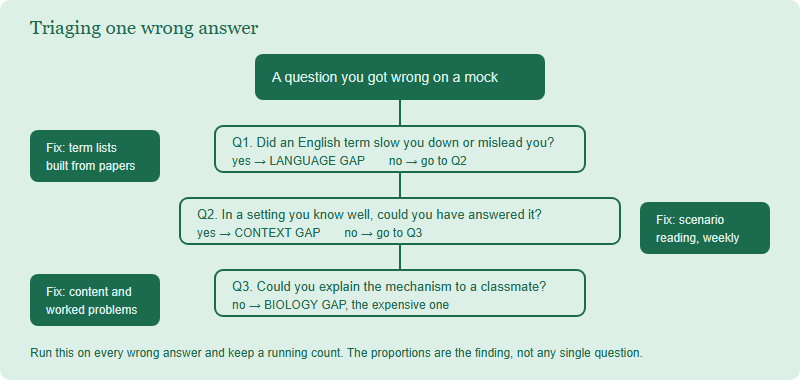
When a student brings us a marked mock and says “I do not know why I got these wrong,” the wrong answers almost always split into three groups that need three completely different responses.
| Gap | What actually happened | Diagnostic question | Fix | Cost to close |
|---|---|---|---|---|
| Language | You know the concept in Chinese but did not recognise the English term fast enough | Would I have answered this instantly if the key noun had been in Chinese? | Targeted terminology work on the words that recur in biology writing | Low. Weeks, and it compounds. |
| Context | You knew the biology, but the scene the question was set in was unfamiliar, so reading cost you time and certainty | If this had been set somewhere I know well, could I have done it? | Deliberate exposure to a small number of temperate settings and everyday biological scenarios | Low to moderate. Mostly reading. |
| Biology | You have genuinely not met the principle, or you have met it and cannot use it | Do I understand this mechanism well enough to explain it to someone else? | Content study, worked problems, then re-testing | High. This is the real work. |
Most students collapse all three into “I need to study more biology,” which is expensive and sometimes wrong. Some collapse all three into “my English is not good enough,” which is demoralising and usually also wrong. The point of separating them is that two of the three are cheap to fix and the third is not, so misdiagnosing sends your autumn in the wrong direction.
Where context tends to sit across the seven content areas
The olympiad draws on seven content areas: cell biology, plant anatomy and physiology, animal anatomy and physiology, animal behaviour, genetics and evolution, ecology, and taxonomy. From our own work through past papers with China-based students, context exposure is not spread evenly across those seven. Some areas are essentially universal, and some are almost always dressed in a scene.
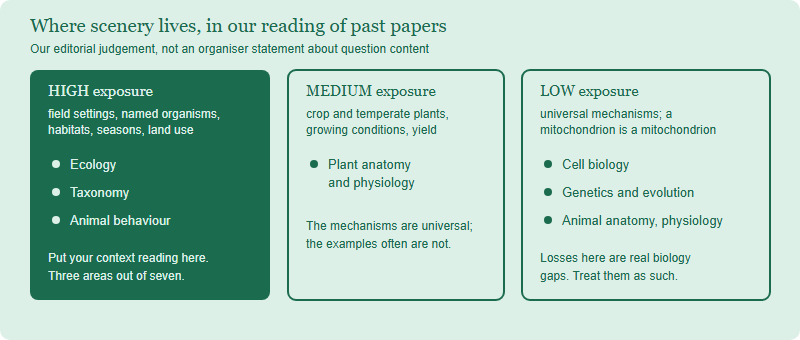
The allocation rule that falls out of this is worth more than the grouping itself. Context work belongs in three of the seven areas. If you are losing marks in cell biology or genetics, do not comfort yourself that the scenery was unfamiliar. A respiration question is a respiration question in Shanghai and in Sheffield, and a wrong answer there is a biology gap that needs content work, not reading. Conversely, if your ecology and behaviour scores are dragging while your cell biology is solid, throwing more mechanism study at the problem will not touch it.
Closing a context gap without memorising British wildlife
The failure mode here is students deciding they must learn British flora and fauna, then building flashcard decks of species names. That is both miserable and useless, because the exam asks students to apply principles to situations described in the question rather than to reproduce a species list. What you actually want is fluency with a small number of recurring scene types, so that a described situation stops feeling foreign. Four habits, roughly two hours a week, from now until a January sitting.
- One temperate-setting profile a week. Pick a scene type such as deciduous woodland, grassland, freshwater stream, hedgerow or estuary, and write half a page on it yourself: what layers or zones it has, what eats what, what changes across a year, what a farmer or conservation body might do to it and why. You are building a mental template, not a species list.
- Read biology in English about ordinary things. Fifteen minutes, twice a week, of general-audience writing on seasonal change, farming, disease or conservation. The aim is that the everyday furniture of a question stops being novel. This overlaps usefully with terminology work, but it is not the same job.
- Convert every stem you found strange into a note. When a past paper sets a question somewhere unfamiliar, write one line: what the setting was, and what you would need to have known about it to read the stem in one pass. After ten papers you will have a short, personal, evidence-based list. That is far better than any generic list somebody else made.
- Keep the error tally. Run the three-question triage on every mock and record the split. If context is under one error in ten, stop doing context work and go back to biology. The tally, not your mood, decides where the next month goes. Where mocks belong in a term is set out in our preparation guide.
Keep the problem in proportion
Be honest about the size of this effect. For most students preparing seriously, the biology gap is much larger than the context gap, and it stays larger all the way to January. Context work is a multiplier on preparation, not a substitute for it. Anybody selling it as the secret to a gold is selling you something.
Where it matters is at the margin, and the margin is where award bands are decided. Boundaries sit only a few marks apart in the middle of the scheme, so a handful of questions read slowly and answered nervously can move you a band without changing anything about your biology. That is the most annoying way to lose an award, and it is one of the few losses that a couple of hours a week can genuinely prevent.
Two closing cautions. First, this article is about the unintended unfamiliarity of the scenery, not the intended unfamiliarity of the science: the paper is designed to hand you biology you have not been taught, and that part is not a gap to be closed but a skill to be practised. Second, do not assume the same context map transfers to other olympiads. A paper written in another country carries its own regional furniture, which is one more reason to treat a spring second paper as a separate preparation with its own review rather than a rerun of January — the sequencing logic is in our BBO then USABO plan, and the practical arrangements for sitting the January paper through a school in China are in our China-region exam guide.
Frequently asked questions
Is the BBO harder for students outside the UK?
The paper is written for a UK course and marked against the UK field, so unfamiliar settings can cost reading time even when your biology is sound.
Should I memorise British species names?
No. The exam rewards reasoning about a described situation, so build familiarity with a few scene types instead of species lists.
How do I tell a context gap from a real biology gap?
Ask whether you could have answered the same question set somewhere familiar. If yes it is context; if no it is biology.
Which content areas deserve context work?
In our reading, mainly ecology, taxonomy and animal behaviour. Cell biology and genetics losses are almost always genuine content gaps.
This is an independent guide operated by Hanlin Education for China-based international-school students. We are not affiliated with, endorsed by, or sponsored by UKBC or the Royal Society of Biology, and official administration of the competition rests with the organiser. The groupings and observations above are our own editorial judgement from working through past papers, not statements about any future paper; confirm current dates, eligibility, format and award details on the UKBC official pages. Errors reported to us are corrected within 7 working days.