
There are only a handful of British Biology Olympiad past papers available, and no official worked answers accompany them. A serious candidate who starts in September will spend that archive by December. The fix is not to re-sit papers you have half-memorised. It is to convert ordinary biology material into BBO-grade items, and to mark them honestly without a scheme.
The supply is smaller than your revision plan assumes
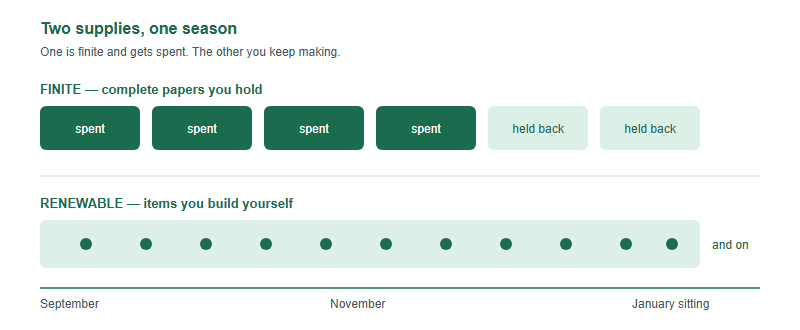
Almost every BBO revision plan we see contains the same silent assumption: that practice papers are effectively unlimited, so “do past papers” can carry three months of work. It cannot. The archive of distinct BBO papers is measured in a small number of seasons, not in dozens. Our own gathered practice pack covers the recent seasons and carries worked solutions for some years but not all of them, because official worked answers are not published alongside these papers. That is not a gap in our pack. It is the state of the world for this competition.
Two consequences follow, and they pull in opposite directions. First, complete papers are a scarce, non-renewable resource, so spending one carelessly in September is expensive. Second, marking is a skill you will need whether you want it or not, because for much of what you sit there is no authority to check yourself against.
The scarcity gets worse once you accept the rule that makes past papers useful at all: a paper you have already worked through is no longer a diagnostic. Your score on a second sitting is inflated by recall, not by biology. So the honest inventory is not “how many papers exist” but “how many untouched papers do I still hold, and what am I saving them for?”
Four moves that turn ordinary biology into BBO-grade questions
The reason you can manufacture usable practice at all is that the BBO does not test recall of a fixed syllabus. UKBC states that students will be presented with topics and ideas they are not familiar with, and that the paper assesses biological intuition, logic and imagination alongside some quick-fire questions of basic knowledge. Unfamiliarity is the design, not an accident. That means any biological material you have never studied is raw stock for a practice item — provided you process it rather than just read it.
Each of the four moves below takes something you already own — a textbook figure, a data table, a paragraph of explanation, a classification key — and removes the part that was doing the thinking for you.
| Move | What you take | What you strip out | What the item then tests | Best fit among the seven areas |
|---|---|---|---|---|
| 1. Blind the figure | Any graph, micrograph or data table with a caption | The caption, the axis titles and the surrounding text | Reading a trend and inferring what was measured, with no verbal scaffold | Animal anatomy and physiology; plant anatomy and physiology; ecology |
| 2. Hide the conclusion | A worked explanation of a mechanism or an experiment | The final sentence that states the result, or the “therefore” | Predicting an outcome from a setup, which is the core BBO reasoning move | Cell biology; genetics and evolution; animal behaviour |
| 3. Scramble the sequence | Any numbered pathway, cycle, cascade or life cycle | The order — shuffle the steps and rewrite them as a flat list | Ordering, which is a genuinely different skill from recognising a true statement | Cell biology; genetics and evolution; plant anatomy and physiology |
| 4. Invert the question | A described organism, tissue, structure or habitat | The name — leave only the features | Working from characteristics back to classification or function | Taxonomy; ecology; animal behaviour |
Move 1 is the highest-yield of the four, and it is worth being concrete about why. Most textbook figures are written to be understood, so the caption hands you the conclusion before you have looked at the axes. Cover it, and the same figure becomes a data-interpretation item: what is on each axis, what is the direction of the effect, what would the control have looked like, and what does the spread suggest about how confident you can be. You have not added any biology. You have removed the help.
Move 3 deserves a note too, because ordering rewards a different kind of knowing. You can often recognise that a statement about a metabolic pathway is true while being unable to place five statements about it in sequence. Shuffling a pathway you have just revised exposes that gap within a minute, and it is the cheapest item type to build, because you already have the numbered list in front of you.
One discipline applies to all four moves. Never invent the underlying content. You are re-presenting material that already exists in a reputable source; you are not writing new biology or inventing plausible-looking data. If you cannot point to where the material came from, you cannot mark it — and an item you cannot mark is worse than no item at all.
Marking an item that has no mark scheme
Because official worked answers do not accompany the past papers, and because self-built items obviously come without one, marking is the real bottleneck. Students tend to respond in one of two unhelpful ways: they skip marking entirely and call the reading “revision”, or they mark generously against a half-remembered impression of what they meant.
Use a source-anchored procedure instead. It costs about the same time as marking against a scheme, and it produces something a scheme cannot: a record of why you were wrong.
- Write the answer down before you look. Commit it in full, in writing. An answer held in your head is unfalsifiable, because you will reconstruct it after seeing the source and conclude that you knew it.
- Return to the part you stripped out. The caption, the concluding sentence or the original order is your mark scheme. This is precisely why moves 1 to 4 produce markable items and invented questions do not.
- Judge direction and mechanism separately. Getting the direction of an effect right while misattributing the mechanism is a different failure from getting both wrong, and it calls for different revision.
- Log the failure type, not the mark. Was it missing knowledge, a misread of the data, an unfamiliar term, or an assumption imported from your own syllabus? The distribution of these across a month tells you what to fix in a way that a running score never does.
- Escalate disputes rather than settling them. Where you genuinely cannot decide whether your answer is defensible, park it and take it to a teacher or a study partner. Two plausible readings of one item is a signal worth keeping, not a tie to break alone.
If you want the wider structure this sits inside — how many complete papers to sit, when to sit them, and how to run the review afterwards — that belongs to the broader BBO preparation plan rather than to any single practice session.
A rotation that does not repeat itself
The practical question is what a week looks like once you accept that complete papers are rationed. The shape below has worked for students we coach, and it deliberately keeps the two supplies apart: manufactured items carry the weekly load, complete papers are reserved for calibration.
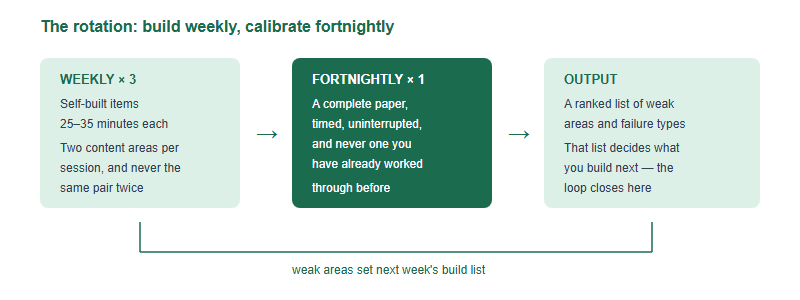
Three details matter more than the shape itself. Build items for the areas you are avoiding, not the ones you enjoy, because the seven content areas are never equally comfortable and the uncomfortable ones are where the marks are sitting. Keep every item you build in one running file, since a bank of eighty questions you wrote yourself is a serious revision resource by December. And sit your timed papers under conditions that resemble the real thing: UKBC describes two forty-five-minute multiple-choice papers taken entirely online, on-site at the registered school, so a session with your phone face-up on the desk is not calibration. The practical arrangements for a China-region sitting are set out in our guide to the BBO China-region exam.
What manufactured practice cannot do
Be clear-eyed about the limits, because overselling this method is how students end up under-prepared in a different way.
Self-built items train reasoning, coverage and the habit of working without scaffolding. They do not train pacing across a whole paper, they do not reproduce the specific register of the real questions, and they cannot tell you where you stand relative to anybody else. Only a complete, untouched, timed paper does those things — which is the argument for rationing rather than hoarding. A paper saved until the week before the sitting and then never actually sat is just as wasted as one burned in September.
They also carry a quiet risk of self-flattery. When you write the item, you know which feature you were pointing at, so you may answer your own question more easily than a stranger would. The countermeasure is time: build items on one day and answer them at least several days later, once you have forgotten the choice you made. Students who build a bank in September and work it in November get a far fairer signal than students who build and answer in the same hour.
Finally, the method is portable, and that is a real dividend if you intend to sit more than one biology olympiad. A converted figure or a scrambled pathway works just as well for a spring paper as for a January one, because the underlying reasoning is shared — which is the practical foundation of the BBO-then-USABO sequence. A bank you build once gets worked twice.
Frequently asked questions
How many BBO past papers are actually available?
A small number of recent seasons, not dozens. Treat the archive as finite and plan to build your own practice once it is spent.
Are official worked answers published with the past papers?
No worked answers accompany them. Our gathered pack carries solutions for some years only, so expect to mark much of your practice yourself.
Can I re-sit a paper I have already worked through?
Only as a timing drill. Recall inflates the score, so a repeat sitting can never be read as a fresh diagnostic of where you stand.
Is a self-built item as good as a real question?
No. It trains reasoning and coverage, not pacing or register, so always hold one untouched paper back for a genuine timed run.
This is an independent English-language guide to the British Biology Olympiad, operated by Hanlin Education for China-based international-school students. We are not affiliated with, endorsed by, or sponsored by UK Biology Competitions (UKBC) or the Royal Society of Biology, and official competition administration rests with the organiser. Formats, dates, eligibility and award boundaries are set by the organiser and can change between seasons — confirm current details on the UKBC official pages. Errors brought to our attention are corrected within 7 working days.