
Most BBO planning stops at the certificate. It should not. The regional listings attach something else to an award: invitations to July 2027 camps with hard capacity limits — 60 places at one, 45 at another — and one of them is marked “closed when full”. That turns a January result into an option on a scarce summer place, and options have to be planned for before you know whether you hold one.
What the listings actually attach to an award
Four items appear on the regional pages alongside the January exam. All are described as following from a BBO award, and the three camp entries carry provisional date markers, which matters more than students usually notice.
| Item | When | Where | Who qualifies | Capacity |
|---|---|---|---|---|
| BBO Asia Camp | July 2027 (marked TBD) | China | Invited award-winning students in BBO | 60 students, “limited registration, closed when full” |
| St Catharine's College biology camp | July 2027 (marked TBD) | St Catharine's College, University of Cambridge, UK | Invited award-winning students in BBO | 45 students |
| BBO Camp (wider-Asia listing) | July 2027 (marked TBC) | Qingdao, China (marked TBC) | Invited award winners in BBO | Not stated |
| EPQ scholarship (wider-Asia listing) | Not stated | — | Gold / Silver / Bronze, restricted to Year 10–12 students taking the Extended Project Qualification | Not stated |
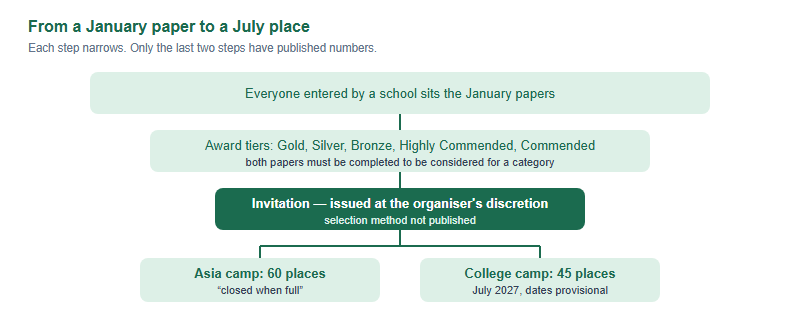
Read the qualification column twice. Every camp entry says invited. None of them says that an award entitles you to a place, and the capacity numbers make clear why: an award tier is awarded to however many students earn it, while a camp holds 60 people or 45 people. Those two numbers cannot both be open-ended. Somewhere between the award list and the camp roster there is a filter, and the listings do not publish how it works.
The honest formulation is therefore narrow: an award is a precondition for an invitation that is issued at the organiser's discretion into a limited number of places, on dates still marked provisional. Anyone who tells you a Gold buys a seat at Cambridge in July is describing something the published material does not say. Confirm the current terms with the organiser or your exam centre before you build a summer around them.
Why “closed when full” is the most useful phrase on the page
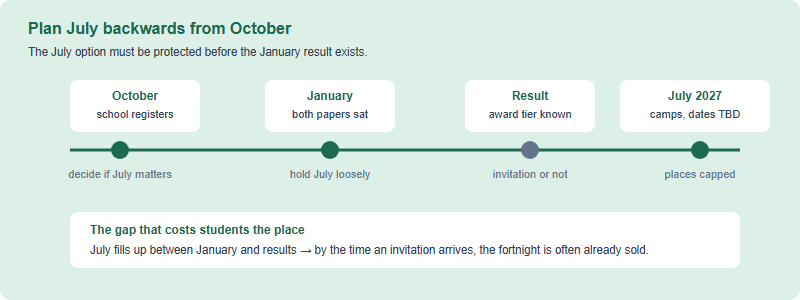
Capacity language tells you about a queue. “Limited registration, closed when full” means places are not held open until every invited student has decided; they go while people are deciding. For a family in China this collides with a specific habit: summer plans for July are commonly settled in spring, and an invitation arriving after results has to compete with commitments already made.
So the practical consequence runs backwards from July into the previous autumn. If a camp is something you would genuinely want, the time to hold July loosely is before you sit the paper in January, not after the result arrives. That is an unglamorous piece of planning, and it is the single most actionable thing in this article: keep a fortnight of July unspoken-for while the option is still live, and release it the moment the option closes.
The reverse is also worth saying plainly. If July 2027 is already committed — a research placement, a family obligation, a summer school you have paid for — then the camps are not part of your reason for sitting the BBO, and you should stop weighting them in the decision. The exam is still worth sitting on its own terms, as we argue in the BBO-then-USABO plan, where the January paper functions as the first half of a single preparation cycle rather than as an entry ticket to anything.
What a camp at a Cambridge college is — and what it is not
One line on the listing does more work in a parent's imagination than anything else on the page: a biology camp held at St Catharine's College, University of Cambridge. It is worth being precise, because the gap between what that is and what people assume it is causes real harm.
What it is: a subject camp, run by the programme, held in the buildings of a Cambridge college during the vacation. Colleges host external academic and conference programmes in the summer as a matter of routine. If the teaching is good, the value is real — concentrated biology, a cohort of students who took the same paper seriously, and a concentrated block of study at a level your school timetable cannot reproduce, though the listings do not publish how long the camp runs.
What it is not: admission to, or assessment by, the University of Cambridge. Attending a programme at a college does not make you a Cambridge applicant with an inside track, does not create a relationship with the admissions process, and is not evaluated by anyone as though it did. Universities know the difference between their own selection processes and commercial or partner programmes using their premises in July, and an application that leans on the venue rather than the biology reads as naive.
This matters for how you would ever write about it. A camp is defensible in an application when it is evidence of what you learned and did — a technique you can discuss, a topic you went deeper into, an investigation you started there. It is indefensible as a name-drop. That distinction is the same one we make about the award itself in our guide to preparing for the BBO: the credential is a pointer, and the biology behind it is the substance.
The scholarship line, and its eligibility catch
The wider-Asia listing also attaches scholarship amounts to award tiers — 3,000 RMB for Gold, 2,000 for Silver, 1,000 for Bronze — but the qualifying condition is easy to miss and rules out most readers of this site. The listing restricts it to Year 10–12 students pursuing the Extended Project Qualification. It is an EPQ scholarship that a BBO award unlocks, not a BBO prize.
If you are not doing an EPQ, this particular scholarship is not for you, but do not conclude there is nothing: the China-region listing sets out award-linked scholarships of its own, on separate terms. Check the listing your school uses and confirm current terms with the organiser. If you are — and a meaningful number of A-Level students at Chinese international schools are — then there is a genuine sequencing insight here. An EPQ in a biological topic and a BBO award in the same year are mutually reinforcing: the qualification supplies a supervised piece of independent work, and the olympiad supplies an externally marked measure of subject strength. Amounts, eligibility and availability are listed by the regional programme and can change between seasons, so confirm before you count on any figure.
How any of this reads inside an application
Worth being clear-eyed about the mechanism. An admissions reader is not scoring an award or a camp in isolation; they are checking whether the picture in front of them holds together. A biology award sits next to the biology grades on your transcript, next to what your teacher says about you, next to whatever you claim to be interested in on the page. When those independent sources agree, the file becomes easier to believe. When they disagree — a strong olympiad result attached to weak subject grades, or a Cambridge-branded camp attached to an applicant who cannot discuss any biology from it — the reader notices the disagreement, not the credential.
That is the useful way to think about the camps. A camp place adds a second, independent data point in the same direction as the award, and gives you material specific enough to survive a follow-up question. It corroborates. What it never does is substitute for the rest of the file, and no result here guarantees any outcome anywhere. If you have to choose between spending July on a camp you were invited to and spending it on work you can actually talk about, the deciding question is which one leaves you able to say something precise in September.
What to do with this in September
- Decide now whether July matters to you. If yes, keep a fortnight uncommitted through the winter. If no, take the camps out of your reasoning entirely and judge the BBO on the exam alone.
- Ask your exam centre what they have seen. Schools that have entered before know whether their students received invitations and when. That is better information than any listing.
- Treat every date on the listings as provisional. Both camps are marked TBD or TBC, and one location is marked TBC as well. Provisional means it can move; plan for the possibility that it does.
- Do not let the camps drive the biology. The award comes first and only comes from the paper. Everything in this article is downstream of getting both papers right in January.
Does a BBO award guarantee a camp place?
No. The listings describe invitations issued to award winners into capped cohorts of 60 and 45 places, with selection criteria not published.
Is the St Catharine's camp run by the University of Cambridge?
The listing describes a camp held at St Catharine's College. Attending a programme at a college is not affiliation with, or admission to, the university.
When are the 2027 camps?
Both are listed as July 2027 but marked TBD or TBC, and one location is also provisional. Confirm on the official pages before booking anything.
Who can get the EPQ scholarship?
The wider-Asia listing restricts it to Year 10–12 students taking the Extended Project Qualification who hold a Gold, Silver or Bronze award.
This is an independent guide operated by Hanlin Education for China-based international-school students. We are not affiliated with, endorsed by, or sponsored by UKBC or the Royal Society of Biology, and we have no connection to the University of Cambridge or any of its colleges; official administration of the British Biology Olympiad and of any associated camps rests with the organiser. Camp dates, capacities, invitation criteria and scholarship terms are set by the organiser and change between seasons — confirm current details on the UKBC official pages and with your own exam centre before committing time or money. Errors reported to us are corrected within 7 working days.