
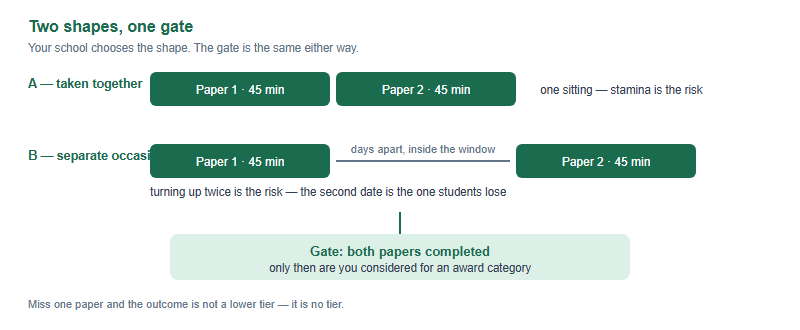
One sentence on the UKBC page changes how you should prepare: “Students will need to complete both papers to be considered for an award category.” Missing the second of the two 45-minute papers is not a lower score — it removes you from the award list. And a second sentence decides the shape of your exam: the papers “can be taken together or on separate occasions”, and your school picks which.
The rule that decides whether you get an award at all
Most exam rules are about marks. This one is about eligibility, which is a different and harsher category. UKBC describes the competition as “two, 45-minute multiple choice papers”, and states that completing both is the condition for being considered for an award category at all — the tiers being Gold, Silver, Bronze, Highly Commended, Commended and Participation.
Consider what that does to a familiar student calculation. In a normal exam, a missed section costs you the marks in that section; you can still be above a boundary if the rest went well. Here, a student who sits paper 1 brilliantly and misses paper 2 does not land a tier lower. They are outside the tier structure. Every hour of autumn preparation is routed through a completion requirement that has nothing to do with biology.
That reframes what “being ready” means. Readiness is not only knowing the seven content areas covered in our syllabus and study-plan guide. It is also knowing, by December, exactly when both of your papers happen and what would have to go wrong for you to miss one. Illness, a clashing mock, a timetable change, a device failure, a school trip — each of these is survivable if you know about the rule in October and invisible if you do not.
Together or on separate occasions — and you are not the one who chooses
The second sentence is the one nobody plans for. UKBC states plainly that the papers can be taken together or on separate occasions. Inside the published competition window of 15th to 22nd January, a school may run both papers back to back in one 90-minute block, or run paper 1 on the Monday and paper 2 on the Thursday.
Those are two genuinely different exams to sit, and the difference is not trivial:
| Both papers together | Papers on separate occasions | |
|---|---|---|
| What it feels like | One sustained block; concentration has to hold to the end | Two short sprints; each one starts cold |
| Main risk | Fatigue in the second half, and carrying a bad first paper into the second | Missing the second date entirely; losing warm-up between sittings |
| What helps | Endurance practice and a deliberate reset between papers | A short re-entry routine, and the date written down twice |
| What you control | Pacing across the whole block | Turning up to both |
Notice the asymmetry in the last row. In the together format your enemy is stamina. In the split format your enemy is administration — and administration is where the award cliff bites. The split format is the friendlier exam to sit and the more dangerous one to be casual about.
Designing practice when you do not yet know the shape
You will probably not know your school's choice until December. That is fine, because the two formats reward one shared skill and one distinct skill each, and you can build all three in the same autumn.
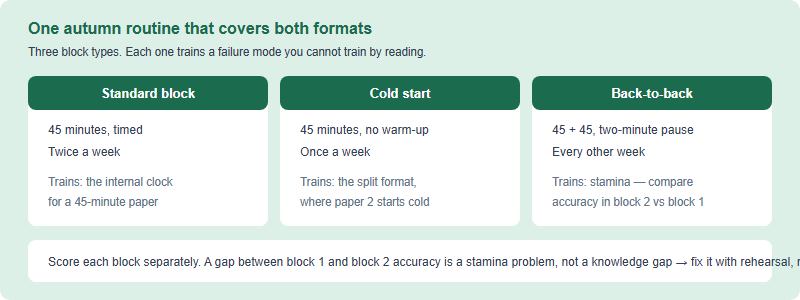
- The shared skill: the 45-minute unit. Whatever the shape, the atomic block is 45 minutes. Make that your default practice length — not 30, not an hour. You want an internal clock that knows what fifteen minutes remaining feels like inside a 45-minute paper specifically.
- For the together format: one 90-minute rehearsal, occasionally. Roughly every other week from November, run two 45-minute blocks back to back with a two-minute pause and no phone. You are not testing biology here; you are testing whether your accuracy in block two matches block one. If it drops sharply, that is a stamina problem with a stamina fix, and it is much cheaper to find in November than in January.
- For the split format: the cold start. The under-rehearsed skill is beginning well without a warm-up, because your second paper may fall on a random Thursday between lessons. Once a week, start a 45-minute block within two minutes of sitting down — no re-reading notes, no easing in. In our own coaching, the opening questions of a cold paper are where careless marks tend to go.
This is a small change to a practice routine, not a new one. If you are already working through our BBO-then-USABO sequence, the point is simply to cut the same material into 45-minute units rather than open-ended study sessions, so that timing is being trained at the same time as content.
What the regional listings describe, and what is simply not published
If you sit through a regional programme rather than directly with UKBC, the format description you will see differs from the organiser's. The China-region listing describes a single 90-minute individual written test with no practical, delivered on paper at a partnering school; the wider-Asia listing describes 90 minutes delivered online and mentions sequencing and short-answer questions alongside multiple choice. UKBC's own page describes two 45-minute multiple-choice papers taken entirely online, on site, invigilated in person by teachers.
These are not necessarily in conflict — two 45-minute papers sat together occupy 90 minutes, and offices describe the same assessment differently for different audiences. But they are different enough that you should not rehearse for one and arrive at the other. Ask your exam centre three questions and take their answer as governing for your sitting: how long in total, delivered how, and is it one sitting or two?
Just as important is what nobody publishes. The UKBC page states the duration and the question type but does not state how many questions each paper contains, and says nothing about whether marks are deducted for wrong answers. Both facts materially change how you should handle a question you cannot resolve, and neither should be guessed at. If you have seen a figure quoted confidently somewhere, treat it as unverified until your centre or the official pages confirm it — and in the meantime practise on the assumption that time, not marking policy, is your binding constraint.
The online dependency nobody rehearses
On the UKBC route the delivery detail is explicit: both papers are entirely online, so every student needs an internet-connected device, and teachers invigilate in person under normal examination conditions. A short online paper introduces failure modes a paper exam does not have — a browser that logs you out, a device that will not hold charge for the second block, a room where thirty students all connect at once.
None of this is your responsibility to solve, but some of it is yours to anticipate. Do at least one practice block on the same class of device you will use, plugged in, with other tabs closed. If your school sitting is split across two days, confirm that the device arrangement is the same on both. The point is not anxiety; it is that a completion requirement and a technology dependency in the same exam deserve five minutes of thought rather than none.
The October conversation
Everything above collapses into a short list of questions for whoever registers you, best asked once registration opens rather than in January:
- Are we sitting the two papers together, or on separate occasions?
- What are the date and time of each — and can I have both in writing?
- Is it delivered online or on paper for our centre, and on what device?
- What happens if a student is ill for one of the two papers?
That last question is the one worth asking even though you expect not to need it. The answer determines whether a single unlucky Thursday costs you a tier or costs you the season, and it is far easier to establish in October, when it is a hypothetical, than in January, when it is a crisis. For the surrounding logistics of the international sitting, our China-region exam guide covers how the entry route itself works.
What happens if I miss the second BBO paper?
UKBC states students need to complete both papers to be considered for an award category, so a missed paper is not simply a lower score.
Are the two BBO papers sat on the same day?
Not necessarily. UKBC states the papers can be taken together or on separate occasions, and the registered school decides which.
How long is the BBO in total?
UKBC describes two 45-minute multiple-choice papers. Regional listings describe a single 90-minute sitting — confirm which applies at your centre.
Does the BBO deduct marks for wrong answers?
The UKBC page does not state a marking policy on this point, so do not assume either way. Confirm on the official pages or with your exam centre.
This is an independent guide operated by Hanlin Education for China-based international-school students. We are not affiliated with, endorsed by, or sponsored by UKBC or the Royal Society of Biology; official administration of the British Biology Olympiad rests with the organiser. Exam format, delivery method, timing and marking arrangements are set by the organiser and by your exam centre and can change between seasons — confirm current details on the UKBC official pages and with your own school before relying on them. Errors reported to us are corrected within 7 working days.