
The most expensive mark to lose on the British Biology Olympiad is not the question you cannot answer. It is the one you answer confidently and wrongly, because nothing prompts you to flag it. This file lists fifteen common biology misconceptions across the seven BBO content areas, the wording that should slow you down, and a routine for unlearning each one before January.
Why a confident error costs more than a gap
UKBC describes the BBO as “two, 45-minute multiple choice papers”, and the regional partner's China-region listing also describes multiple-choice questions. Multiple choice changes the economics of being wrong. When you meet something you have never learned, you notice: you slow down, reason from principles, flag the item and come back. When you hold a wrong belief, the option that matches it looks like recognition. You select it in seconds and move on, feeling good about your pace.
In any well-constructed multiple-choice item, the wrong options have to be plausible, or nobody would choose them. The most plausible wrong answer to a biology question is very often the one a widespread misconception points towards. That is a general feature of how multiple-choice questions work, not a claim about any particular paper — and it is exactly why a misconception is a worse problem than a gap.
There is a second reason these beliefs survive into sixth form. School assessment often rewards the correct sentence, and it is entirely possible to learn the sentence alongside a wrong model underneath it. The BBO is built to probe the model: UKBC calls it “not primarily a test of knowledge” and presents students with unfamiliar material to reason through. A wrong model reasons its way to a wrong answer, fluently. In our teaching groups, the misses students argue with longest are almost always the ones they were sure about.
Finding the ones you hold: tag your confidence
You cannot find a misconception by rereading notes, because the notes are usually correct and your reading of them is not. You find it in your answers. The method takes seconds per question:
- On every practice question, write S, P or G beside your answer — sure, probably, guess — before you check anything.
- When you mark, sort the results into four boxes, as in the grid below.
- Keep a separate list of the sure-and-wrong items. That list, not your score, is the most useful output of the paper.
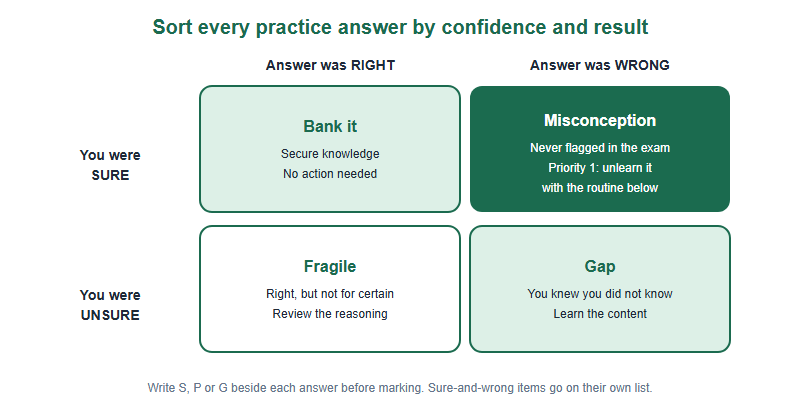
A practical note: the grid only works if you tag before you mark. Tagging afterwards is contaminated by knowing the answer, and it is easy to remember being less sure of a mistake than you really were.
The file: fifteen beliefs across the seven content areas
These are misconceptions we meet again and again when teaching olympiad biology. Read the “actually true” column carefully, then look hardest at the right-hand column: that wording is what a tempting wrong option tends to sound like.
| Area | The confident belief | What is actually true | Wording that should slow you down |
|---|---|---|---|
| Cell biology | Energy is released when the bond in ATP breaks | Breaking a bond always needs energy. ATP hydrolysis releases energy overall because the products are more stable than the reactants. | “energy stored in the phosphate bond is released as it breaks” |
| Cell biology | Diffusion stops when concentrations are equal | Molecules keep moving at equilibrium; movement in each direction balances, so there is no net movement. | “molecules stop moving across the membrane” |
| Cell biology | All active transport uses ATP directly | Secondary active transport (co-transport) uses an ion gradient built by primary active transport, often an ATP-driven pump. | “every carrier moving a solute against its gradient hydrolyses ATP” |
| Plant anatomy & physiology | Plants photosynthesise instead of respiring | Plant cells respire continuously; in bright light photosynthesis can outpace respiration, which masks it in gas exchange. | “plants respire only in the dark” |
| Plant anatomy & physiology | A plant's mass comes mainly from the soil | Most dry mass is built from carbon fixed from atmospheric carbon dioxide; soil minerals are a small fraction. | “growth in dry mass is mainly minerals absorbed by the roots” |
| Plant anatomy & physiology | Living xylem cells pump water upwards using ATP | Mature xylem vessels are dead, hollow tubes; water is pulled up passively by transpiration (cohesion–tension). | “xylem cells use ATP to move water to the leaves” |
| Plant anatomy & physiology | Stomata open when guard cells lose water | Guard cells take up potassium ions, water follows, the cells become turgid and the pore opens; losing turgor closes it. | “flaccid guard cells hold the stoma open” |
| Animal anatomy & physiology | Arteries carry oxygenated blood; veins carry deoxygenated blood | Arteries carry blood away from the heart, veins towards it. The pulmonary artery carries deoxygenated blood. | “it is a vein, so the blood must be low in oxygen” |
| Animal anatomy & physiology | A stronger stimulus produces a bigger action potential | Action potentials are all-or-none; intensity is coded mainly by impulse frequency and by how many neurones fire. | “the larger stimulus produced a larger action potential” |
| Animal behaviour | Animals behave for the good of the species | Selection acts on differences in reproductive success; costly helping is usually explained by kin selection or reciprocity. | “sacrifices itself to ensure the survival of the species” |
| Genetics & evolution | Dominant alleles are the common ones and will spread | Dominance describes a heterozygote's phenotype, not frequency. Without selection, drift, migration, mutation or non-random mating, frequencies stay constant. | “because the allele is dominant, its frequency will increase” |
| Genetics & evolution | Mutations arise because an organism needs them | Mutations arise without regard to usefulness; selection then changes the frequency of variants already present. | “the population developed the mutation in response to the change” |
| Genetics & evolution | The fittest individuals are the strongest or longest-lived | Evolutionary fitness is reproductive success: the relative contribution to the next generation. | “fitness is the ability to survive the longest” |
| Ecology | Energy is recycled through an ecosystem, like nutrients | Nutrients cycle; energy flows one way, entering mainly as light and leaving as heat, with losses at every transfer. | “decomposers return energy to the producers” |
| Taxonomy | Taxa drawn next to each other on a tree are the most closely related | Relatedness is read from the most recent common ancestor. Branches can rotate around a node without changing any relationship. | “A is drawn beside B, so A is closer to B than to C” |
Three that deserve a closer look
The ATP bond. This one survives because textbooks for younger students talk about “high-energy bonds”, and the phrase sticks. The correct model is about the whole reaction: the products of ATP hydrolysis have lower free energy than the reactants, so the reaction releases energy overall, even though breaking the bond itself costs energy. Test yourself: if an option says energy is released when the bond breaks, and another says the products are more stable than the reactants, you should be choosing the second without hesitation.
Dominance and frequency. Many students quietly assume that “dominant” means “winning”. It does not. The allele responsible for Huntington's disease is dominant and rare. In a Hardy–Weinberg population, an allele's frequency does not change from one generation to the next simply because it is dominant or recessive; something else — selection, drift, migration or mutation — has to act; non-random mating on its own changes genotype frequencies, not allele frequencies. Test yourself: when a question describes a dominant allele increasing, look in the stem for the force that is actually causing it.
Reading trees by the tips. On a phylogenetic tree, the order of the names along the edge carries no information by itself. Swap the two branches that leave any node and you have drawn exactly the same tree. The only question that matters is: which node do these two taxa share, and is it more recent than the node either shares with a third? Test yourself: take any tree you have, rotate two branches on paper, and check that your answers about relatedness do not change.
Unlearning takes a different routine from learning
Rereading the correct fact rarely dislodges a misconception, because the old belief is fluent and the new sentence is not. What works is making the two collide on purpose, then testing the result later rather than straight away.
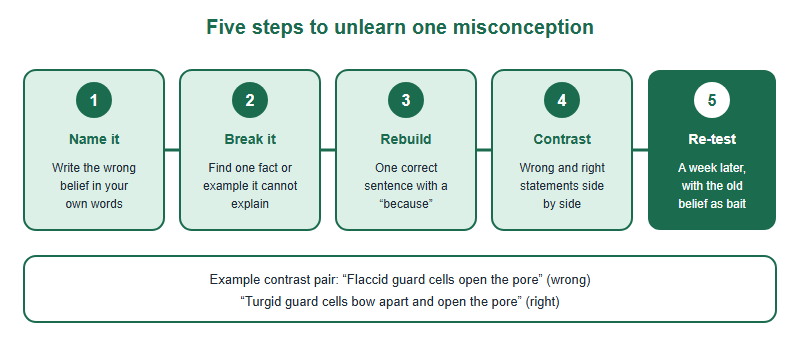
- Name it. Write the wrong belief down, plainly, in your own words. It feels odd to write something false on purpose; do it anyway, because a belief you will not state is a belief you cannot check.
- Break it. Find one fact it cannot survive. The pulmonary artery breaks the artery rule. A tree with rotated branches breaks tip-reading. The fact that mature xylem vessels are dead breaks the idea that xylem cells pump water.
- Rebuild with “because”. One sentence, mechanism included. “Stomata open because potassium uptake lowers guard-cell water potential, water enters and the turgid cells bow apart.”
- Build a contrast pair. Put the wrong statement and the right one next to each other on a card. You are training discrimination between two options that look alike, which is exactly the job a multiple-choice paper asks of you.
- Re-test later, with bait. A week on, answer a question in which the old belief is one of the options. Our gathered past-paper pack, which includes worked solutions for some years, is one source; a question you write yourself with the old belief as a deliberate trap works too.
Where this fits in your autumn
Misconception work is not a separate revision stream. It rides on top of the timed practice you are already doing. From your first timed paper onwards, tag confidence on every answer, keep the sure-and-wrong list, and clear it before you add new reading. A short list cleared properly is worth more than a long one acknowledged and forgotten. The wider sequence of reading and timed papers is set out in our guide to preparing for the BBO.
Whichever route you sit — online at school through UKBC, or the paper-based sitting on the partner's 2027 China-region listing (our China-region exam guide was written for the 2026 sitting) — both published descriptions call the questions multiple choice, and the logic above applies to both. It also compounds. The biology you unlearn for January does not relearn itself by spring, so if you are planning a second olympiad later in the season, every belief cleared now is cleared for that paper as well; that sequence is set out in our BBO-then-USABO plan.
What is the difference between a misconception and a knowledge gap?
A gap is something you know you do not know. A misconception is a wrong belief held confidently, so you choose the wrong option without flagging it.
How do I find my own biology misconceptions?
Rate your confidence on every practice answer before marking. The wrong answers you marked as sure are your misconception list.
Is this list an official UKBC syllabus document?
No. It is our editorial selection from teaching olympiad biology. Confirm the competition format and rules on the UKBC official pages.
When should I start working on misconceptions?
From your first timed practice paper. Tag confidence, keep the sure-and-wrong list, and clear it before adding new reading.
This is an independent guide operated by Hanlin Education for China-based international-school students. We are not affiliated with, endorsed by, or sponsored by UKBC or the Royal Society of Biology; official administration of the British Biology Olympiad rests with the organiser. The misconception list is our own editorial material and does not describe the content of any specific paper; competition format, content areas and rules can change between seasons — confirm current details on the UKBC official pages and with your school. Errors reported to us are corrected within 7 working days.