
The British Biology Olympiad does allow extra time for students who usually receive additional time in their school’s public examinations. The allowance is not a single fixed percentage; UKBC describes it as “the appropriate proportion” and places the facilitation duty on the invigilating teacher, who uses timing information shown on the exam portal. Because the arrangement is teacher-facilitated, confirming the details before competition day is the shared responsibility of the student and the coordinating teacher.
Who the Official Extra-Time Rule Covers
The UKBC FAQ confirms that students who usually receive additional time in public examinations may have the appropriate proportion of extra time for the BBO. The operative word is usually. The rule is designed for learners whose school has already assessed and documented a need for additional time in formal, externally set examinations such as GCSEs, A-Levels, Scottish Highers, or equivalent national qualifications.
In practice, the BBO access arrangement mirrors a student’s existing provision rather than creating a new one. A student who has never been granted extra time in school assessments would not fall within the rule as written. Equally, a student whose access arrangement covers only a reader or a scribe—but not additional minutes—should not assume the timing rule applies to them. The scope is specific to timing.
Because the BBO is sat on-site at a registered school or college under normal examination conditions, the access arrangement operates within the same invigilation framework as any other formal sitting. The student does not sit alone at home. How the arrangement is implemented in practice—how the proportion is calculated, how the invigilator tracks it—should be confirmed with the coordinating teacher, since UKBC leaves the facilitation detail to the invigilator.
Why There Is No Universal Percentage
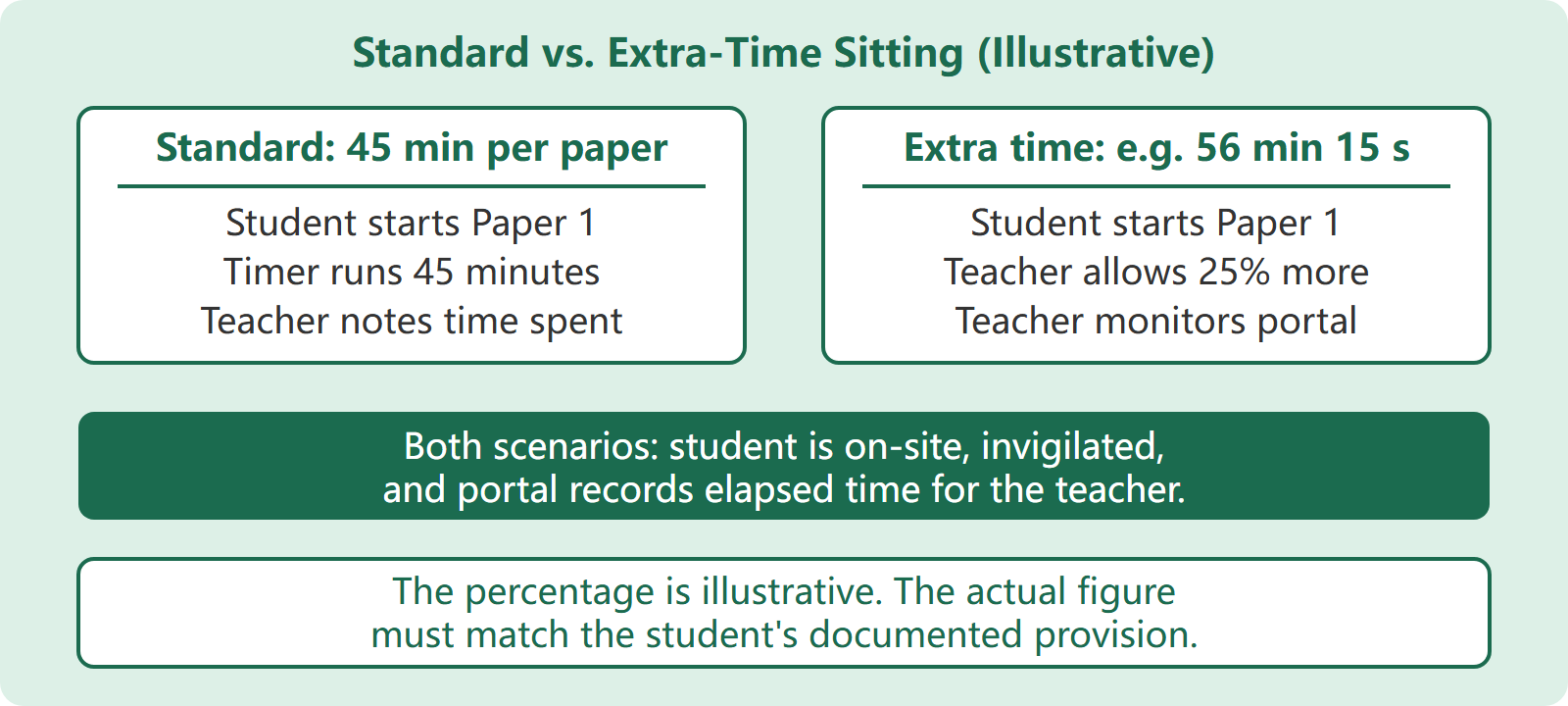
UKBC does not publish a single multiplier—25 %, 50 %, or otherwise—because access arrangements in UK schools vary by individual assessment. One student may hold a 25 % allowance; another may have 50 % or a rest-break provision. The BBO rule says “the appropriate proportion,” leaving the exact figure to match whatever the student’s school has already documented for public exams.
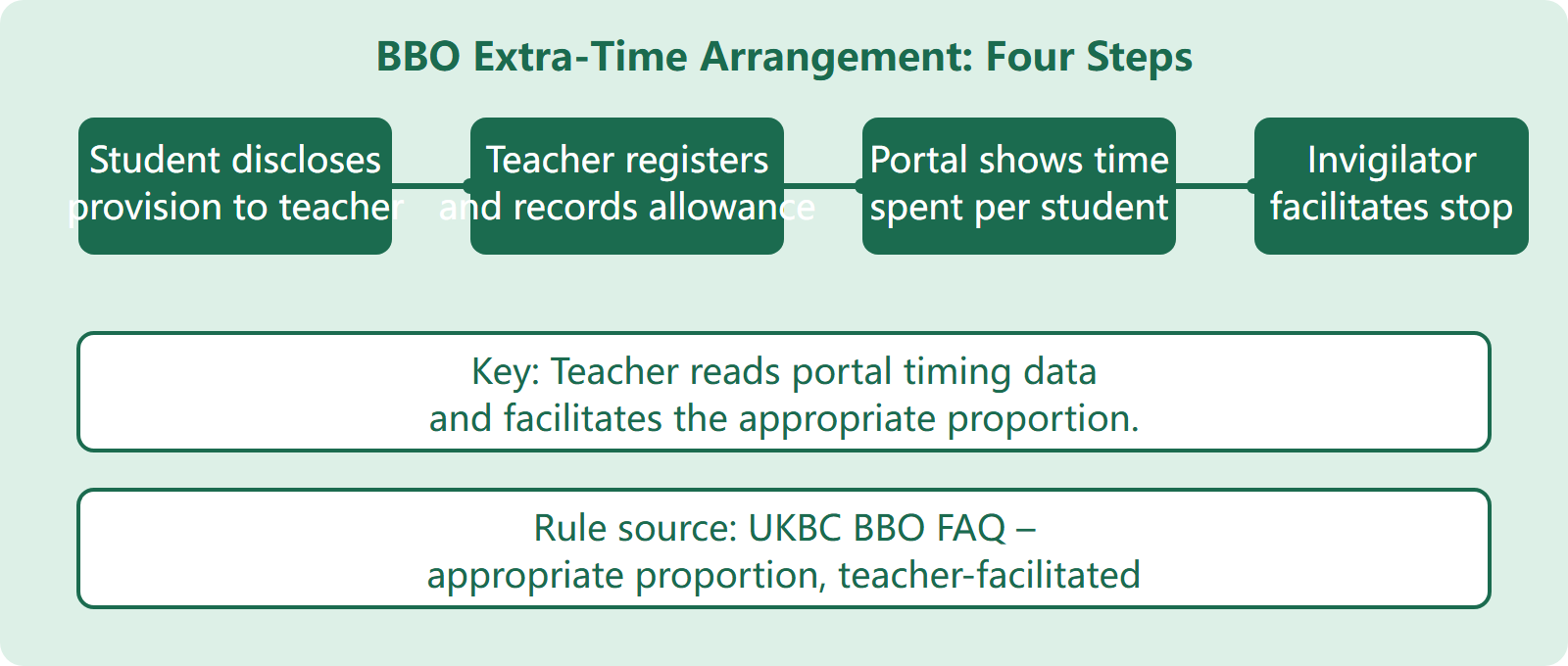
UKBC confirms that teachers will be made aware on the exam portal of how much time a student has spent on the competition, and that it is up to the invigilating teacher to facilitate the extra time correctly. The portal therefore serves as an information source for the teacher rather than a self-service adjustment for the student. For students and parents reading this, the practical implication is clear: the extra time exists as a rule, but it requires the invigilating teacher to enact it. If no one at the school knows the student needs it, it will not happen. Confirm the implementation details with your teacher well before competition day.
The Teacher’s Role: Registration, Invigilation, Portal Timing and Facilitation
UKBC is explicit that only teachers can register candidates and invigilate the competition. The teacher’s responsibilities in the access-arrangement context include:
- Registering the student through the UKBC portal once enrolment opens (1 October for the 2027 sitting window of 15–22 January).
- Knowing the student’s documented provision before competition day, typically via the school’s SEN or access-arrangements register.
- Invigilating on-site under normal examination conditions. The BBO papers are taken online, but the student must be physically present at the registered school or college.
- Monitoring portal timing data. UKBC confirms that teachers will be made aware on the exam portal of how much time a student has spent on the competition. The teacher uses this information to judge when the student’s proportional allowance has been used.
- Facilitating correctly. UKBC places the facilitation duty on the invigilating teacher, stating that it is up to that teacher to facilitate the extra time correctly.
If a school has multiple students sitting the BBO, the teacher must track each student’s individual allowance separately. The portal’s per-student timing display supports this, but the teacher still needs a written record of who holds what provision.
A Practical Checklist for Students and Coordinating Teachers
The following table summarises the actions, who owns them, and when they should be completed. The dates reference the 2027 BBO window; adjust if your school sits the paper in a different UKBC cycle.
| Action | Who | When (illustrative) | Why it matters |
|---|---|---|---|
| Disclose existing extra-time provision to the BBO coordinating teacher | Student / parent | Well before the sitting (confirm with teacher) | Teacher needs time to note the arrangement and plan facilitation |
| Confirm the student’s documented percentage or provision with the school’s SEN / exams officer | Coordinating teacher | Before competition day (confirm timeline with school) | Ensures the “appropriate proportion” matches the official record |
| Register all candidates on the UKBC portal | Coordinating teacher | After 1 October, well before 15 January | Only registered students receive portal accounts |
| Brief invigilating teacher on each student’s allowance | Coordinating teacher | Before the sitting (confirm with school) | Invigilator must know who gets what on the day |
| Practice a past paper under timed conditions matching the adjusted allowance | Student | December–early January | Builds pacing awareness for the longer window |
| On competition day, monitor portal timing and stop the student at the correct point | Invigilating teacher | 15–22 January sitting | UKBC places facilitation duty on the invigilator |
Students should note that the BBO consists of two 45-minute multiple-choice papers. If a student holds a 25 % allowance, the illustrative adjusted time per paper would be 56 minutes and 15 seconds (45 × 1.25). This is an illustrative calculation only; the actual figure depends on the student’s documented provision. The two papers can be taken together or on separate occasions within the competition window, which offers scheduling flexibility for students who need a rest break between papers.
For a deeper look at how the online timer and flagging system work on the day, see the BBO Online Paper Walkthrough (2026-27), which covers the portal interface in detail.
What Not to Assume: Self-Declaration, Remote Sitting and Uninvigilated Access
Several misconceptions circulate in student forums. None of them is supported by the UKBC rules:
- Self-declared extra time. A student cannot simply decide on competition day that they need more time. The UKBC rule applies to students who usually have additional time in public examinations, meaning the provision should already exist in the school’s record. Confirm the process with your coordinating teacher.
- Remote or at-home sitting. The BBO papers are taken online, but “online” refers to the delivery format, not the location. UKBC specifies that the competition is to be taken on-site at the registered school or college, and that students must be invigilated by a teacher in person. A student sitting at home would not meet these conditions.
- Uninvigilated access. UKBC requires that all students be invigilated by a teacher, similar to other examinations. If no teacher is present, the sitting does not meet the competition’s conditions.
- Private tutors or online-only providers arranging access. UKBC explicitly excludes private tutoring companies, online-only tuition providers, and individuals acting independently of a school from registering candidates or acting as examination centres. If your school does not offer the BBO, the route is to ask the school to register, not to seek an alternative provider. The school-registration rule guide explains this in detail.
Students who also need to understand the two-paper requirement—both papers must be completed to qualify for an award—should review the two-paper rule explainer, because an access arrangement that covers only one paper would leave the student ineligible for a certificate category.
Frequently Asked Questions
Does the BBO automatically add extra time to a student’s portal timer?
UKBC does not describe an automatic adjustment. The portal shows the teacher how much time a student has spent on the competition, and UKBC places the facilitation duty on the invigilating teacher. Confirm with your teacher how the arrangement will be implemented at your school before competition day.
Can a student request extra time on competition day without prior documentation?
The UKBC rule applies to students who usually have additional time in public examinations, which implies an existing documented provision. A same-day request without prior school documentation is not addressed by the published rule. Students should confirm the process with their coordinating teacher well in advance.
Who is responsible for making sure the extra time is applied correctly?
UKBC places the facilitation duty on the invigilating teacher. The student should confirm the arrangement with the teacher before competition day, but the operational responsibility for applying the correct proportion sits with the teacher overseeing the sitting.
Further Reading
- UKBC British Biology Olympiad official page – primary source for the access-arrangement FAQ, eligibility, and competition dates.
- BBO Online Paper Walkthrough (2026-27): Flags, Calculators and the Paper 2 Timer Trap – covers the portal interface students will use on the day.
- You Cannot Enter the BBO Yourself: The School-Registration Rule – explains why teacher registration is the only valid entry route.
- Both Papers or No Award: The BBO Two-Paper Rule – relevant if an access arrangement affects scheduling across the two papers.
Editorial note: This article is published by BBO Biology (en.bbobiology.org.cn), an independent educational resource. We are not affiliated with, endorsed by, or acting on behalf of UK Biology Competitions (UKBC) or the Royal Society of Biology. All competition rules referenced here are drawn from the UKBC public pages as of September 2026. Schools and students should verify current access-arrangement procedures directly with UKBC and their own examinations officer before the January sitting.